Sirenia
The Sirenia, commonly referred to as sea cows or sirenians, are an order of fully aquatic, herbivorous mammals that inhabit swamps, rivers, estuaries, marine wetlands, and coastal marine waters. The extant Sirenia comprise two distinct families:Dugongidae and Trichechidae with a total of three species.

File:Underwater photography of mammal manatee.jpg (Ramos Keith, U.S. Fish and Wildlife Service) File:I432^cimgpsh ori… · Public Domain · via Wikipedia/Commons. May be a photograph of a specimen, or an artist’s reconstruction — an interpretation of a skeleton, since colour and soft tissue are almost never preserved.
On record
Recorded, not inferred- Also called
- sirenianPBDB
- Sits inside
- TethytheriaPBDB
- Diet
- herbivorePBDB
- Life habit
- aquaticPBDB
- Motility
- actively mobilePBDB, for Osteichthyes
- Environment
- marinePBDB
Time the record covers
At least 48 million years on record.
The record covers at least 48.07 Mya to 11.7 ka. No occurrence read is dated outside 66 Mya to 0 Mya.
940 occurrences of Sirenia on record, most of them in the Miocene. The Paleobiology Database records this as a living group. Bar height is expected occurrences, not a count: each fossil is spread across the span it is dated to, so a tall narrow bar means tight dating and a low wide one means loose.
When
940 occurrencesThese are dates about fossils, not the animal: the record can only begin after it arose and end before it died out, so either end may reach further. Shares are expected occurrences: a fossil dated to a span is counted partly in each period it straddles. More on what this infers.
Found in
224 formations
- Birket Qarun Formation22
- Pirabas Formation18
- Burgeschleinitz Formation16
- Calvert Formation · Chesapeake Group15
- Monterey Formation15
- Peace River Formation · Hawthorn Group11
Loading coastlines…
The named rock units Sirenia has been recovered from, largest first. Drawn where the rock is now, not where it formed. 200 further formations hold fewer occurrences each and are not listed. 405 occurrences have no formation on record, which is common for older literature.
Sirenia and its relatives
MioceneWhere Sirenia and its relatives were recorded in the Miocene.
Found in the same rock
1,833 taxa- Dugongidae32 sites
- Myliobatis19 sites
- Odontoceti17 sites
- Hemipristis serra16 sites
- Carcharodon hastalis15 sites
- Carcharhinus14 sites
- Otodus megalodon14 sites
- Hydrodamalis cuestae12 sites
- Metaxytherium12 sites
- Testudines12 sites
- Cetacea11 sites
- Crocodylia11 sites
- Mysticeti11 sites
- Physeteridae10 sites
- Aves9 sites
- Balaenopteridae9 sites
- Crenatosiren olseni9 sites
- Delphinidae9 sites
- Galeocerdo aduncus9 sites
- Ostrea9 sites
- Protosiren9 sites
- Dasyatis8 sites
- Isurus8 sites
- Metaxytherium crataegense8 sites
The Paleobiology Database records 794 sites for Sirenia, and this reads 240 of them. The number is how many of those sites it was catalogued from too. The 24 sharing the most are listed.
This is not a list of everything alive at the time. It is only what has come out of the same ground as this animal and been written down.
Entered from
379 references- Pilleri, 198760
- Late Eocene sea cows (Mammalia, Sirenia) from Wadi al Hitan in the western desert of Fayum, Egypt35
- Pilleri et al., 198935
- Sirenian evolution in the North Pacific Ocean34
- North American Eocene sea cows (Mammalia: Sirenia)23
- Miocene marine mammals from Portugal: Paleogeographical and Paleoecological significance22
- Overview of the Transylvanian Paleogene sea cows’ distribution records, with a focus on a new Oligocene locality21
- Metaxytherium serresii (Mammalia: Sirenia) from the early Pliocene of Libya and France: A Reevaluation of its morphology, phyletic position, and biostratigraphic and paleoecological significance19
- The sirenian Metaxytherium (Mammalia: Dugongidae) in the Badenian (Middle Miocene) of Central Europe16
- Eocene sea cows (Sirenia, Mammalia) from Hungary15
- The osteology and relationships of Metaxytherium krahuletzi Deperet, 1895 (Mammalia, Sirenia)15
- New sirenian findings from Crete Island14
Each of the 940 occurrences read was entered from one of these publications, ordered by how many each accounts for. This is not a search for papers mentioning the name. 367 further references are not listed. Entries link to doi.org where the Paleobiology Database holds an identifier, and to its own record where it does not. Relayed as the Paleobiology Database holds them, not checked against what they resolve to.
Media and terms
Media content1
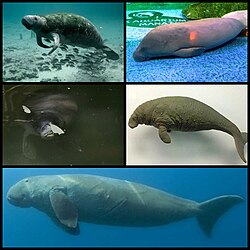
Picture of Sirenia
- Source
- Wikipedia/Commons
- Credit
- File:Underwater photography of mammal manatee.jpg (Ramos Keith, U.S. Fish and Wildlife Service) File:I432^cimgpsh ori…
- Licence
- Public Domain
- Commercial use
- the licence allows it
No 3D scan of Sirenia was found in MorphoSource and Sketchfab.
Smithsonian Open Access was not reached for this taxon, so this list is what the others held rather than everything there is.
The description on this site
- Source
- Wikipedia, “Sirenia”
- Licence
- CC BY-SA 4.0
This is what the site found, which is not the same as what exists.
Keep going
What may have been alongside itTethytheria through timeFormations of the MioceneThe world it lived on
Occurrence data from the Paleobiology Database, CC BY 4.0. (Illiger 1811)