Sceptroneis
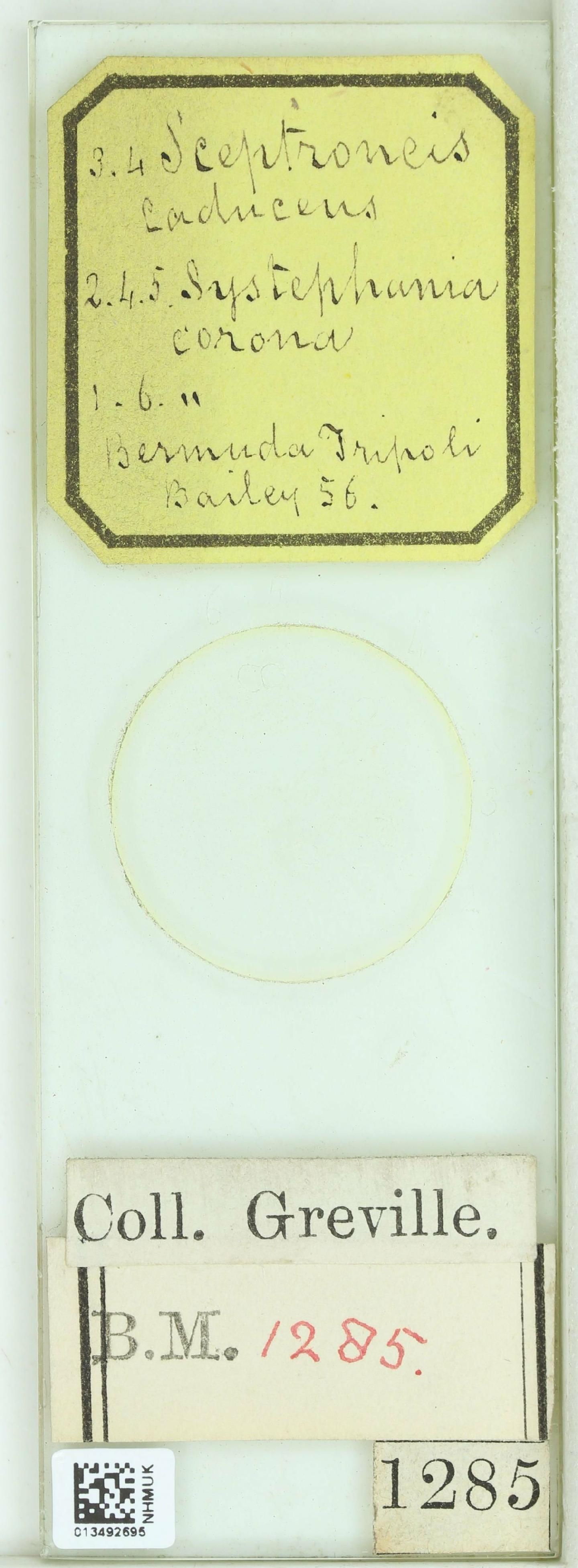
Bailey · CC0 · via GBIF. May be a photograph of a specimen, or an artist’s reconstruction — an interpretation of a skeleton, since colour and soft tissue are almost never preserved.
On record
Recorded, not inferred- Sits inside
- RhaphoneidaceaePBDB
- Diet
- "photoautotroph"PBDB, for Bacillariophyceae
- Environment
- marine,brackish,freshwaterPBDB, for Bacillariophyceae
Time the record covers
At least 72 million years on record.
The record covers at least 72.2 Mya to 129 ka. No occurrence read is dated outside 83.6 Mya to 11.7 ka.
62 occurrences of Sceptroneis on record, most of them in the Late Cretaceous. The Paleobiology Database records this as a living group. Bar height is expected occurrences, not a count: each fossil is spread across the span it is dated to, so a tall narrow bar means tight dating and a low wide one means loose.
When
62 occurrencesThese are dates about fossils, not the animal: the record can only begin after it arose and end before it died out, so either end may reach further. Shares are expected occurrences: a fossil dated to a span is counted partly in each period it straddles. More on what this infers.
Found in
5 formations
- Mason River Formation31
- Lopez de Bertodano Formation15
- Sobral Formation4
- Bateque Formation3
- Pungo River Formation1
Loading coastlines…
The named rock units Sceptroneis has been recovered from, largest first. Drawn where the rock is now, not where it formed. 8 occurrences have no formation on record, which is common for older literature.
Sceptroneis and its relatives
Late CretaceousWhere Sceptroneis and its relatives were recorded in the Late Cretaceous.
Found in the same rock
281 taxa- Hemiaulus45 sites
- Trinacria45 sites
- Stephanopyxis43 sites
- Pterotheca40 sites
- Stephanopyxis turris39 sites
- Actinoptychus33 sites
- Paralia sulcata32 sites
- Goniothecium29 sites
- Pseudopyxilla29 sites
- Thalassiosiropsis29 sites
- Hemiaulus polymorphus27 sites
- Meristiosolen sp. 127 sites
- Micrampula parvula27 sites
- Stellarima27 sites
- Stephanopyxis simonseni24 sites
- Trochosiropsis24 sites
- Costopyxis23 sites
- Cortinocornus rossicus22 sites
- Anaulus20 sites
- Gladiopsis speciosus20 sites
- Triceratium19 sites
- Corinna18 sites
- Bacillariophyceae17 sites
- Odontotropis17 sites
The Paleobiology Database records 54 sites for Sceptroneis, and this reads all of them. The number is how many of those sites it was catalogued from too. The 24 sharing the most are listed.
This is not a list of everything alive at the time. It is only what has come out of the same ground as this animal and been written down.
Entered from
7 references- Upper Cretaceous diatom biostratigraphy of the Arctic archipelago and northern continental margin, Canada31
- Upper Cretaceous and lower Paleocene diatom and silicoflagellate biostratigraphy of Seymour Island, eastern Antarctic Peninsula19
- Site U13605
- A Late Middle Eocene diatomite in northwestern Baja California Sur, Mexico: Implications for tectonic translation3
- Site U15012
- Site U13591
- Biostratigraphy and paleoecology of a diatomaceous clay unit in the Miocene Pungo River Formation of Beaufort County, North Carolina1
Each of the 62 occurrences read was entered from one of these publications, ordered by how many each accounts for. This is not a search for papers mentioning the name. Entries link to doi.org where the Paleobiology Database holds an identifier, and to its own record where it does not. Relayed as the Paleobiology Database holds them, not checked against what they resolve to.
Media and terms
Media content1
Picture of Sceptroneis
- Source
- GBIF
- Credit
- Bailey
- Licence
- CC0
- Commercial use
- the licence allows it
No 3D scan was found. Smithsonian Open Access, MorphoSource and Sketchfab were all searched.
This is what the site found, which is not the same as what exists.
Keep going
What may have been alongside itRhaphoneidaceae through timeFormations of the Late CretaceousThe world it lived on
Occurrence data from the Paleobiology Database, CC BY 4.0. Ehrenberg 1844