Ruminantia
Ruminants are herbivorous grazing or browsing artiodactyls belonging to the suborder Ruminantia that are able to easily acquire nutrients from plant-based fibers by fermenting it in a specialized stomach prior to digestion, principally through microbial actions. The process, which takes place in the front part of the digestive system and therefore is called foregut fermentation, typically requires the fermented ingesta to be regurgitated and chewed again. The process of rechewing the ingesta to further break down plant matter and stimulate digestion is called rumination or chewing the cud. The word ruminant comes from the Latin rūminārī, "to ruminate", from rūmen, the first stomach.

File:Bison bonasus (Linnaeus 1758).jpg ( Michael Gäbler ) File:Tragulus javanicus jerusalem zoo.jpg ( Levg ) File:Kou… · Public Domain · via Wikipedia/Commons. May be a photograph of a specimen, or an artist’s reconstruction — an interpretation of a skeleton, since colour and soft tissue are almost never preserved.
On record
Recorded, not inferred- Also called
- ruminantPBDB
- Sits inside
- ArtiodactylaPBDB
- Diet
- grazer, browserPBDB, for Artiodactyla
- Life habit
- ground dwellingPBDB, for Artiodactyla
- Motility
- actively mobilePBDB, for Osteichthyes
- Environment
- terrestrialPBDB, for Artiodactyla
Time the record covers
At least 41 million years on record.
The record covers at least 41.03 Mya to 11.7 ka. No occurrence read is dated outside 66 Mya to 0 Mya.
12,000+ occurrences of Ruminantia on record. The Paleobiology Database records this as a living group. Bar height is expected occurrences, not a count: each fossil is spread across the span it is dated to, so a tall narrow bar means tight dating and a low wide one means loose.
When
12,000 occurrences readThese are dates about fossils, not the animal: the record can only begin after it arose and end before it died out, so either end may reach further. Shares are expected occurrences: a fossil dated to a span is counted partly in each period it straddles. The read hit its cap, so every figure above is a floor and the shares are of the occurrences read. More on what this infers.
Found in
at least 535 formations
- Koobi Fora Formation · Omo Group768
- Nachukui Formation · Omo Group305
- Shungura Formation · Omo Group281
- Vogel River Series Formation218
- Olduvai Formation · Vogel River Series Group147
- Swartkrans Formation · Transvaal Group125
Loading coastlines…
The named rock units Ruminantia has been recovered from, largest first. Drawn where the rock is now, not where it formed. The read hit its cap, so each count is a floor. 511 further formations hold fewer occurrences each and are not listed. 6,165 occurrences have no formation on record, which is common for older literature.
Found in the same rock
1,379 taxa- Brontotheriidae66 sites
- Protoreodon pumilus41 sites
- Hesperocyon gregarius36 sites
- Leptomeryx evansi36 sites
- Ischyromys30 sites
- Mesohippus bairdi29 sites
- Palaeolagus temnodon29 sites
- Palaeolagus haydeni28 sites
- Leptomeryx27 sites
- Paradjidaumo trilophus27 sites
- Hesperocyon26 sites
- Ischyromys typus26 sites
- Ischyromys veterior26 sites
- Hyracodon25 sites
- Merycoidodon culbertsonii25 sites
- Poebrotherium24 sites
- Herpetotherium fugax23 sites
- Leptomeryx speciosus22 sites
- Equidae21 sites
- Leptictidae21 sites
- Eumys elegans20 sites
- Megalagus brachyodon20 sites
- Leptomerycidae19 sites
- Megalagus turgidus19 sites
The Paleobiology Database records at least 1,212 sites for Ruminantia, and this reads 240 of them. The number is how many of those sites it was catalogued from too. The 24 sharing the most are listed.
This is not a list of everything alive at the time. It is only what has come out of the same ground as this animal and been written down.
Entered from
at least 1,845 references- Family Bovidae568
- Synonymies and reidentifications of North American fossil mammals357
- Stratigraphy and Paleontology of pliocene and Pleistocene Localities West of Lake Turkana, Kenya261
- Laetoli: a Pliocene Site in Northern Tanzania218
- Horned ruminants of North America120
- Catalogue of Tertiary Fossil Sites of the Land Mammals in the U.S.S.R.119
- Family Giraffidae107
- Paleoenvironmental and Cultural Implications of Late Holocene Archaeological Faunas from the Orange Free State and North Central Cape Province, South Africa105
- I giacimenti Quaternari di vertebrati fossili nell'Italia Nord-Orientale95
- Mittelpleistozane Saugetierfaunen aus Mitteleuropa - der Versuch einer biostratigraphischen Zuordnung86
- Lothagam: the dawn of humanity in eastern Africa83
- The Villafranchian mammalian faunas and biochronology of Greece80
Each of the 12,000 occurrences read was entered from one of these publications, ordered by how many each accounts for. This is not a search for papers mentioning the name. That read hit its cap, so each count is a floor. 1,833 further references are not listed. Entries link to doi.org where the Paleobiology Database holds an identifier, and to its own record where it does not. Relayed as the Paleobiology Database holds them, not checked against what they resolve to.
Media and terms
Media content1
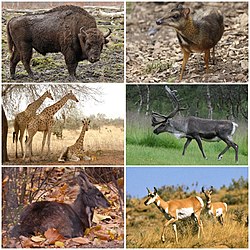
Picture of Ruminantia
- Source
- Wikipedia/Commons
- Credit
- File:Bison bonasus (Linnaeus 1758).jpg ( Michael Gäbler ) File:Tragulus javanicus jerusalem zoo.jpg ( Levg ) File:Kou…
- Licence
- Public Domain
- Commercial use
- the licence allows it
No 3D scan of Ruminantia was found in Sketchfab.
Smithsonian Open Access and MorphoSource were not reached for this taxon, so this list is what the others held rather than everything there is.
The description on this site
- Source
- Wikipedia, “Ruminant”
- Licence
- CC BY-SA 4.0
This is what the site found, which is not the same as what exists.
Keep going
What may have been alongside itArtiodactyla through timeThe world it lived on
Occurrence data from the Paleobiology Database, CC BY 4.0. (Scopoli 1777)