Rhinocerotoidea
Rhinocerotoidea is a superfamily of perissodactyls which includes the living rhinoceroses and their extinct relatives. In addition to rhinoceroses (Rhinocerotidae), Rhinocerotoidea also comprises at least three extinct families: the Amynodontidae, Hyracodontidae, and Paraceratheriidae. The relationships between the different groups are not well resolved, and two additional extinct families are sometimes recognized, the Eggysodontidae and Forstercooperiidae.

Rodrigo J De Marco · CC0 · via Wikipedia/Commons. May be a photograph of a specimen, or an artist’s reconstruction — an interpretation of a skeleton, since colour and soft tissue are almost never preserved.
On record
Recorded, not inferred- Sits inside
- CeratomorphaPBDB
- Diet
- browserPBDB, for Ceratomorpha
- Life habit
- ground dwellingPBDB, for Ceratomorpha
- Motility
- actively mobilePBDB, for Osteichthyes
- Environment
- terrestrialPBDB, for Eutheria
Time the record covers
At least 51 million years on record.
The record covers at least 51.1 Mya to 11.7 ka. No occurrence read is dated outside 56 Mya to 0 Mya.
3,516 occurrences of Rhinocerotoidea on record, most of them in the Miocene. The Paleobiology Database records this as a living group. Bar height is expected occurrences, not a count: each fossil is spread across the span it is dated to, so a tall narrow bar means tight dating and a low wide one means loose.
When
3,516 occurrencesThese are dates about fossils, not the animal: the record can only begin after it arose and end before it died out, so either end may reach further. Shares are expected occurrences: a fossil dated to a span is counted partly in each period it straddles. More on what this infers.
Found in
424 formations
- Ash Hollow Formation · Ogallala Group92
- Bridger Formation90
- Brule Formation · White River Group71
- Valentine Formation · Ogallala Group70
- Vogel River Series Formation66
- Shungura Formation · Omo Group48
Loading coastlines…
The named rock units Rhinocerotoidea has been recovered from, largest first. Drawn where the rock is now, not where it formed. 400 further formations hold fewer occurrences each and are not listed. 1,354 occurrences have no formation on record, which is common for older literature.
Rhinocerotoidea and its relatives
MioceneWhere Rhinocerotoidea and its relatives were recorded in the Miocene.
Found in the same rock
1,170 taxa- Hyrachyus57 sites
- Hyrachyus modestus40 sites
- Sciuravus nitidus33 sites
- Omomys carteri30 sites
- Hyrachyus eximius28 sites
- Microsyops elegans28 sites
- Hyopsodus minusculus27 sites
- Brontotheriidae25 sites
- Amynodon22 sites
- Amynodon advenus22 sites
- Hyopsodus paulus22 sites
- Herpetotherium knighti19 sites
- Protoreodon pumilus19 sites
- Antiacodon pygmaeus17 sites
- Epihippus gracilis16 sites
- Notharctus robinsoni16 sites
- Uintaparamys parvus16 sites
- Amynodontopsis bodei15 sites
- Orohippus pumilus15 sites
- Paramys delicatus15 sites
- Smilodectes mcgrewi15 sites
- Washakius insignis15 sites
- Thisbemys corrugatus14 sites
- Trionychidae14 sites
The Paleobiology Database records at least 1,536 sites for Rhinocerotoidea, and this reads 240 of them. The number is how many of those sites it was catalogued from too. The 24 sharing the most are listed.
This is not a list of everything alive at the time. It is only what has come out of the same ground as this animal and been written down.
Entered from
1,087 references- The Evolution of North American Rhinoceroses311
- Synonymies and reidentifications of North American fossil mammals101
- Laetoli: a Pliocene Site in Northern Tanzania66
- Catalogue of Tertiary Fossil Sites of the Land Mammals in the U.S.S.R.65
- Reidentifications and synonomies of European mammals52
- Miocene rhinoceroses from the Texas Gulf Coastal Plain50
- Will Downs and the Zinda Pir Dome44
- Mammalian Fauna From the Lower Bridger Formation (Bridger A, Early Middle Eocene) of the Southern Green River Basin, Wyoming38
- Vertebrate biostratigraphy of the Ogallala Group in Nebraska37
- Paracerathere Fossils of China28
- Family Rhinocerotidae23
- Fossil mammals from Burma in the American Museum of Natural History22
Each of the 3,516 occurrences read was entered from one of these publications, ordered by how many each accounts for. This is not a search for papers mentioning the name. 1,075 further references are not listed. Entries link to doi.org where the Paleobiology Database holds an identifier, and to its own record where it does not. Relayed as the Paleobiology Database holds them, not checked against what they resolve to.
Media and terms
Media content1
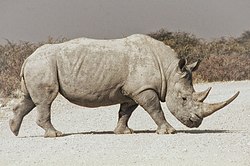
Picture of Rhinocerotoidea
- Source
- Wikipedia/Commons
- Credit
- Rodrigo J De Marco
- Licence
- CC0
- Commercial use
- the licence allows it
No 3D scan of Rhinocerotoidea was found in Sketchfab.
Smithsonian Open Access and MorphoSource were not reached for this taxon, so this list is what the others held rather than everything there is.
The description on this site
- Licence
- CC BY-SA 4.0
This is what the site found, which is not the same as what exists.
Keep going
What may have been alongside itCeratomorpha through timeFormations of the MioceneThe world it lived on
Occurrence data from the Paleobiology Database, CC BY 4.0. Gray 1821