Pseudocyclammina lituus
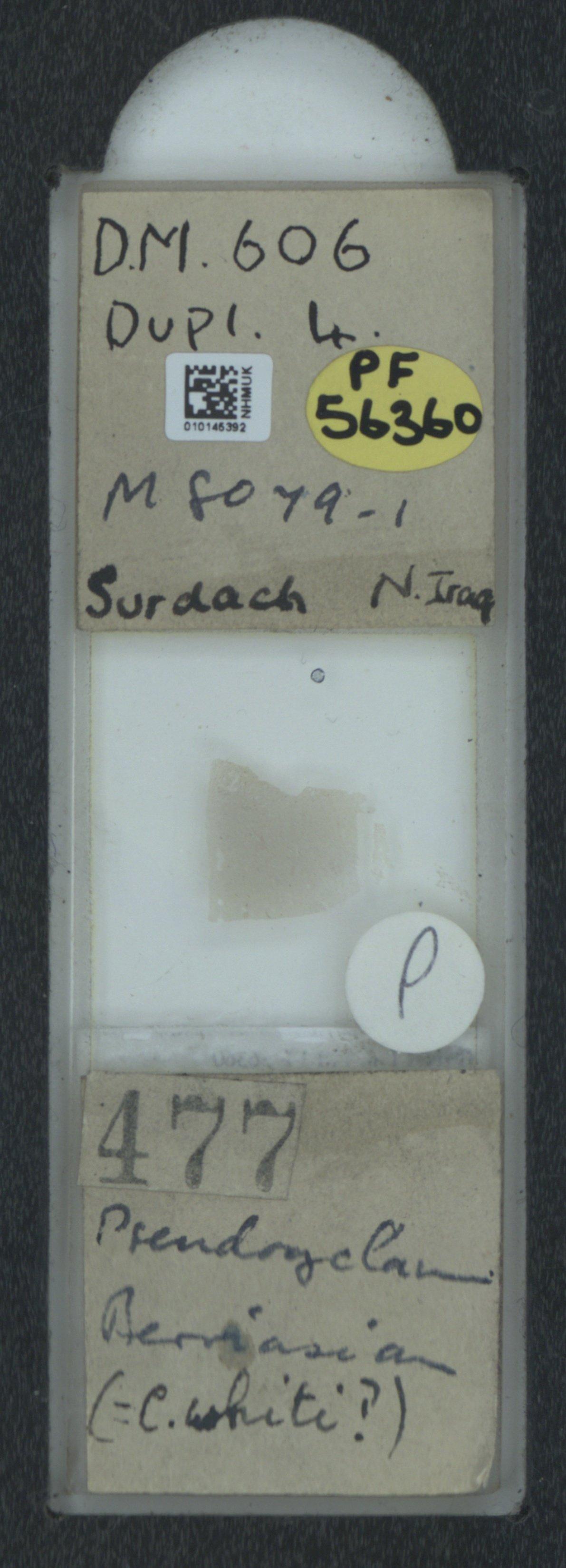
via iDigBio · CC BY · via iDigBio. May be a photograph of a specimen, or an artist’s reconstruction — an interpretation of a skeleton, since colour and soft tissue are almost never preserved.
On record
Recorded, not inferred- Sits inside
- PseudocyclamminaPBDB
- Diet
- detritivorePBDB, for Textulariina
- Life habit
- infaunalPBDB, for Textulariina
- Motility
- stationaryPBDB, for Foraminifera
Time the record covers
At least 58 million years on record.
The record covers at least 184.2 Mya to 125.77 Mya. No occurrence read is dated outside 192.9 Mya to 121.4 Mya.
25 occurrences of Pseudocyclammina lituus on record, most of them in the Late Jurassic. Bar height is expected occurrences, not a count: each fossil is spread across the span it is dated to, so a tall narrow bar means tight dating and a low wide one means loose.
When
25 occurrencesThese are dates about fossils, not the animal: the record can only begin after it arose and end before it died out, so either end may reach further. Shares are expected occurrences: a fossil dated to a span is counted partly in each period it straddles. More on what this infers.
Found in
8 formations
- Plassen Formation2
- Lapos Formation2
- Lamno Formation · Woyla Group1
- Lärchberg Formation1
- Coatepec Sandstone Formation1
- Sa Wer Formation1
Loading coastlines…
The named rock units Pseudocyclammina lituus has been recovered from, largest first. Drawn where the rock is now, not where it formed. 15 occurrences have no formation on record, which is common for older literature.
Pseudocyclammina lituus and its relatives
Late JurassicWhere Pseudocyclammina lituus and its relatives were recorded in the Late Jurassic.
Found in the same rock
172 taxa- Trocholina6 sites
- Ammobaculites4 sites
- Mohlerina basiliensis4 sites
- Montlivaltia4 sites
- Thaumatoporella parvovesiculifera4 sites
- Astacolus3 sites
- Campbelliella striata3 sites
- Clypeina3 sites
- Dentalina3 sites
- Discorbis3 sites
- Lenticulina3 sites
- Macroporella3 sites
- Nautiloculina3 sites
- Salpingoporella3 sites
- Salpingoporella annulata3 sites
- Salpingoporella pygmaea3 sites
- Textularia3 sites
- Actinastrea2 sites
- Actinostromaria2 sites
- Actinostromaria tokadiensis2 sites
- Ammodiscus2 sites
- Astrostylopsis2 sites
- Bacinella irregularis2 sites
- Cayeuxia2 sites
The Paleobiology Database records 12 sites for Pseudocyclammina lituus, and this reads all of them. The number is how many of those sites it was catalogued from too. The 24 sharing the most are listed.
This is not a list of everything alive at the time. It is only what has come out of the same ground as this animal and been written down.
Entered from
18 references- Late Jurassic-Early Cretaceous foraminifera from Štramberk-type limestones, Polish Outer Carpathians5
- Early Cretaceous Foraminifera, Algal Nodules and Calpionellids from the Lapos Valley, Bicaz Gorges (Eastern Carpathians, Romania)2
- Faziesmuster oberjurassischer Plattform-Karbonate (Plassen-Kalke), Nördliche Kalkalpen, Steirisches Salzkammergut, Österreich)2
- Recherches géologiques sur le Crétacé inférieur de l'Estremadura (Portugal)2
- The central‑western Getic Carbonate Platform: Upper Jurassic to Lower Cretaceous biostratigraphy and sedimentary evolution of the Cioclovina–Băniţa sector (Southern Carpathians, Romania)1
- Sequence Stratigraphy and Rudist Facies Development of the Upper Barremian-Lower Cenomanian Platform, Northern Sinai, Egypt1
- Lower Jurassic carbonate succession between Predole and Mlačevo, Central Slovenia1
- Oxfordian to Valanginian palaeoenvironmental evolution on the western Moesian Carbonate Platform: a case study from SW Bulgaria1
- Late Jurassic (Kimmeridgian) larger benthic Foraminifera from Santiago Coatepec, SE Puebla, Mexico1
- Biostratigraphy of Jurassic–Cretaceous Boundary Sediments in the Eastern Crimea1
- The origin of the Woyla Terranes in Sumatra and the Late Mesozoic evolution of the Sundaland margin1
- Lower Cretaceous Rudist faunas of Southeast Spain: an overview1
Each of the 25 occurrences read was entered from one of these publications, ordered by how many each accounts for. This is not a search for papers mentioning the name. 6 further references are not listed. Entries link to doi.org where the Paleobiology Database holds an identifier, and to its own record where it does not. Relayed as the Paleobiology Database holds them, not checked against what they resolve to.
Media and terms
Media content1
Picture of Pseudocyclammina lituus
- Source
- iDigBio
- Credit
- via iDigBio
- Licence
- CC BY
- Commercial use
- the licence allows it
No 3D scan of Pseudocyclammina lituus was found in Sketchfab.
Smithsonian Open Access and MorphoSource were not reached for this taxon, so this list is what the others held rather than everything there is.
This is what the site found, which is not the same as what exists.
Keep going
What may have been alongside itPseudocyclammina through timeFormations of the Late JurassicThe world it lived on
Occurrence data from the Paleobiology Database, CC BY 4.0. (Yokoyama 1890)