Psephophorus
Psephophorus is an extinct genus of sea turtle that lived from the Oligocene to the Pliocene. Its remains have been found in Europe, Africa, North America, and New Zealand. It was first named by Hermann von Meyer in 1847, and contains eight species, P. polygonus, P. calvertensis, P. eocaenus, P. oregonesis, P. californiensis, P. rupeliensis, P. scaldii, and P. terrypratchetti.

Jonathan Chen · CC BY-SA 4.0 · via Wikipedia/Commons. May be a photograph of a specimen, or an artist’s reconstruction — an interpretation of a skeleton, since colour and soft tissue are almost never preserved.
On record
Recorded, not inferred- Sits inside
- DermochelyiniPBDB
- Diet
- durophage, piscivorePBDB, for Dermochelyidae
- Life habit
- aquaticPBDB, for Dermochelyidae
- Motility
- actively mobilePBDB, for Osteichthyes
- Environment
- marinePBDB, for Dermochelyidae
Time the record covers
At least 32 million years on record.
The record covers at least 37.71 Mya to 5.333 Mya. No occurrence read is dated outside 41.03 Mya to 2.58 Mya.
32 occurrences of Psephophorus on record, most of them in the Miocene. Bar height is expected occurrences, not a count: each fossil is spread across the span it is dated to, so a tall narrow bar means tight dating and a low wide one means loose.
When
32 occurrencesThese are dates about fossils, not the animal: the record can only begin after it arose and end before it died out, so either end may reach further. Shares are expected occurrences: a fossil dated to a span is counted partly in each period it straddles. More on what this infers.
Found in
18 formations
- Calvert Formation · Chesapeake Group7
- La Meseta Formation3
- St. Marys Formation · Chesapeake Group2
- Gram Formation1
- Doberg Formation1
- Monterey Formation1
Loading coastlines…
The named rock units Psephophorus has been recovered from, largest first. Drawn where the rock is now, not where it formed. 5 occurrences have no formation on record, which is common for older literature.
Psephophorus and its relatives
MioceneWhere Psephophorus and its relatives were recorded in the Miocene.
Found in the same rock
878 taxa- Myliobatis7 sites
- Odontoceti7 sites
- Otodus megalodon6 sites
- Squatina6 sites
- Trachyaspis lardyi6 sites
- Carcharhinus5 sites
- Carcharodon hastalis5 sites
- Eurhinodelphis5 sites
- Squalus5 sites
- Ziphiidae5 sites
- Aetobatus4 sites
- Hemipristis serra4 sites
- Mysticeti4 sites
- Procolpochelys grandaeva4 sites
- Raja4 sites
- Aves3 sites
- Carcharias cuspidatus3 sites
- Cetacea3 sites
- Galeocerdo3 sites
- Lagodon rhomboides3 sites
- Merluccius3 sites
- Metaxytherium3 sites
- Morus3 sites
- Mustelus3 sites
The Paleobiology Database records 30 sites for Psephophorus, and this reads all of them. The number is how many of those sites it was catalogued from too. The 24 sharing the most are listed.
This is not a list of everything alive at the time. It is only what has come out of the same ground as this animal and been written down.
Entered from
24 references- Miocene and Pliocene Chelonians from the Calvert Cliffs and Nearby Regions6
- Geology and biostratigraphy of the Potomac River Cliffs at Stratford Hall, Westmoreland County, Virginia2
- An Eocene leatherback turtle (Cryptodira; Dermochelyidae) from Seymour Island, Antarctica2
- Description of a New Species of Leatherback Turtle from the Miocene of Maryland2
- Multispecies leatherback turtle assemblage from the Oligocene Chandler Bridge and Ashley formations of South Carolina, USA1
- First record of a leatherback sea turtle (Dermochelyidae) from the Mio-Pliocene Purisima Formation of northern California, USA1
- A Miocene leatherback turtle from the Westerschelde (The Netherlands) with possible cetacean bite marks: identification, taphonomy and cladistics1
- Fossil-collecting from the middle Miocene Carmel Church Quarry marine ecosystem in Caroline County, Virginia1
- Gross morphology and microstructure of type locality ossicles of Psephophorus polygonus Meyer, 1847 (Testudines, Dermochelyidae)1
- Weddellian marine/coastal vertebrates diversity from a basal horizon (Ypresian, Eocene) of the Cucullaea I Allomember, La Meseta formation, Seymour (Marambio) Island, Antarctica1
- Fossil sea turtles (Chelonii, Dermochelyidae and Cheloniidae) from the Miocene of Pietra Leccese (late Burdigalian-early Messinian), Southern Italy1
- The Italian fossil record of the sea turtles1
Each of the 32 occurrences read was entered from one of these publications, ordered by how many each accounts for. This is not a search for papers mentioning the name. 12 further references are not listed. Entries link to doi.org where the Paleobiology Database holds an identifier, and to its own record where it does not. Relayed as the Paleobiology Database holds them, not checked against what they resolve to.
Media and terms
Media content2

Picture of Psephophorus
- Source
- Wikipedia/Commons
- Credit
- Jonathan Chen
- Licence
- CC BY-SA 4.0
- Commercial use
- the licence allows it
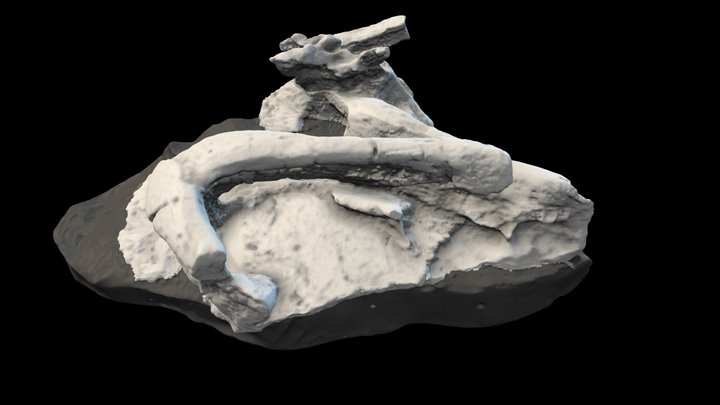
Smithsonian Open Access and MorphoSource were not reached for this taxon, so this list is what the others held rather than everything there is.
The description on this site
- Licence
- CC BY-SA 4.0
This is what the site found, which is not the same as what exists.
Keep going
What may have been alongside itDermochelyini through timeFormations of the MioceneThe world it lived on
Occurrence data from the Paleobiology Database, CC BY 4.0. von Meyer 1847