Prozostrodontia
Prozostrodontia is a clade of cynodonts including mammaliaforms and their closest relatives such as Tritheledontidae and Tritylodontidae. It was erected as a node-based taxon by Liu and Olsen (2010) and defined as the least inclusive clade containing Prozostrodon brasiliensis, Tritylodon langaevus, Pachygenelus monus, and Mus musculus. Prozostrodontia is diagnosed by several characters, including:Reduced prefrontal and postorbital bones, with the disappearance of a strut of bone called the postorbital bar separating the eye socket from the temporal region Unfused symphysis between the dentary bones in the lower jaw The presence of a small hole within the eye socket called the sphenopalatine foramen A long sagittal crest extending to the rearmost part of the lambdoidal crest at the back of the skull Neural spines of the dorsal vertebrae angled backward A convex-shaped iliac crest and a reduced posterior iliac spine on the hip An acetabular notch on the ischium The position of a small projection called the lesser trochanter close to the head of the femur

5of7 · CC BY-SA 2.0 · via Wikipedia/Commons. May be a photograph of a specimen, or an artist’s reconstruction — an interpretation of a skeleton, since colour and soft tissue are almost never preserved.
On record
Recorded, not inferred- Sits inside
- ProbainognathiaPBDB
- Motility
- actively mobilePBDB, for Osteichthyes
- Environment
- terrestrialPBDB, for Amniota
Time the record covers
At most 32 million years on record.
Every occurrence read is dated to somewhere between 237 Mya and 205.7 Mya, and nothing in the dating separates them, so that window is what the record shows rather than a span.
8 occurrences of Prozostrodontia on record, most of them in the Late Triassic. Bar height is expected occurrences, not a count: each fossil is spread across the span it is dated to, so a tall narrow bar means tight dating and a low wide one means loose.
When
8 occurrences- Late Triassic100%
These are dates about fossils, not the animal: the record can only begin after it arose and end before it died out, so either end may reach further. Shares are expected occurrences: a fossil dated to a span is counted partly in each period it straddles. More on what this infers.
Found in
4 formations
- Santa Maria Formation · Rosário do Sul Group4
- Candelária Formation · Santa Maria Group2
- Caturrita Formation · Rosário do Sul Group1
- Santo Domingo Formation1
Loading coastlines…
The named rock units Prozostrodontia has been recovered from, largest first. Drawn where the rock is now, not where it formed.
Prozostrodontia and its relatives
Late TriassicWhere Prozostrodontia and its relatives were recorded in the Late Triassic.
Found in the same rock
29 taxa- Archosauriformes2 sites
- Prozostrodon brasiliensis2 sites
- Sauropodomorpha2 sites
- Aetosauria1 site
- Agudotherium gassenae1 site
- Alemoatherium huebneri1 site
- Archosauromorpha1 site
- Botucaraitherium belarminoi1 site
- Capitosauroidea1 site
- Erythrovenator jacuiensis1 site
- Exaeretodon1 site
- Gnathovorax cabreirai1 site
- Gomphodontosuchus brasiliensis1 site
- Guaibasaurus1 site
- Guaibasaurus candelariensis1 site
- Hoplitosuchus raui1 site
- Huayracursor jaguensis1 site
- Hyperodapedon1 site
- Hyperodapedon mariensis1 site
- Hyperodapedon sanjuanensis1 site
- Jachaleria candelariensis1 site
- Lagerpetidae1 site
- Mystriosuchinae1 site
- Probainognathia1 site
The Paleobiology Database records 6 sites for Prozostrodontia, and this reads all of them. The number is how many of those sites it was catalogued from too. The 24 sharing the most are listed.
This is not a list of everything alive at the time. It is only what has come out of the same ground as this animal and been written down.
Entered from
8 references- A long-necked early dinosaur from a newly discovered Upper Triassic basin in the Andes1
- A New Prozostrodontian Cynodont (Eucynodontia, Probainognathia) from the Upper Triassic of Southern Brazil1
- Prozostrodon brasiliensis, a probainognathian cynodont from the Late Triassic of Brazil: second record and improvements on its dental anatomy1
- A new Upper Triassic cynodont-bearing fossiliferous site from southern Brazil, with taphonomic remarks and description of a new traversodontid taxon1
- A new cynodont from the Santa Maria Formation, South Brazil, improves Late Triassic probainognathian diversity1
- A new prozostrodontian cynodont (Therapsida) from the Late Triassic Riograndia Assemblage Zone (Santa Maria Supersequence) of Southern Brazil1
- On two advanced carnivorous cynodonts from the Late Triassic of Southern Brazil1
- A possible mammalian ancestor from the Middle Triassic of Brazil (Therapsida-Cynodontia)1
Each of the 8 occurrences read was entered from one of these publications, ordered by how many each accounts for. This is not a search for papers mentioning the name. Entries link to doi.org where the Paleobiology Database holds an identifier, and to its own record where it does not. Relayed as the Paleobiology Database holds them, not checked against what they resolve to.
Media and terms
Media content1
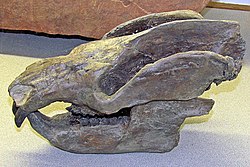
Picture of Prozostrodontia
- Source
- Wikipedia/Commons
- Credit
- 5of7
- Licence
- CC BY-SA 2.0
- Commercial use
- the licence allows it
No 3D scan of Prozostrodontia was found in Sketchfab.
Smithsonian Open Access and MorphoSource were not reached for this taxon, so this list is what the others held rather than everything there is.
The description on this site
- Licence
- CC BY-SA 4.0
This is what the site found, which is not the same as what exists.
Keep going
What may have been alongside itProbainognathia through timeFormations of the Late TriassicThe world it lived on
Occurrence data from the Paleobiology Database, CC BY 4.0. Liu and Olsen 2010