Prodissopsalis
Prodissopsalis is an extinct genus of placental mammals from extinct family Hyaenodontidae, that lived in Europe during the middle Eocene. P. eocaenicus fossils are known from France and the site of Geiseltal in Germany. P. jimenezi is known from Mazaterón in Spain.

DagdaMor · CC BY-SA 4.0 · via Wikipedia/Commons. May be a photograph of a specimen, or an artist’s reconstruction — an interpretation of a skeleton, since colour and soft tissue are almost never preserved.
On record
Recorded, not inferred- Sits inside
- HyaenodontidaePBDB
- Diet
- carnivorePBDB, for Hyaenodontidae
- Life habit
- ground dwellingPBDB, for Hyaenodontidae
- Motility
- actively mobilePBDB, for Osteichthyes
- Environment
- terrestrialPBDB, for Eutheria
Time the record covers
At most 11 million years on record.
Every occurrence read is dated to somewhere between 48.07 Mya and 37.71 Mya, and nothing in the dating separates them, so that window is what the record shows rather than a span.
9 occurrences of Prodissopsalis on record, most of them in the Eocene. Bar height is expected occurrences, not a count: each fossil is spread across the span it is dated to, so a tall narrow bar means tight dating and a low wide one means loose.
When
9 occurrences- Eocene100%
These are dates about fossils, not the animal: the record can only begin after it arose and end before it died out, so either end may reach further. Shares are expected occurrences: a fossil dated to a span is counted partly in each period it straddles. More on what this infers.
Prodissopsalis and its relatives
EoceneWhere Prodissopsalis and its relatives were recorded in the Eocene.
Found in the same rock
98 taxa- Palaeotherium isselanum4 sites
- Eurohippus parvulus3 sites
- Hyrachyus3 sites
- Lophiodon remensis3 sites
- Propalaeotherium voigti3 sites
- Rhinocerolophiodon buxovillanum3 sites
- Amphirhagatherium weigelti2 sites
- Diplocynodon2 sites
- Eolacerta robusta2 sites
- Geiselotherium pilzi2 sites
- Geiselotherium robustum2 sites
- Imperatoria gallwitzi2 sites
- Imperatoria hageni2 sites
- Leonhardtina gracilis2 sites
- Lophiodon tapirotherium2 sites
- Propalaeotherium hassiacum2 sites
- Protoadapis2 sites
- Proviverra typica2 sites
- Quercygale helvetica2 sites
- Acrididae1 site
- Ailuravus picteti1 site
- Allognathosuchus1 site
- Amphiperca1 site
- Aniliidae1 site
The Paleobiology Database records 4 sites for Prodissopsalis, and this reads all of them. The number is how many of those sites it was catalogued from too. The 24 sharing the most are listed.
This is not a list of everything alive at the time. It is only what has come out of the same ground as this animal and been written down.
Entered from
4 references- I. Abhandlung: Die Creodontier aus der mitteleozänen Braunkohle des Geiseltals (I. Part: The Creodonta from the Middle Eocene of Geiseltal)5
- Les carnivores du gisement lutetien de Lissieu (Rhône)2
- Zur Stellung der Wirbeltierfauna des Geiseltals, insbesondere der Mammalier, im europäischen Mitteleozän (Position of the European Middle Eocene vertebrate fauna of the Geisel Valley, with special focus on mammals)1
- Découverte d’une faune de mammifères dans le Lutétien supérieur de la Défense, à Puteaux, près Paris (Hauts-de-Seine)1
Each of the 9 occurrences read was entered from one of these publications, ordered by how many each accounts for. This is not a search for papers mentioning the name. Each entry links to the Paleobiology Database's own record for the work.
Media and terms
Media content1
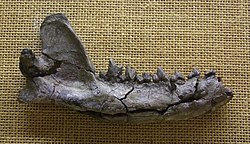
Picture of Prodissopsalis
- Source
- Wikipedia/Commons
- Credit
- DagdaMor
- Licence
- CC BY-SA 4.0
- Commercial use
- the licence allows it
No 3D scan of Prodissopsalis was found in Sketchfab.
Smithsonian Open Access and MorphoSource were not reached for this taxon, so this list is what the others held rather than everything there is.
The description on this site
- Licence
- CC BY-SA 4.0
This is what the site found, which is not the same as what exists.
Keep going
What may have been alongside itHyaenodontidae through timeFormations of the EoceneThe world it lived on
Occurrence data from the Paleobiology Database, CC BY 4.0. Matthes 1950