Prioniodina
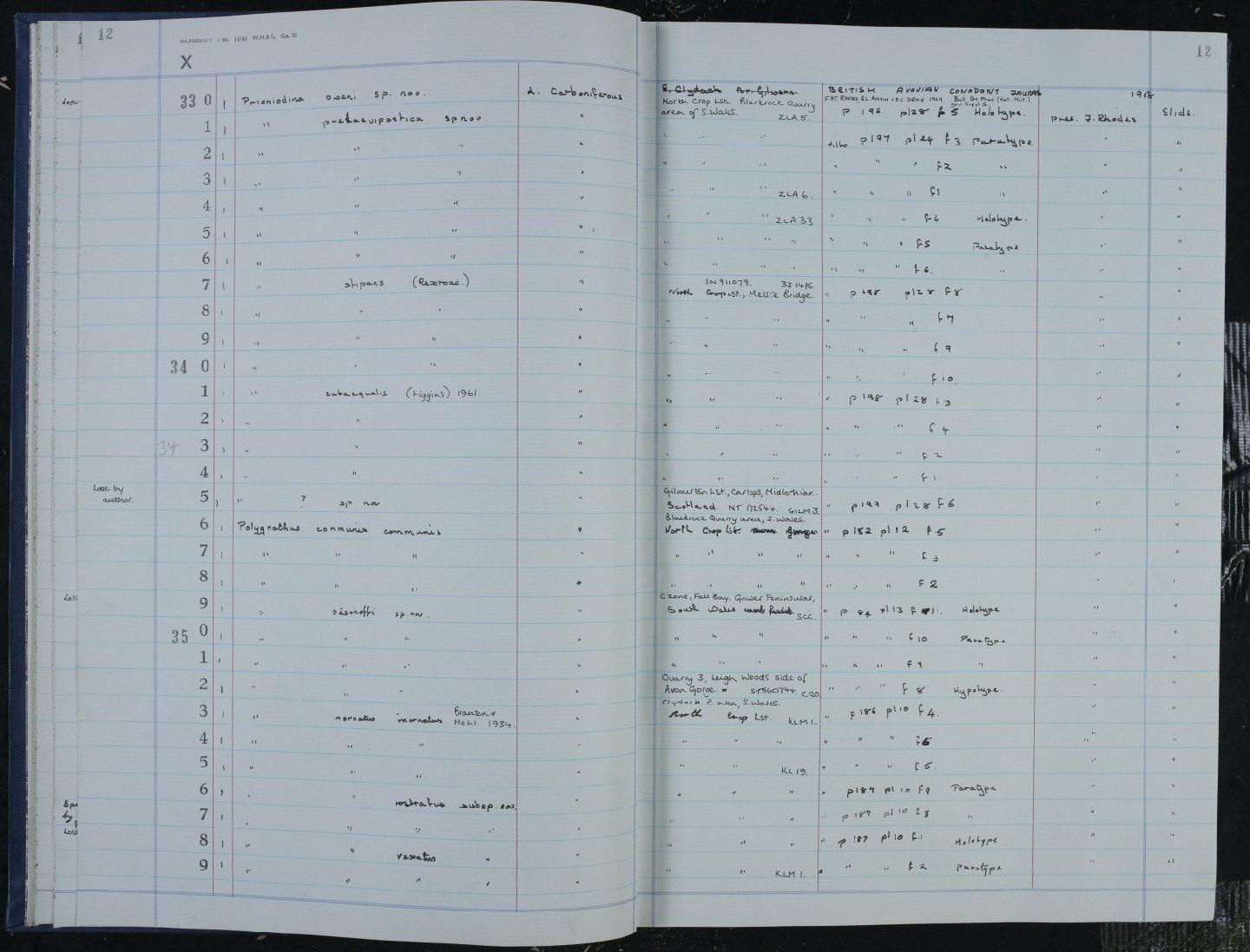
via GBIF · CC0 · via GBIF. May be a photograph of a specimen, or an artist’s reconstruction — an interpretation of a skeleton, since colour and soft tissue are almost never preserved.
On record
Recorded, not inferred- Sits inside
- PrioniodinidaePBDB
- Diet
- carnivorePBDB, for Conodonta
- Life habit
- nektonicPBDB, for Conodonta
- Motility
- actively mobilePBDB, for Conodonta
- Vision
- well-developedPBDB, for Conodonta
Time the record covers
At least 230 million years on record.
The record covers at least 458.2 Mya to 227.3 Mya. No occurrence read is dated outside 477.1 Mya to 205.7 Mya.
129 occurrences of Prioniodina on record, most of them in the Middle Triassic. Bar height is expected occurrences, not a count: each fossil is spread across the span it is dated to, so a tall narrow bar means tight dating and a low wide one means loose.
When
129 occurrencesThese are dates about fossils, not the animal: the record can only begin after it arose and end before it died out, so either end may reach further. Shares are expected occurrences: a fossil dated to a span is counted partly in each period it straddles. More on what this infers.
Found in
18 formations
- Füred Formation5
- Buchenstein Formation5
- Väszoly Formation4
- Lockup Well limestone Formation · Broken River Group3
- Big Stone Gap Shale Formation2
- Sa'haronim Formation · Ramon Group2
Loading coastlines…
The named rock units Prioniodina has been recovered from, largest first. Drawn where the rock is now, not where it formed. 96 occurrences have no formation on record, which is common for older literature.
Prioniodina and its relatives
Middle TriassicWhere Prioniodina and its relatives were recorded in the Middle Triassic.
Found in the same rock
540 taxa- Neohindeodella triassica28 sites
- Enantiognathus25 sites
- Neospathodus25 sites
- Gondolella navicula22 sites
- Lonchodina22 sites
- Ozarkodina18 sites
- Cratognathodus multihamatus17 sites
- Chirodella15 sites
- Cypridodella spengleri15 sites
- Gladigondolella tethydis15 sites
- Quadralella polygnathiformis15 sites
- Gondolella14 sites
- Neohindeodella13 sites
- Epigondolella12 sites
- Hibbardella12 sites
- Neogondolella11 sites
- Neogondolella mombergensis11 sites
- Diplododella magnidentata10 sites
- Neohindeodella suevica10 sites
- Cornudina9 sites
- Hibbardella (Diplododella)9 sites
- Paragondolella excelsa9 sites
- Conodonta8 sites
- Epigondolella bidentata7 sites
The Paleobiology Database records 57 sites for Prioniodina, and this reads all of them. The number is how many of those sites it was catalogued from too. The 24 sharing the most are listed.
This is not a list of everything alive at the time. It is only what has come out of the same ground as this animal and been written down.
Entered from
28 references- The Fossil Record of Conodonts in Greece67
- Holothurien-Sklerite und Conodonten aus der Mittel- und Obertrias von Köveskál (Balatonhochland, Ungarn)14
- Conodontes Triasiques d'une partie des Dinarides et des Carpates yougoslaves10
- Das "Taghanic Event" im höheren Mittel-Devon von West-Europa und Marokko8
- Late Emsian-Givetian Stratigraphy and Conodont Biofacies - Carbonate Slope and Offshore Shoal to Sheltered Lagoon and Nearshore Carbonate Ramp - Broken River, North Queensland, Australia3
- Silurian and Devonian conodonts from Spanish Sahara3
- Geology of the Bristol and Wallace quadrangles, Virginia2
- Triassic conodonts from Israel2
- Frasnian conodonts at high palaeolatitude (Amazonas Basin, north Brazil)1
- Brachiopods and conodonts from the Early Carboniferous of South China1
- Stop 2.1A - Givetian conodonts from the Poccis section (Carnic Alps, Italy)1
- Registro de conodontos del Triásico Medio en un nautiloideo de Espejeras (Alicante, España) [Middle Triassic conodonts record in a nautiloid from Espejeras (Alicante, Spain)]1
Each of the 129 occurrences read was entered from one of these publications, ordered by how many each accounts for. This is not a search for papers mentioning the name. 16 further references are not listed. Entries link to doi.org where the Paleobiology Database holds an identifier, and to its own record where it does not. Relayed as the Paleobiology Database holds them, not checked against what they resolve to.
Media and terms
Media content1
Picture of Prioniodina
- Source
- GBIF
- Credit
- via GBIF
- Licence
- CC0
- Commercial use
- the licence allows it
No 3D scan was found. Smithsonian Open Access, MorphoSource and Sketchfab were all searched.
This is what the site found, which is not the same as what exists.
Keep going
What may have been alongside itPrioniodinidae through timeFormations of the Middle TriassicThe world it lived on
Occurrence data from the Paleobiology Database, CC BY 4.0. Ulrich and Bassler 1925