Pleuroploca
Pleuroploca is a genus of very large predatory sea snails with an operculum, marine gastropod mollusks in the family Fasciolariidae, which includes the spindle shells, the tulip shells and other allied genera.

Manuel CABALLER · CC BY 4.0 · via Wikipedia/Commons. May be a photograph of a specimen, or an artist’s reconstruction — an interpretation of a skeleton, since colour and soft tissue are almost never preserved.
On record
Recorded, not inferred- Sits inside
- FasciolariinaePBDB
- Diet
- carnivorePBDB, for Fasciolariidae
- Life habit
- epifaunalPBDB, for Fasciolariidae
- Motility
- actively mobilePBDB, for Fasciolariidae
- Vision
- limitedPBDB, for Gastropoda
Time the record covers
At least 59 million years on record.
The record covers at least 59.24 Mya to 129 ka. No occurrence read is dated outside 61.66 Mya to 11.7 ka.
36 occurrences of Pleuroploca on record, most of them in the Miocene. The Paleobiology Database records this as a living group. Bar height is expected occurrences, not a count: each fossil is spread across the span it is dated to, so a tall narrow bar means tight dating and a low wide one means loose.
When
36 occurrences- Paleocene6%
- Miocene58%
- Pliocene28%
- Pleistocene8%
These are dates about fossils, not the animal: the record can only begin after it arose and end before it died out, so either end may reach further. Shares are expected occurrences: a fossil dated to a span is counted partly in each period it straddles. More on what this infers.
Found in
19 formations
- Gatun Formation9
- Muddy Creek Formation3
- Tubará Formation3
- Mare Formation · Cabo Blanco Group2
- Playa Grande Formation · Cabo Blanco Group1
- Talparo Formation1
Loading coastlines…
The named rock units Pleuroploca has been recovered from, largest first. Drawn where the rock is now, not where it formed. 4 occurrences have no formation on record, which is common for older literature.
Pleuroploca and its relatives
MioceneWhere Pleuroploca and its relatives were recorded in the Miocene.
Found in the same rock
843 taxa- Callocardia (Agriopoma) gatunensis8 sites
- Chione (Chionopsis) tegulum7 sites
- Clathrodrillia gatunensis7 sites
- Conus aemulator7 sites
- Conus molis7 sites
- Oliva gatunensis7 sites
- Polystira7 sites
- Psammacoma gatunensis7 sites
- Anadara6 sites
- Anadara (Rasia) dariensis6 sites
- Bellucina actinus6 sites
- Cadulus (Platyschides)6 sites
- Lirophora (Panchione) mactropsis6 sites
- Macrocallista maculata6 sites
- Stigmaulax guppiana6 sites
- Architectonica nobilis5 sites
- Bivetiella dariena5 sites
- Bothrocorbula (Hexacorbula) gatunensis5 sites
- Caryocorbula oropendula stena5 sites
- Clementia (Clementia) dariena dariena5 sites
- Conus burckhardti5 sites
- Cyclinella cyclica5 sites
- Ervilia valhosierr5 sites
- Euclia codazzii5 sites
The Paleobiology Database records 18 sites for Pleuroploca, and this reads all of them. The number is how many of those sites it was catalogued from too. The 24 sharing the most are listed.
This is not a list of everything alive at the time. It is only what has come out of the same ground as this animal and been written down.
Entered from
21 references- Geology and paleontology of canal zone and adjoing parts of Panama: Description of Tertiary mollusks (gastropods: Columbellidae to Volutidae).8
- The Miocene of Northern Costa Rica3
- The gastropods of the older Tertiary of Australia (Part 1)3
- Unpublished notes on Caribbean collection of Jack and Winifred Gibson-Smith, Naturhistorisches Museum Basel2
- Biozonation of the Neogene invertebrate megafauna of the Hellenic area2
- Late Cenozoic gastropods from northern Venezuela2
- Marine Miocene and related deposits of North Colombia2
- Resilience of marine invertebrate communities during the early Cenozoic hyperthermals1
- Late Pleistocene gastropods from the raised reefal limestone of Jeddah, Saudi Arabia: taxonomic and palaeoenvironmental implications1
- Paleontology and stratigraphy of the Miocene Saddleback Valley Limestone, Orange County, Southern California1
- Neogene molluscs, shallow marine paleoenvironments, and chronostratigraphy of the Guajira Peninsula, Colombia1
- The Cainozoic palaeontology and stratigraphy of KwaZulu-Natal. Part 5. The False Bay Coral Limestone Formation. Stratigraphy and fauna1
Each of the 36 occurrences read was entered from one of these publications, ordered by how many each accounts for. This is not a search for papers mentioning the name. 9 further references are not listed. Entries link to doi.org where the Paleobiology Database holds an identifier, and to its own record where it does not. Relayed as the Paleobiology Database holds them, not checked against what they resolve to.
Media and terms
Media content2

Picture of Pleuroploca
- Source
- Wikipedia/Commons
- Credit
- Manuel CABALLER
- Licence
- CC BY 4.0
- Commercial use
- the licence allows it
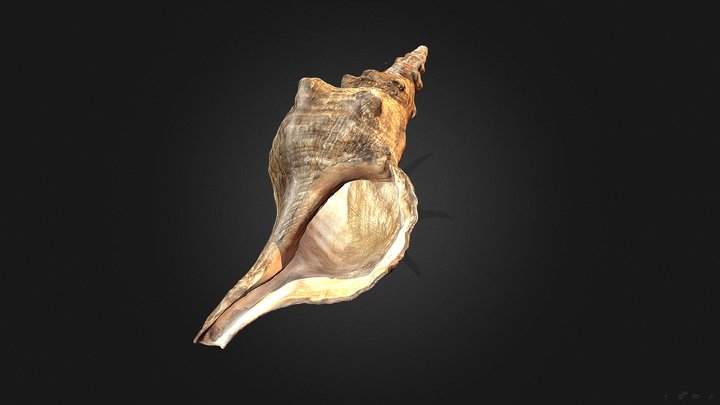
3D model
- Source
- Sketchfab
- Credit
- darwinmuseum.ru
- Licence
- CC Attribution
- Commercial use
- cannot be read from the licence given — check the record
Smithsonian Open Access was not reached for this taxon, so this list is what the others held rather than everything there is.
The description on this site
- Source
- Wikipedia, “Pleuroploca”
- Licence
- CC BY-SA 4.0
This is what the site found, which is not the same as what exists.
Keep going
What may have been alongside itFasciolariinae through timeFormations of the MioceneThe world it lived on
Occurrence data from the Paleobiology Database, CC BY 4.0. (Fischer 1884)