Placodermi
Placoderms are vertebrate animals of the class Placodermi, an extinct group of prehistoric fish known from Paleozoic fossils during the Silurian and the Devonian periods. While their endoskeletons are mainly cartilaginous, their head and thorax were covered by articulated armoured plates, and the rest of the body was scaled or naked depending on the species.

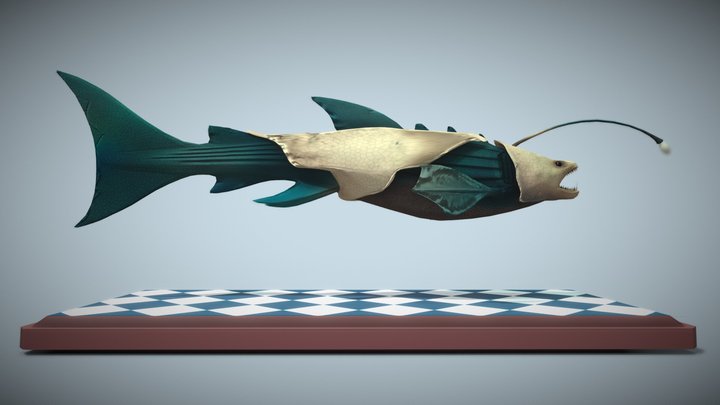
User:Haplochromis · CC BY-SA 3.0 · via Wikipedia/Commons. May be a photograph of a specimen, or an artist’s reconstruction — an interpretation of a skeleton, since colour and soft tissue are almost never preserved.
On record
Recorded, not inferred- Also called
- armour-plated fishPBDB
- Sits inside
- GnathostomataPBDB
- Diet
- carnivorePBDB
- Life habit
- nektonicPBDB
- Motility
- actively mobilePBDB
Time the record covers
At least 227 million years on record.
The record covers at least 432.9 Mya to 205.7 Mya. No occurrence read is dated outside 438.6 Mya to 201.4 Mya.
1,034 occurrences of Placodermi on record, most of them in the Devonian. The Paleobiology Database records this as a living group, and the chart stops with its fossils rather than at the present. Bar height is expected occurrences, not a count: each fossil is spread across the span it is dated to, so a tall narrow bar means tight dating and a low wide one means loose.
When
1,034 occurrences- Silurianunder 1%
- Devonian98%
- Carboniferousunder 1%
- Late Triassicunder 1%
These are dates about fossils, not the animal: the record can only begin after it arose and end before it died out, so either end may reach further. Shares are expected occurrences: a fossil dated to a span is counted partly in each period it straddles. More on what this infers.
Found in
247 formations
- Gogo Formation42
- Kellwasserkalk Formation42
- Rousay Formation31
- Aztec Siltstone Formation28
- Xitun Formation21
- Dniester Formation18
Loading coastlines…
The named rock units Placodermi has been recovered from, largest first. Drawn where the rock is now, not where it formed. 223 further formations hold fewer occurrences each and are not listed. 131 occurrences have no formation on record, which is common for older literature.
Placodermi and its relatives
DevonianWhere Placodermi and its relatives were recorded in the Devonian.
Found in the same rock
1,755 taxa- Glyptolepis21 sites
- Acanthodii16 sites
- Millerosteus minor16 sites
- Cheirolepis13 sites
- Dipterus13 sites
- Osteolepididae13 sites
- Sarcopterygii13 sites
- Byssacanthus dilatatus12 sites
- Acanthodes11 sites
- Dipnoi11 sites
- Arthrodira10 sites
- Bothriolepis10 sites
- Cheiracanthus10 sites
- Coccosteus cuspidatus10 sites
- Orvikuina10 sites
- Actinolepis tuberculata9 sites
- Actinopterygii9 sites
- Diplacanthus9 sites
- Dipterus valenciennesi9 sites
- Holoptychiidae9 sites
- Moythomasia9 sites
- Onychodus9 sites
- Asterolepis8 sites
- Asterolepis estonica8 sites
The Paleobiology Database records 481 sites for Placodermi, and this reads 240 of them. The number is how many of those sites it was catalogued from too. The 24 sharing the most are listed.
This is not a list of everything alive at the time. It is only what has come out of the same ground as this animal and been written down.
Entered from
312 references- The Middle Devonian fishes of the Baltic States (Estonia, Latvia) and Belarus79
- End-Devonian extinction and a bottleneck in the early evolution of modern jawed vertebrates36
- Bothriolepid antiarchs (Vertebrata, Placodermi) from the Devonian of the north-western part of the East European platform35
- Comparative study of the fossiliferous sites of the Devonian33
- Evidence for Placoderms from the Mid-Palaeozoic Sandon Beds of North-western New South Wales, Australia26
- The Early Devonian armoured agnathans of Podolia, Ukraine26
- Siluro-Devonian vertebrate biostratigraphy and biogeography of China25
- An examination of the Devonian fishes of Michigan24
- The vertebrate biostratigraphy of the Rousay sequence in the Middle Devonian of Orkney, Scotland24
- Fossil Fishes of Great Britain18
- Mid Devonian fossil fishes sites of Scotland17
- Antiarchs (placoderm fishes) from the Devonian Aztec Siltstone, Southern Victoria Land, Antarctica16
Each of the 1,034 occurrences read was entered from one of these publications, ordered by how many each accounts for. This is not a search for papers mentioning the name. 300 further references are not listed. Entries link to doi.org where the Paleobiology Database holds an identifier, and to its own record where it does not. Relayed as the Paleobiology Database holds them, not checked against what they resolve to.
Media and terms
Media content2

Picture of Placodermi
- Source
- Wikipedia/Commons
- Credit
- User:Haplochromis
- Licence
- CC BY-SA 3.0
- Commercial use
- the licence allows it
Smithsonian Open Access and MorphoSource were not reached for this taxon, so this list is what the others held rather than everything there is.
The description on this site
- Source
- Wikipedia, “Placoderm”
- Licence
- CC BY-SA 4.0
This is what the site found, which is not the same as what exists.
Keep going
What may have been alongside itGnathostomata through timeFormations of the DevonianThe world it lived on
Occurrence data from the Paleobiology Database, CC BY 4.0. (M'Coy 1848)