Persephona
Persephona is a genus of true crabs in the family Leucosiidae. There are about 5 described species in Persephona.

Andrea Westmoreland from DeLand, United States · CC BY-SA 2.0 · via Wikipedia/Commons. May be a photograph of a specimen, or an artist’s reconstruction — an interpretation of a skeleton, since colour and soft tissue are almost never preserved.
On record
Recorded, not inferred- Sits inside
- EbaliinaePBDB
- Diet
- carnivorePBDB, for Decapoda
- Life habit
- semi-infaunalPBDB, for Leucosioidea
- Motility
- actively mobilePBDB, for Malacostraca
- Vision
- well-developedPBDB, for Malacostraca
Time the record covers
At least 23 million years on record.
The record covers at least 23.04 Mya to 11.7 ka. No occurrence read is dated outside 33.9 Mya to 0 Mya.
44 occurrences of Persephona on record, most of them in the Miocene. The Paleobiology Database records this as a living group. Bar height is expected occurrences, not a count: each fossil is spread across the span it is dated to, so a tall narrow bar means tight dating and a low wide one means loose.
When
44 occurrences- Oligocene2%
- Miocene62%
- Pliocene18%
- Pleistocene11%
- Holocene7%
These are dates about fossils, not the animal: the record can only begin after it arose and end before it died out, so either end may reach further. Shares are expected occurrences: a fossil dated to a span is counted partly in each period it straddles. More on what this infers.
Found in
16 formations
- Cercado Formation · Yaque Group16
- Yorktown Formation4
- Gurabo Formation · Yaque Group3
- Yorktown (?) Formation1
- Duplin Formation1
- Pamlico Formation1
Loading coastlines…
The named rock units Persephona has been recovered from, largest first. Drawn where the rock is now, not where it formed. 8 occurrences have no formation on record, which is common for older literature.
Persephona and its relatives
MioceneWhere Persephona and its relatives were recorded in the Miocene.
Found in the same rock
221 taxa- Calappa flammea12 sites
- Callinectes declivis8 sites
- Hepatus guraboensis7 sites
- Petrochirus inequalis7 sites
- Cryptosoma bairdii5 sites
- Panopeus5 sites
- Mesorhoea mauryae4 sites
- Scylla costata4 sites
- Calappa3 sites
- Eurytium3 sites
- Petrochirus bahamensis3 sites
- Calappa springeri2 sites
- Callinectes2 sites
- Carpilius corallinus2 sites
- Eurypanopeus2 sites
- Hepatus lineatinus2 sites
- Hepatus praecox2 sites
- Hyas2 sites
- Micropanope2 sites
- Mithrax verrucosus2 sites
- Neocallichirus peraensis2 sites
- Petrochirus bouvieri2 sites
- Pilumnus2 sites
- Portunus2 sites
The Paleobiology Database records 30 sites for Persephona, and this reads all of them. The number is how many of those sites it was catalogued from too. The 24 sharing the most are listed.
This is not a list of everything alive at the time. It is only what has come out of the same ground as this animal and been written down.
Entered from
14 references- Decapod crustaceans from the Neogene of the Caribbean: diversity, distribution and prospectus18
- Fossil Crustacea of the Atlantic and Gulf Coastal Plain9
- Neogene and Quaternary crabs (Crustacea, Decapoda) collected from Costa Rica and Panama by members of the Panama Paleontology Project4
- Notes on North American Crustacea3
- Crustacea (Anomura, Brachyura) from the Miocene of Veracruz and Chiapas, Mexico: New records and new species1
- Neogene decapod crustaceans from the Caribbean of Colombia1
- A field guide to the Cretaceous and Cenozoic fossil decapod crustacean localities of Jamaica1
- Fossil Crustacea of the Late Pleistocene Port Morant Formation, west Port Morant Harbour, southeastern Jamaica1
- Crustáceos (Decapoda: Brachyura) fósiles de Cuba1
- Decapod, stomatopod and cirripede Crustacea from the Pliocene Bowden shell bed, St Thomas parish, Jamaica1
- Tertiary and Pleistocene crabs from Barbados and Trinidad1
- New species of fossil decapod crustaceans from California1
Each of the 44 occurrences read was entered from one of these publications, ordered by how many each accounts for. This is not a search for papers mentioning the name. 2 further references are not listed. Entries link to doi.org where the Paleobiology Database holds an identifier, and to its own record where it does not. Relayed as the Paleobiology Database holds them, not checked against what they resolve to.
Media and terms
Media content2

Picture of Persephona
- Source
- Wikipedia/Commons
- Credit
- Andrea Westmoreland from DeLand, United States
- Licence
- CC BY-SA 2.0
- Commercial use
- the licence allows it
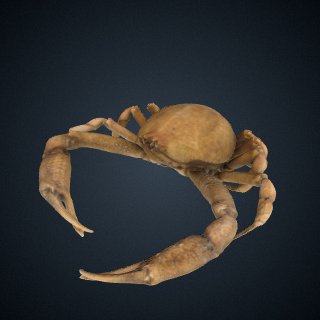
3D scan
- Source
- Smithsonian
- Licence
- CC0 — this site’s default, not the record’s
- Commercial use
- the licence allows it
- Specimen
- Persephona punctata aquilonaris
The description on this site
- Source
- Wikipedia, “Persephona”
- Licence
- CC BY-SA 4.0
This is what the site found, which is not the same as what exists.
Keep going
What may have been alongside itEbaliinae through timeFormations of the MioceneThe world it lived on
Occurrence data from the Paleobiology Database, CC BY 4.0. Leach 1817