Periphragnis
No picture of Periphragnis was found. Wikidata, iDigBio and Smithsonian Open Access were searched and had none. Wikipedia did not answer, so this is what the others held rather than everything there is. GBIF was asked, and what came back is not recorded: nothing, or a picture this site could not tie to Periphragnis, or no answer at all. This entry cannot say which.
On record
Recorded, not inferred- Sits inside
- ToxodontiaPBDB
- Diet
- herbivorePBDB, for Notoungulata
- Life habit
- scansorialPBDB, for Eutheria
- Motility
- actively mobilePBDB, for Osteichthyes
- Environment
- terrestrialPBDB, for Eutheria
Time the record covers
At least 8.1 million years on record.
The record covers at least 42 Mya to 33.9 Mya. No occurrence read is dated outside 48 Mya to 27.3 Mya.
24 occurrences of Periphragnis on record, most of them in the Eocene. Bar height is expected occurrences, not a count: each fossil is spread across the span it is dated to, so a tall narrow bar means tight dating and a low wide one means loose.
When
24 occurrencesThese are dates about fossils, not the animal: the record can only begin after it arose and end before it died out, so either end may reach further. Shares are expected occurrences: a fossil dated to a span is counted partly in each period it straddles. More on what this infers.
Found in
3 formations
Loading coastlines…
The named rock units Periphragnis has been recovered from, largest first. Drawn where the rock is now, not where it formed. 15 occurrences have no formation on record, which is common for older literature.
Periphragnis and its relatives
EoceneWhere Periphragnis and its relatives were recorded in the Eocene.
Found in the same rock
127 taxa- Pseudhyrax eutrachytheroides7 sites
- Notopithecidae4 sites
- Pseudeutatus depictus4 sites
- Astraponotus3 sites
- Distylophorus alouatinus3 sites
- Eohyrax3 sites
- Litopterna3 sites
- Notoungulata3 sites
- Polyacrodon lanciformis3 sites
- Propyrotherium saxeum3 sites
- Pseudhyrax strangulatus3 sites
- Trigonostylops3 sites
- Astrapotheria2 sites
- Barrancatatus rigidus2 sites
- Eohegetotherium2 sites
- Eomorphippus obscurus2 sites
- Guilielmoscottia plicifera2 sites
- Machlydotherium asperum2 sites
- Mammalia2 sites
- Meteutatus2 sites
- Notopithecus2 sites
- Notostylops2 sites
- Otronia muehlbergi2 sites
- Polyacrodon ligatus2 sites
The Paleobiology Database records 13 sites for Periphragnis, and this reads all of them. The number is how many of those sites it was catalogued from too. The 24 sharing the most are listed.
This is not a list of everything alive at the time. It is only what has come out of the same ground as this animal and been written down.
Entered from
8 references- The beginning of the age of mammals in South America. Part II11
- Noticias preliminares sobre nuevos mamíferos fósiles del Cretáceo superior y Terciario inferior de la Patagonia4
- Eocene mammals from volcaniclastic deposits of the Somun Cura Plateau: biostratigraphic implications for north Patagonia Paleogene3
- Biostratigraphy of the Casamayoran, Early Eocene of Patagonia2
- New Notoungulates (Notostylopidae and Basal Toxodontians) from the Early Oligocene Tinguiririca Fauna of the Andean Main Range, Central Chile1
- A new ?Eocene mammal fauna from the Andean Main Range1
- Vertebrate paleontology, geology, and geochronology of the Tapera de López and Scarritt Pocket, Chubut Province, Argentina1
- A specimen of Pseudostylops subquadratus Ameghino1
Each of the 24 occurrences read was entered from one of these publications, ordered by how many each accounts for. This is not a search for papers mentioning the name. Entries link to doi.org where the Paleobiology Database holds an identifier, and to its own record where it does not. Relayed as the Paleobiology Database holds them, not checked against what they resolve to.
Media and terms
Media content1
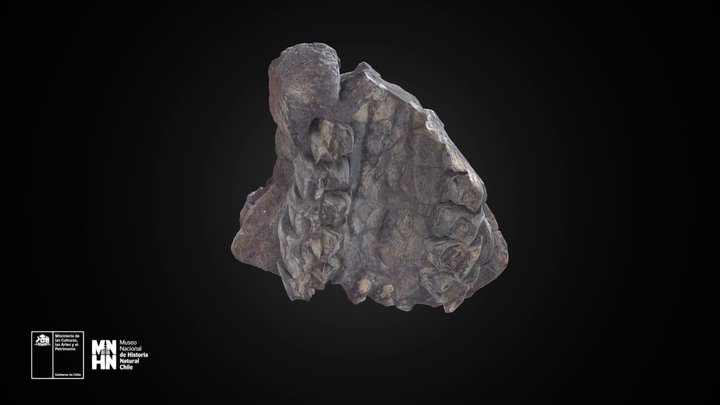
3D model
- Source
- Sketchfab
- Licence
- CC Attribution
- Commercial use
- cannot be read from the licence given — check the record
No picture of Periphragnis was found. Wikidata, iDigBio and Smithsonian Open Access were searched and had none.
Wikipedia did not answer, so this is what the others held rather than everything there is.
GBIF was asked, and what came back is not recorded: nothing, or a picture this site could not tie to Periphragnis, or no answer at all. This entry cannot say which.
This is what the site found, which is not the same as what exists.
Keep going
What may have been alongside itToxodontia through timeFormations of the EoceneThe world it lived on
Occurrence data from the Paleobiology Database, CC BY 4.0. Roth 1899