Pedionomus torquatus
The plains-wanderer is an atypical species of wading bird, the only representative of family Pedionomidae and genus Pedionomus. It is endemic to Australia. Its historic range included much of eastern Australia, including Victoria, New South Wales, South Australia and the Northern Territory, but in recent years, it has become endangered with remaining known populations concentrated in the Riverina region of New South Wales and western Queensland.

JJ Harrison · CC BY-SA 3.0 · via Wikipedia/Commons. May be a photograph of a specimen, or an artist’s reconstruction — an interpretation of a skeleton, since colour and soft tissue are almost never preserved.
On record
Recorded, not inferred- Also called
- plains-wandererPBDB
- Sits inside
- PedionomusPBDB
- Diet
- carnivorePBDB, for Coelurosauria
- Life habit
- ground dwelling, solitaryPBDB, for Theropoda
- Motility
- actively mobilePBDB, for Theropoda
- Environment
- marinePBDB, for Charadriiformes
- Mass
- 72.4 gWikidata
Time the record covers
At least 117 thousand years on record.
The record covers at least 129 ka to 11.7 ka. No occurrence read is dated outside 2.58 Mya to 0 Mya.
4 occurrences of Pedionomus torquatus on record, most of them in the Pleistocene. The Paleobiology Database records this as a living group. Bar height is expected occurrences, not a count: each fossil is spread across the span it is dated to, so a tall narrow bar means tight dating and a low wide one means loose.
When
4 occurrences- Pleistocene75%
- Holocene25%
These are dates about fossils, not the animal: the record can only begin after it arose and end before it died out, so either end may reach further. Shares are expected occurrences: a fossil dated to a span is counted partly in each period it straddles. More on what this infers.
Pedionomus torquatus and its relatives
PleistoceneWhere Pedionomus torquatus and its relatives were recorded in the Pleistocene.
Found in the same rock
105 taxa- Antechinus flavipes3 sites
- Cercartetus nanus3 sites
- Dasyurus viverrinus3 sites
- Egernia3 sites
- Isoodon obesulus3 sites
- Perameles gunnii3 sites
- Petaurus breviceps3 sites
- Procoptodon browneorum3 sites
- Procoptodon gilli3 sites
- Pseudocheirus peregrinus3 sites
- Sminthopsis crassicaudata3 sites
- Sthenurus andersoni3 sites
- Tiliqua3 sites
- Acrobates pygmaeus2 sites
- Amphibolurus barbatus2 sites
- Bettongia2 sites
- Bettongia lesueur2 sites
- Bettongia penicillata2 sites
- Cercartetus lepidus2 sites
- Coturnix pectoralis2 sites
- Dasyurus maculatus2 sites
- Dromaius novaehollandiae2 sites
- Gallirallus philippensis2 sites
- Gymnorhina tibicen2 sites
The Paleobiology Database records 4 sites for Pedionomus torquatus, and this reads all of them. The number is how many of those sites it was catalogued from too. The 24 sharing the most are listed.
This is not a list of everything alive at the time. It is only what has come out of the same ground as this animal and been written down.
Entered from
3 references- Pleistocene fossil vertebrate sites of the South East region of South Australia II2
- Tigriornis leucolopha1
- Small fossil vertebrates from Victoria Cave, Naracoorte, South Australia. III. Birds (Aves)1
Each of the 4 occurrences read was entered from one of these publications, ordered by how many each accounts for. This is not a search for papers mentioning the name. Entries link to doi.org where the Paleobiology Database holds an identifier, and to its own record where it does not. Relayed as the Paleobiology Database holds them, not checked against what they resolve to.
Media and terms
Media content1
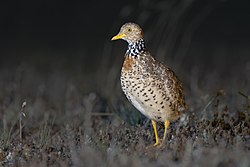
Picture of Pedionomus torquatus
- Source
- Wikipedia/Commons
- Credit
- JJ Harrison
- Licence
- CC BY-SA 3.0
- Commercial use
- the licence allows it
No 3D scan of Pedionomus torquatus was found in Sketchfab.
Smithsonian Open Access and MorphoSource were not reached for this taxon, so this list is what the others held rather than everything there is.
The description on this site
- Licence
- CC BY-SA 4.0
This is what the site found, which is not the same as what exists.
Keep going
What may have been alongside itPedionomus through timeFormations of the PleistoceneThe world it lived on
Occurrence data from the Paleobiology Database, CC BY 4.0. Gould 1841