Paxillosida
The Paxillosida are a large order of sea stars.

Dr. Dwayne Meadows, NOAA/NMFS/OPR · Public Domain · via Wikipedia/Commons. May be a photograph of a specimen, or an artist’s reconstruction — an interpretation of a skeleton, since colour and soft tissue are almost never preserved.
On record
Recorded, not inferred- Sits inside
- ValvataceaPBDB
- Diet
- carnivorePBDB, for Asteroidea
- Life habit
- low-level epifaunalPBDB, for Asteroidea
- Motility
- slow-movingPBDB, for Asteroidea
- Vision
- limitedPBDB, for Asteroidea
- Environment
- marinePBDB, for Echinodermata
Time the record covers
At least 224 million years on record.
The record covers at least 227.3 Mya to 2.58 Mya. No occurrence read is dated outside 237 Mya to 11.7 ka.
208 occurrences of Paxillosida on record, most of them in the Late Cretaceous. The Paleobiology Database records this as a living group. Bar height is expected occurrences, not a count: each fossil is spread across the span it is dated to, so a tall narrow bar means tight dating and a low wide one means loose.
When
208 occurrences- Late Triassic1%
- Early Jurassicunder 1%
- Middle Jurassic11%
- Late Jurassic10%
- Early Cretaceous14%
- Late Cretaceous36%
- Paleocene2%
- Eocene13%
- Oligocene2%
- Miocene6%
- Pliocene3%
- Pleistoceneunder 1%
These are dates about fossils, not the animal: the record can only begin after it arose and end before it died out, so either end may reach further. Shares are expected occurrences: a fossil dated to a span is counted partly in each period it straddles. More on what this infers.
Found in
74 formations
- La Meseta Formation17
- Gulpen Formation12
- Maastricht Formation11
- Pierre Blanche de Langrune Formation7
- Maastricht Formation6
- Effinger Schichten Formation4
Loading coastlines…
The named rock units Paxillosida has been recovered from, largest first. Drawn where the rock is now, not where it formed. 50 further formations hold fewer occurrences each and are not listed. 59 occurrences have no formation on record, which is common for older literature.
Paxillosida and its relatives
Late CretaceousWhere Paxillosida and its relatives were recorded in the Late Cretaceous.
Found in the same rock
2,001 taxa- Astropectinidae30 sites
- Goniasteridae23 sites
- Hemiaster19 sites
- Chomataster acules15 sites
- Ctenophoraster downeyae15 sites
- Echinogalerus15 sites
- Nucleopygus13 sites
- Lophidiaster pygmaeus12 sites
- Ophiomusium granulosum12 sites
- Astropecten11 sites
- Caletaster romani11 sites
- Catopygus11 sites
- Gauthieria pseudoradiata11 sites
- Trichaster ornatus11 sites
- Valettaster ocellatus11 sites
- Applinocrinus cretaceus10 sites
- Hemipneustes striatoradiatus10 sites
- Temnocidaris (Stereocidaris)10 sites
- Cardiaster granulosus9 sites
- Oolopygus9 sites
- Polydiadema9 sites
- Temnocidaris9 sites
- Lophidiaster8 sites
- Ostrea8 sites
The Paleobiology Database records 163 sites for Paxillosida, and this reads all of them. The number is how many of those sites it was catalogued from too. The 24 sharing the most are listed.
This is not a list of everything alive at the time. It is only what has come out of the same ground as this animal and been written down.
Entered from
80 references- Late Cretaceous-Early Paleocene echinoderms and the K/T boundary in the southeast Netherlands and the northeast Belgium. - part 5: Asteroids27
- Eocene stelleroids (Echinodermata) at Seymour Island, Antarctic Peninsula17
- Les Goniasteridae (Asteroidea, Echinodermata) jurassiques et crétacés de France. Taphonomie, systématique, biostratigraphie, paléobiogéographie, évolution.12
- Ossicle morphology of some recent asteroids and description of some West American fossil asteroids8
- Les stelléridés mésozoïques du bassin de Paris8
- New latest Cretaceous and earliest Paleogene asteroids (Echinodermata) from the Netherlands and Denmark and their palaebiological significance.6
- Some Albian (Cretaceous) asteroids (Echinodermata) from Texas and their paleobiological implications6
- Crinoid, asteroids, and ophiuroids in the Jamaican fossil record6
- Astérides du Cénomanien de Charente-Maritime (SW France)6
- Jura Vaudois et Neuchatelois6
- Diversity patterns and biostratigraphy of Cenozoic echinodems from Florida5
- Chrispaulia, a new genus of mud star (Asteroidea, Goniopectinidae) from the Cretaceous of England4
Each of the 208 occurrences read was entered from one of these publications, ordered by how many each accounts for. This is not a search for papers mentioning the name. 68 further references are not listed. Entries link to doi.org where the Paleobiology Database holds an identifier, and to its own record where it does not. Relayed as the Paleobiology Database holds them, not checked against what they resolve to.
Media and terms
Media content1
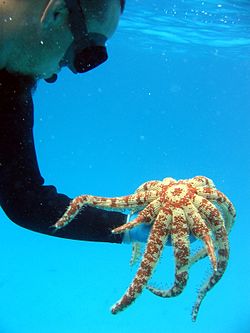
Picture of Paxillosida
- Source
- Wikipedia/Commons
- Credit
- Dr. Dwayne Meadows, NOAA/NMFS/OPR
- Licence
- Public Domain
- Commercial use
- the licence allows it
No 3D scan of Paxillosida was found in Sketchfab.
Smithsonian Open Access and MorphoSource were not reached for this taxon, so this list is what the others held rather than everything there is.
The description on this site
- Source
- Wikipedia, “Paxillosida”
- Licence
- CC BY-SA 4.0
This is what the site found, which is not the same as what exists.
Keep going
What may have been alongside itValvatacea through timeFormations of the Late CretaceousThe world it lived on
Occurrence data from the Paleobiology Database, CC BY 4.0. (Perrier 1884)