Parkinsonia
Parkinsonia is a genus of ammonites belonging to the family Parkinsoniidae.

Kaldari · CC0 · via Wikipedia/Commons. May be a photograph of a specimen, or an artist’s reconstruction — an interpretation of a skeleton, since colour and soft tissue are almost never preserved.
On record
Recorded, not inferred- Sits inside
- ParkinsoniinaePBDB
- Diet
- carnivorePBDB, for Ammonoidea
- Life habit
- nektonicPBDB, for Ammonoidea
- Motility
- fast-movingPBDB, for Ammonoidea
- Vision
- well-developedPBDB, for Cephalopoda
- Environment
- marinePBDB, for Cephalopoda
Time the record covers
At most 14 million years on record.
Every occurrence read is dated to somewhere between 174.7 Mya and 161.5 Mya, and nothing in the dating separates them, so that window is what the record shows rather than a span.
163 occurrences of Parkinsonia on record, most of them in the Middle Jurassic. Bar height is expected occurrences, not a count: each fossil is spread across the span it is dated to, so a tall narrow bar means tight dating and a low wide one means loose.
When
163 occurrences- Middle Jurassic100%
These are dates about fossils, not the animal: the record can only begin after it arose and end before it died out, so either end may reach further. Shares are expected occurrences: a fossil dated to a span is counted partly in each period it straddles. More on what this infers.
Found in
16 formations
- Tsudakhar Formation43
- Djangura Formation35
- Parkinsonian-Oolith Formation13
- "Berching" Formation11
- Dalichai Formation11
- Tasharvat Formation5
Loading coastlines…
The named rock units Parkinsonia has been recovered from, largest first. Drawn where the rock is now, not where it formed. 33 occurrences have no formation on record, which is common for older literature.
Parkinsonia and its relatives
Middle JurassicWhere Parkinsonia and its relatives were recorded in the Middle Jurassic.
Found in the same rock
134 taxa- Gonolkites subplanulatus7 sites
- Oxycerites6 sites
- Gonolkites convergens4 sites
- Gonolkites crassum4 sites
- Oxycerites aspidoides4 sites
- Planisphinctes tenuissimus4 sites
- Procerites4 sites
- Rarecostites mutabilis4 sites
- Vermisphinctes4 sites
- Cadomites (Polyplectites)3 sites
- Cadomites deslongchampsi3 sites
- Gonolkites rectangularis3 sites
- Lobosphinctes loczyi3 sites
- Cadomites (Cadomites) rectelobatus2 sites
- Garantiana tetragona2 sites
- Haselburgites datunense2 sites
- Lissoceras (Lissoceras) psilodiscus2 sites
- Lissoceras oolithicum2 sites
- Lobosphinctes2 sites
- Lobosphinctes costulatosus2 sites
- Neocrassina2 sites
- Oecotraustes (Oecotraustes) bomfordi2 sites
- Oraniceras fretensis2 sites
- Phylloceras2 sites
The Paleobiology Database records 91 sites for Parkinsonia, and this reads all of them. The number is how many of those sites it was catalogued from too. The 24 sharing the most are listed.
This is not a list of everything alive at the time. It is only what has come out of the same ground as this animal and been written down.
Entered from
18 references- Besnosov and Mitta, 199363
- Ammonites, Microfauna, and Palynomorphs from the Lower Part of the Upper Bajocian Parkinsoni Zone of the Basin of the Bolshoi Zelenchuk River, Northern Caucasus17
- Bajocian-Bathonian (Middle Jurassic) ammonites from the Polish Jura. Part 2: Families Stephanoceratidae, Perisphinctidae, Parkinsoniidae, Morphoceratidae and Tulitidae17
- Feinstratigraphie und Ammonitenfauna der Acris-Subzone (Parkinsoni-Zone, Ober-Bajocium, Mittlerer Jura) am Ipf (östliche Schwäbische Alb, Süddeutschland)14
- Zur Stratigraphie des Mittel- und unteren Oberjuras in Sengenthal bei Neumarkt /Opf. (Fränkische Alb) [On the stratigraphy of the Middle and early Upper Jurassic at Sengenthal, near Neumarkt/Opf. (Franconian Alb)]11
- Superfamily Perisphinctoidea (Ammonoidea) in the Bajocian–Lower Bathonian of the Kuban River Basin (Northern Caucasus, Russia)8
- Late Bajocian and Bathonian (Middle Jurassic) ammonites from the Dalichai Formation north of Damghan (Alborz, North Iran)8
- The Inferior Oolite at Coombe Quarry, near Mapperton, Dorset, and a new Middle Jurassic ammonite faunal horizon, Aa-3b, Leioceras comptocostosum n.biosp. in the Scissum Zone of the Lower Aalenian7
- On some Rarecostites (Parkinsoniidae, Ammonoidea) from the upper Bajocian Parkinsoni zone of the northern Caucasus4
- On some Parkinsonia (Ammonoidea: Parkinsoniidae) from the Uppermost Bajocian of the Kuban and Urup rivers interfluve (Northern Caucasus, Russia)3
- Late Bajocian-Bathonian ammonites from northeast Iran3
- Verkhniy bayos i nishniy bat v okrestnostyakh Saratova - Upper Bajocian and Lower Bathonian in the vicinity of Saratov2
Each of the 163 occurrences read was entered from one of these publications, ordered by how many each accounts for. This is not a search for papers mentioning the name. 6 further references are not listed. Entries link to doi.org where the Paleobiology Database holds an identifier, and to its own record where it does not. Relayed as the Paleobiology Database holds them, not checked against what they resolve to.
Media and terms
Media content2

Picture of Parkinsonia
- Source
- Wikipedia/Commons
- Credit
- Kaldari
- Licence
- CC0
- Commercial use
- the licence allows it
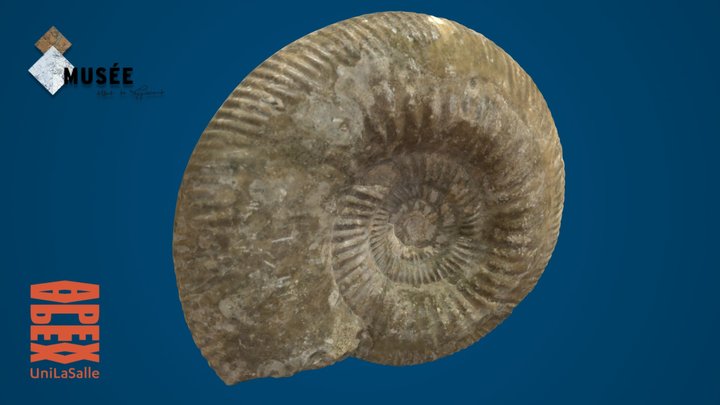
3D model
- Source
- Sketchfab
- Credit
- APEX UniLaSalle
- Licence
- CC Attribution-NonCommercial-ShareAlike
- Commercial use
- the licence does not allow it
This entry was cached before the site began recording what Smithsonian Open Access and MorphoSource did, so a search that failed cannot be told from one that found nothing.
The description on this site
- Licence
- CC BY-SA 4.0
This is what the site found, which is not the same as what exists.
Keep going
What may have been alongside itParkinsoniinae through timeFormations of the Middle JurassicThe world it lived on
Occurrence data from the Paleobiology Database, CC BY 4.0. Bayle