Paraceratherium
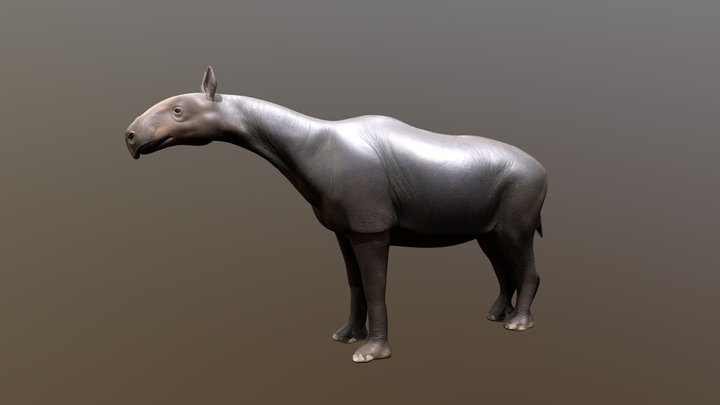
Paraceratherium is an extinct genus of hornless rhinocerotoids belonging to the family Paraceratheriidae. It is one of the largest terrestrial mammals that has ever existed and lived from the Early to Late Oligocene epoch. The first fossils were discovered in what is now Pakistan, and remains have been found across Eurasia between China and the Balkans. Paraceratherium means "near the hornless beast", in reference to Aceratherium, the genus in which the type species P. bugtiense was originally placed.

MikSed · CC BY-SA 4.0 · via Wikipedia/Commons. May be a photograph of a specimen, or an artist’s reconstruction — an interpretation of a skeleton, since colour and soft tissue are almost never preserved.
On record
Recorded, not inferred- Sits inside
- ParaceratheriinaePBDB
- Diet
- browserPBDB, for Ceratomorpha
- Life habit
- ground dwellingPBDB, for Ceratomorpha
- Motility
- actively mobilePBDB, for Osteichthyes
- Environment
- terrestrialPBDB, for Eutheria
- Length
- 7.4 mWikidata
- Mass
- 30 tonneWikidata
Time the record covers
At least 6.6 million years on record.
The record covers at least 33.9 Mya to 27.3 Mya. No occurrence read is dated outside 37.71 Mya to 15.98 Mya.
38 occurrences of Paraceratherium on record, most of them in the Oligocene. The Paleobiology Database records this as a living group, and the chart stops with its fossils rather than at the present. Bar height is expected occurrences, not a count: each fossil is spread across the span it is dated to, so a tall narrow bar means tight dating and a low wide one means loose.
When
38 occurrencesThese are dates about fossils, not the animal: the record can only begin after it arose and end before it died out, so either end may reach further. Shares are expected occurrences: a fossil dated to a span is counted partly in each period it straddles. More on what this infers.
Found in
17 formations
- Chitarwata Formation3
- Taoshuyuanzi Formation3
- Aral Formation2
- Wulanbulage Formation2
- Naogangdai Formation2
- Aktau Formation2
Loading coastlines…
The named rock units Paraceratherium has been recovered from, largest first. Drawn where the rock is now, not where it formed. 12 occurrences have no formation on record, which is common for older literature.
Paraceratherium and its relatives
OligoceneWhere Paraceratherium and its relatives were recorded in the Oligocene.
Found in the same rock
131 taxa- Tsaganomys altaicus5 sites
- Tataromys sigmodon4 sites
- Amphechinus3 sites
- Desmatolagus pusillus3 sites
- Desmatolagus robustus3 sites
- Dzungariotherium turfanensis3 sites
- Eucricetodon asiaticus3 sites
- Karakoromys decessus3 sites
- Rhinocerotidae3 sites
- Tataromys minor3 sites
- Tataromys plicidens3 sites
- Turpanotherium elegans3 sites
- Anomoemys lohiculus2 sites
- Anthracotherium bugtiense2 sites
- Baluchitherium osborni2 sites
- Cadurcodon ardynensis2 sites
- Cricetops dormitor2 sites
- Desmatolagus gobiensis2 sites
- Didymoconus2 sites
- Entelodon dirus2 sites
- Eucricetodon caducus2 sites
- Eumeryx2 sites
- Lophiomeryx2 sites
- Miomeryx2 sites
The Paleobiology Database records 33 sites for Paraceratherium, and this reads all of them. The number is how many of those sites it was catalogued from too. The 24 sharing the most are listed.
This is not a list of everything alive at the time. It is only what has come out of the same ground as this animal and been written down.
Entered from
23 references- Paracerathere Fossils of China8
- Catalogue of Tertiary Fossil Sites of the Land Mammals in the U.S.S.R.5
- Notes on Early Oligocene ursids (Carnivora, Mammalia) from Saint Jacques, Nei Mongol, China2
- Oligocene stratigraphy, sequence stratigraphy, and mammalian biochronology north of the Aral Sea, Western Kazakstan2
- Mise en évidence de l'Oligocène sur le territoire des Bugti (Balouchistan, Pakistan)2
- Thaumastotherium osbosni, a new genus of perissodactyl from the Upper Oligocene deposits of the Bugti Hills of Baluchistan. Preliminary notice2
- An Oligocene giant rhino provides insights into Paraceratherium evolution1
- New fossils of paraceratheres (Perissodactyla, Mammalia) from the Early Oligocene of the Lanzhou Basin, Gansu Province, China1
- Giant rhinoceros Paraceratherium and other vertebrates from Oligocene and middle Miocene deposits of the Kağızman-Tuzluca Basin, Eastern Turkey1
- A giant rhinocerotoid (Mammalia, Perissodactyla) from the Late Oligocene of north-central Anatolia (Turkey)1
- 8. Rhinocerotidae (Perissodactyla, Mammalia)1
- New artiodactyl ruminant mammal from the late Oligocene of Pakistan1
Each of the 38 occurrences read was entered from one of these publications, ordered by how many each accounts for. This is not a search for papers mentioning the name. 11 further references are not listed. Entries link to doi.org where the Paleobiology Database holds an identifier, and to its own record where it does not. Relayed as the Paleobiology Database holds them, not checked against what they resolve to.
Media and terms
Media content2

Picture of Paraceratherium
- Source
- Wikipedia/Commons
- Credit
- MikSed
- Licence
- CC BY-SA 4.0
- Commercial use
- the licence allows it
Smithsonian Open Access was not reached for this taxon, so this list is what the others held rather than everything there is.
The description on this site
- Licence
- CC BY-SA 4.0
This is what the site found, which is not the same as what exists.
Keep going
What may have been alongside itParaceratheriinae through timeFormations of the OligoceneThe world it lived on
Occurrence data from the Paleobiology Database, CC BY 4.0. Forster Cooper 1911