Panopea (Panopea)
No picture of Panopea (Panopea) was found. Wikidata and iDigBio were searched and had none. Wikipedia and Smithsonian Open Access did not answer, so this is what the others held rather than everything there is. GBIF was asked, and what came back is not recorded: nothing, or a picture this site could not tie to Panopea (Panopea), or no answer at all. This entry cannot say which.
On record
Recorded, not inferred- Sits inside
- PanopeaPBDB
- Diet
- suspension feederPBDB, for Panopea
- Life habit
- deep infaunalPBDB, for Panopea
- Motility
- stationaryPBDB, for Panopea
- Vision
- blindPBDB, for Bivalvia
Time the record covers
At least 84 million years on record.
The record covers at least 89.8 Mya to 5.333 Mya. No occurrence read is dated outside 93.9 Mya to 2.58 Mya.
52 occurrences of Panopea (Panopea) on record, most of them in the Miocene. The Paleobiology Database records this as a living group, and the chart stops with its fossils rather than at the present. Bar height is expected occurrences, not a count: each fossil is spread across the span it is dated to, so a tall narrow bar means tight dating and a low wide one means loose.
When
52 occurrencesThese are dates about fossils, not the animal: the record can only begin after it arose and end before it died out, so either end may reach further. Shares are expected occurrences: a fossil dated to a span is counted partly in each period it straddles. More on what this infers.
Found in
21 formations
- Puerto Madryn Formation6
- Polonez Cove Formation3
- Fels Formation3
- Sagdere Formation · Akcay Group3
- Monte Leon Fm Formation2
- Cape Melville Formation · Moby Dick Group2
Loading coastlines…
The named rock units Panopea (Panopea) has been recovered from, largest first. Drawn where the rock is now, not where it formed. 16 occurrences have no formation on record, which is common for older literature.
Panopea (Panopea) and its relatives
MioceneWhere Panopea (Panopea) and its relatives were recorded in the Miocene.
Found in the same rock
1,122 taxa- Venus (Ventricoloidea) multilamella16 sites
- Aequipecten12 sites
- Glossus (Glossus)12 sites
- Gouldia (Gouldia) minima12 sites
- Scapharca (Scapharca) diluvii12 sites
- Varicorbula gibba12 sites
- Astarte (Astarte) radiata11 sites
- Calyptraea chinensis11 sites
- Gemmula (Gemmula)11 sites
- Limopsis (Limopsis) aurita11 sites
- Lyrotyphis11 sites
- Pyrgolampros11 sites
- Retusa (Cylichnina)11 sites
- Ringicula buccinea11 sites
- Syrnola11 sites
- Yoldia (Yoldia) glaberrima11 sites
- Yoldiella11 sites
- Aporrhais (Aporrhais)10 sites
- Asthenotoma10 sites
- Babylonella10 sites
- Bittium spina10 sites
- Cirsotrema10 sites
- Conus (Conolithes)10 sites
- Cylichna (Cylichna)10 sites
The Paleobiology Database records 32 sites for Panopea (Panopea), and this reads all of them. The number is how many of those sites it was catalogued from too. The 24 sharing the most are listed.
This is not a list of everything alive at the time. It is only what has come out of the same ground as this animal and been written down.
Entered from
27 references- Die Fauna des marinen Miozäns von Kevelaer (Niederrhein). Band 2 Bivalvia, Scaphopoda, Cephalopoda, Bryozoa, Annelida, Brachiopoda8
- Tertiary Marine Molluscan Assemblages of Eastern Patagonia (Argentina): A Biostratigraphic Analysis4
- Middle Miocene bivalves of the Puerto Madryn Formation, Valdes Peninsule, Chubut Province, Argentina (Lucinidae-Pholadidae): Part 24
- Molluscan biostratigraphy and paleoenvironmental reconstruction of Oligocene deposits in the Denizli and Kale-Tavas subbasins (SW Turkey)3
- Computer-based mollusc stratigraphy - a case study from the Eggenburgian (Lower Miocene) type region (NE Austria)3
- Biota of the "Pecten Conglomerate" (Polenez Cove Formation, Pliocene) of King George Island (South Shetland Islands, Antarctica)3
- The molluscan fauna of the late Oligocene Branden Clay, Denmark2
- Early Miocene bivalves from the Cape Melville Formation, King George Island, West Antarctic2
- Middle Miocene bivalves of the Puerto Madryn Formation, Valdes Peninsule, Chubut Province, Argentina (Nuculidae-Pectinidae): Part 12
- A new species of genus Panopea (Bivalvia) from King George Island, Antarctica2
- Les formations recifales coralliennes du Miocene superieur d'Algerie et du Maroc [Upper Miocene coral reef formations from Algeria and Morocco]2
- The mollusc fauna of the Stemerdink Bed (Miocene, Reinbekian) from outcrops in the Slinge brook at Winterswijk-Brinkheurne (The Netherlands, province of Gelderland)2
Each of the 52 occurrences read was entered from one of these publications, ordered by how many each accounts for. This is not a search for papers mentioning the name. 15 further references are not listed. Entries link to doi.org where the Paleobiology Database holds an identifier, and to its own record where it does not. Relayed as the Paleobiology Database holds them, not checked against what they resolve to.
Media and terms
Media content1
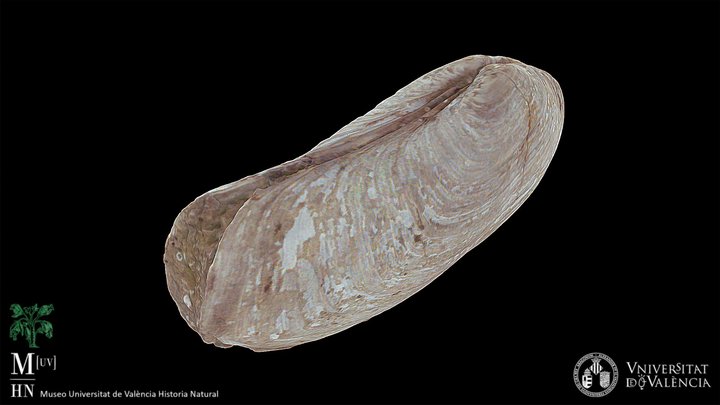
3D model
- Source
- Sketchfab
- Licence
- CC Attribution
- Commercial use
- cannot be read from the licence given — check the record
No picture of Panopea (Panopea) was found. Wikidata and iDigBio were searched and had none.
Wikipedia and Smithsonian Open Access did not answer, so this is what the others held rather than everything there is.
GBIF was asked, and what came back is not recorded: nothing, or a picture this site could not tie to Panopea (Panopea), or no answer at all. This entry cannot say which.
Smithsonian Open Access and MorphoSource were not reached for this taxon, so this list is what the others held rather than everything there is.
This is what the site found, which is not the same as what exists.
Keep going
What may have been alongside itPanopea through timeFormations of the MioceneThe world it lived on
Occurrence data from the Paleobiology Database, CC BY 4.0. Menard 1807