Paguridae
The Paguridae are a family of hermit crabs of the order Decapoda. The king crabs, Lithodidae, are now widely understood to be derived from deep within the Paguridae, with some authors placing their ancestors within the genus Pagurus.

Hans Hillewaert · CC BY-SA 4.0 · via Wikipedia/Commons. May be a photograph of a specimen, or an artist’s reconstruction — an interpretation of a skeleton, since colour and soft tissue are almost never preserved.
On record
Recorded, not inferred- Sits inside
- PaguroideaPBDB
- Diet
- detritivorePBDB, for Paguroidea
- Life habit
- epifaunalPBDB, for Decapoda
- Motility
- actively mobilePBDB, for Malacostraca
- Vision
- well-developedPBDB, for Malacostraca
Time the record covers
At least 184 million years on record.
The record covers at least 184.2 Mya to 11.7 ka. No occurrence read is dated outside 201.4 Mya to 0 Mya.
130 occurrences of Paguridae on record, most of them in the Miocene. The Paleobiology Database records this as a living group. Bar height is expected occurrences, not a count: each fossil is spread across the span it is dated to, so a tall narrow bar means tight dating and a low wide one means loose.
When
130 occurrences- Early Jurassic7%
- Middle Jurassic11%
- Late Jurassic13%
- Early Cretaceous8%
- Late Cretaceous4%
- Paleoceneunder 1%
- Eocene10%
- Oligocene6%
- Miocene21%
- Pliocene5%
- Pleistocene4%
- Holocene10%
These are dates about fossils, not the animal: the record can only begin after it arose and end before it died out, so either end may reach further. Shares are expected occurrences: a fossil dated to a span is counted partly in each period it straddles. More on what this infers.
Found in
34 formations
- Oxford Clay Formation · Ancholme Group8
- Glen Rose Limestone Formation · Trinity Group4
- Sandakan Formation4
- Marno-Calcaires à Oolites Ferrugineuses Formation4
- Mount Laurel Formation · Monmouth Group2
- Castell'Arquato Formation2
Loading coastlines…
The named rock units Paguridae has been recovered from, largest first. Drawn where the rock is now, not where it formed. 10 further formations hold fewer occurrences each and are not listed. 75 occurrences have no formation on record, which is common for older literature.
Paguridae and its relatives
MioceneWhere Paguridae and its relatives were recorded in the Miocene.
Found in the same rock
1,726 taxa- Pagurus13 sites
- Pilumnus mediterraneus7 sites
- Xantho moldavicus7 sites
- Conus5 sites
- Galathea weinfurteri5 sites
- Goniochirus cristatus5 sites
- Maja biaensis5 sites
- Pachygrapsus hungaricus5 sites
- Pisa oroszyi5 sites
- Anapagurus4 sites
- Calappa4 sites
- Calappa heberti4 sites
- Callianassa4 sites
- Callianassa kerepesiensis4 sites
- Callianassa munieri4 sites
- Daira speciosa4 sites
- Dromia neogenica4 sites
- Eryma mandelslohi4 sites
- Glycymeris4 sites
- Heikeopsis tuberculata4 sites
- Lucanthonisia eotvoesi4 sites
- Ostrea4 sites
- Pagurus rakosensis4 sites
- Pariphiculus decemtuberculatus4 sites
The Paleobiology Database records 74 sites for Paguridae, and this reads all of them. The number is how many of those sites it was catalogued from too. The 24 sharing the most are listed.
This is not a list of everything alive at the time. It is only what has come out of the same ground as this animal and been written down.
Entered from
64 references- Notes sur les Crustaces Jurassiques du Bassin Du Jura14
- Notes on North American Crustacea11
- Decapod crustacea of the Badenian10
- On the decapod crustaceans of the Oxford Clay8
- Middle Miocene decapod Crustacea from southern Poland5
- A rich and highly endemic decapod crustacean fauna from the Middle Jurassic of north-east France4
- Miocene and Pleistocene Crabs (Crustacea, Decapoda) from Sabah and Sarawak4
- I granchi eremiti (Crustacea, Decapoda, Anomura, Paguroidea) dell’Eocene medio di cava “Main” di Arzignano (Vicenza, Italia settentrionale)3
- New Cretaceous and Tertiary decapod crustaceans from western North America3
- Fossil decapod crustaceans from the Lower Cretaceous, Glen Rose Limestone of central Texas3
- Description des crustacés fossiles de la Haute-Saône et du Haut-Jura3
- Filling the early Eocene gap of paguroids (Decapoda, Anomura): a new highly diversified fauna from the Spanish Pyrenees (Serraduy Formation, Graus-Tremp Basin)2
Each of the 130 occurrences read was entered from one of these publications, ordered by how many each accounts for. This is not a search for papers mentioning the name. 52 further references are not listed. Entries link to doi.org where the Paleobiology Database holds an identifier, and to its own record where it does not. Relayed as the Paleobiology Database holds them, not checked against what they resolve to.
Media and terms
Media content1
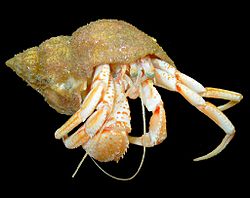
Picture of Paguridae
- Source
- Wikipedia/Commons
- Credit
- Hans Hillewaert
- Licence
- CC BY-SA 4.0
- Commercial use
- the licence allows it
No 3D scan was found. Smithsonian Open Access, MorphoSource and Sketchfab were all searched.
The description on this site
- Source
- Wikipedia, “Paguridae”
- Licence
- CC BY-SA 4.0
This is what the site found, which is not the same as what exists.
Keep going
What may have been alongside itPaguroidea through timeFormations of the MioceneThe world it lived on
Occurrence data from the Paleobiology Database, CC BY 4.0. Latreille 1802