Pagurus
Pagurus is a genus of hermit crabs in the family Paguridae. Like other hermit crabs, their abdomen is not calcified and they use gastropod shells as protection. These marine decapod crustaceans are omnivorous, but mostly prey on small animals and scavenge carrion. Trigonocheirus and Pagurixus used to be considered subgenera of Pagurus, but the former is nowadays included in Orthopagurus, while the latter has been separated as a distinct genus.

dphershman · CC BY 2.0 · via Wikipedia/Commons. May be a photograph of a specimen, or an artist’s reconstruction — an interpretation of a skeleton, since colour and soft tissue are almost never preserved.
On record
Recorded, not inferred- Sits inside
- PaguridaePBDB
- Diet
- detritivorePBDB, for Paguroidea
- Life habit
- epifaunalPBDB, for Decapoda
- Motility
- actively mobilePBDB, for Malacostraca
- Vision
- well-developedPBDB, for Malacostraca
Time the record covers
At least 165 million years on record.
The record covers at least 165.3 Mya to 11.7 ka. No occurrence read is dated outside 168.2 Mya to 0 Mya.
60 occurrences of Pagurus on record. The Paleobiology Database records this as a living group. Bar height is expected occurrences, not a count: each fossil is spread across the span it is dated to, so a tall narrow bar means tight dating and a low wide one means loose.
When
60 occurrences- Middle Jurassic2%
- Late Jurassic2%
- Early Cretaceous12%
- Late Cretaceous3%
- Paleocene2%
- Eocene14%
- Oligocene12%
- Miocene18%
- Pliocene9%
- Pleistocene6%
- Holocene20%
These are dates about fossils, not the animal: the record can only begin after it arose and end before it died out, so either end may reach further. Shares are expected occurrences: a fossil dated to a span is counted partly in each period it straddles. More on what this infers.
Found in
23 formations
- Glen Rose Limestone Formation · Trinity Group4
- Makah Formation2
- Calcaire de Caen Formation1
- Mount Laurel Formation · Monmouth Group1
- Talbot Formation1
- Eutaw Formation1
Loading coastlines…
The named rock units Pagurus has been recovered from, largest first. Drawn where the rock is now, not where it formed. 33 occurrences have no formation on record, which is common for older literature.
Found in the same rock
1,156 taxa- Xantho moldavicus7 sites
- Pilumnus mediterraneus6 sites
- Galathea weinfurteri5 sites
- Pachygrapsus hungaricus5 sites
- Pisa oroszyi5 sites
- Calappa heberti4 sites
- Callianassa munieri4 sites
- Daira speciosa4 sites
- Dromia neogenica4 sites
- Glycymeris4 sites
- Lucanthonisia eotvoesi4 sites
- Maja biaensis4 sites
- Actumnus telegdii3 sites
- Anapagurus3 sites
- Calappa granulata3 sites
- Callianassa3 sites
- Callianassa kerepesiensis3 sites
- Cerithium3 sites
- Charybdis mathiasi3 sites
- Chlorodiella mediterranea3 sites
- Conus3 sites
- Eriphia3 sites
- Matuta brocchii3 sites
- Micippa hungarica3 sites
The Paleobiology Database records 38 sites for Pagurus, and this reads all of them. The number is how many of those sites it was catalogued from too. The 24 sharing the most are listed.
This is not a list of everything alive at the time. It is only what has come out of the same ground as this animal and been written down.
Entered from
38 references- Notes on North American Crustacea10
- Decapod crustacea of the Badenian5
- New Cretaceous and Tertiary decapod crustaceans from western North America3
- Fossil decapod crustaceans from the Lower Cretaceous, Glen Rose Limestone of central Texas3
- I granchi eremiti (Crustacea, Decapoda, Anomura, Paguroidea) dell’Eocene medio di cava “Main” di Arzignano (Vicenza, Italia settentrionale)2
- Brachyuran and anomuran fauna from the Cenozoic of Piedmont (NW Italy)2
- Middle Miocene decapod Crustacea from southern Poland2
- Fossil Crustacea of the Atlantic and Gulf Coastal Plain2
- The fossil stalk-eyed Crustacea of the Pacific slope of North America2
- A new coral-associated decapod assemblage from the Upper Miocene (Messinian) Upper Coralline Limestone of Malta (central Mediterranean)1
- Die Alzey-Formation der klassichen Lokalitat Wlschberg bei Waldbockelheim (Rupelium, Oligozan, Mainzer Becken) - Ergebnisse neuer Grabungen1
- Crostacei decapodi dell'Oligocene di Soghe e Valmarana (Monti Berici, Vicenza - Italia Settentrionale)1
Each of the 60 occurrences read was entered from one of these publications, ordered by how many each accounts for. This is not a search for papers mentioning the name. 26 further references are not listed. Entries link to doi.org where the Paleobiology Database holds an identifier, and to its own record where it does not. Relayed as the Paleobiology Database holds them, not checked against what they resolve to.
Media and terms
Media content2

Picture of Pagurus
- Source
- Wikipedia/Commons
- Credit
- dphershman
- Licence
- CC BY 2.0
- Commercial use
- the licence allows it
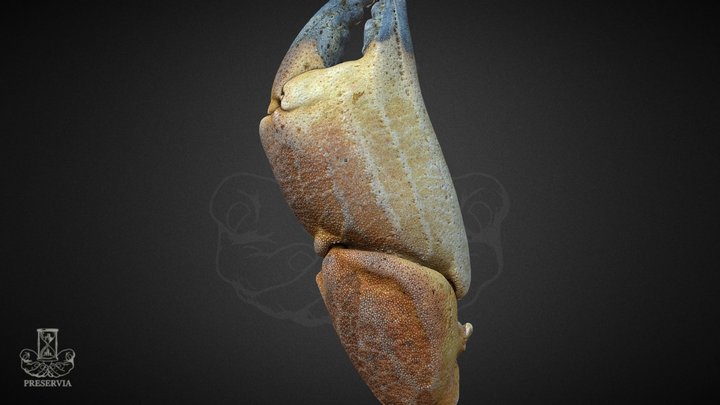
3D model
- Source
- Sketchfab
- Licence
- CC Attribution
- Commercial use
- cannot be read from the licence given — check the record
The description on this site
- Source
- Wikipedia, “Pagurus”
- Licence
- CC BY-SA 4.0
This is what the site found, which is not the same as what exists.
Keep going
What may have been alongside itPaguridae through timeThe world it lived on
Occurrence data from the Paleobiology Database, CC BY 4.0. Fabricius 1775