Oecotraustes
Oecotraustes is an extinct cephalopod genus included in the ammonid family Oppeliidae and named by Wilhelm Waagen in 1869. Species in the genus lived during the Middle Jurassic.
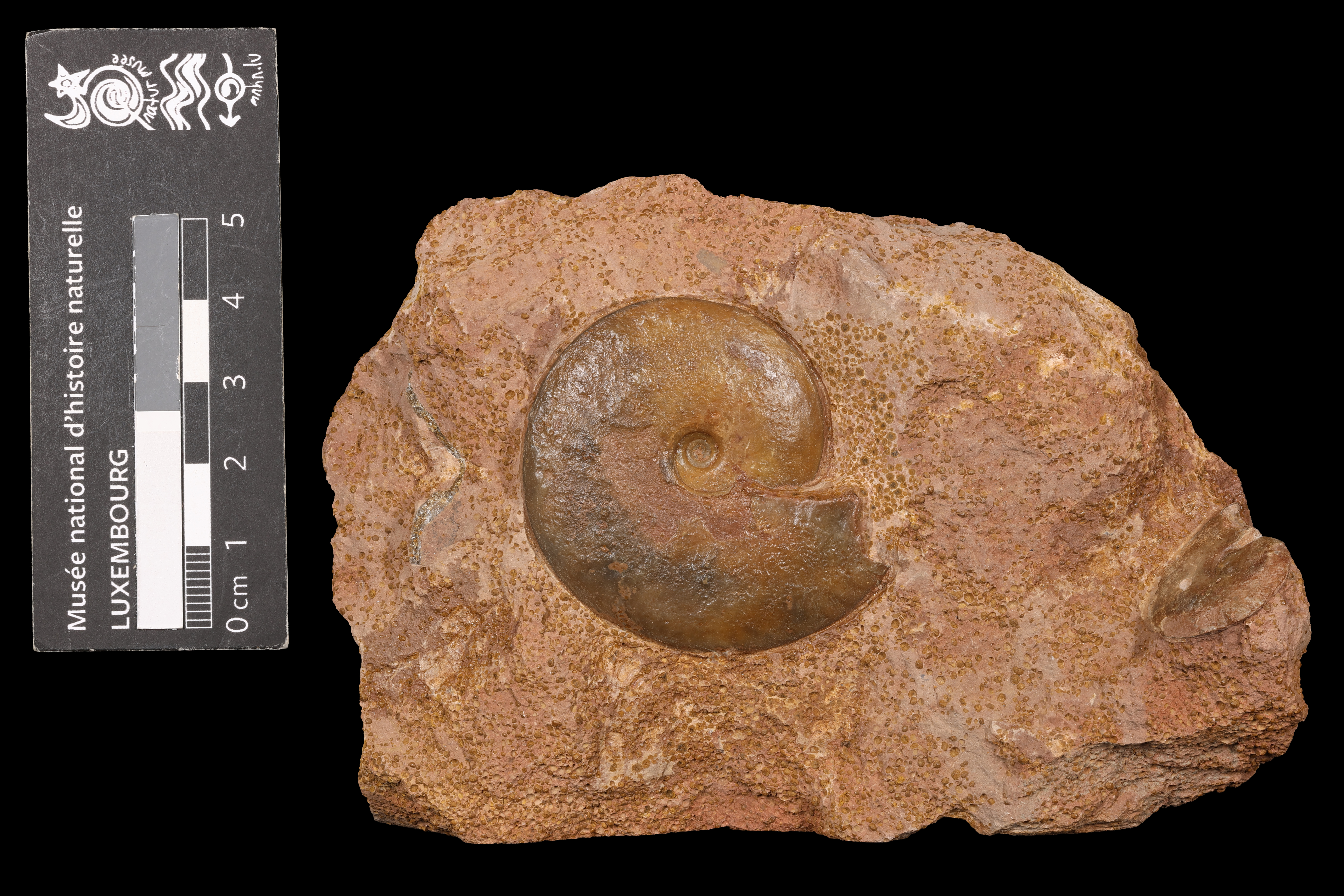
Kurt Meiers · CC0 · via GBIF. May be a photograph of a specimen, or an artist’s reconstruction — an interpretation of a skeleton, since colour and soft tissue are almost never preserved.
On record
Recorded, not inferred- Sits inside
- OppeliidaePBDB
- Diet
- carnivorePBDB, for Ammonoidea
- Life habit
- nektonicPBDB, for Ammonoidea
- Motility
- fast-movingPBDB, for Ammonoidea
- Vision
- well-developedPBDB, for Cephalopoda
- Environment
- marinePBDB, for Cephalopoda
Time the record covers
At least 3.3 million years on record.
The record covers at least 168.6 Mya to 165.3 Mya. No occurrence read is dated outside 170.9 Mya to 161.5 Mya.
28 occurrences of Oecotraustes on record, most of them in the Middle Jurassic. Bar height is expected occurrences, not a count: each fossil is spread across the span it is dated to, so a tall narrow bar means tight dating and a low wide one means loose.
When
28 occurrences- Middle Jurassic100%
These are dates about fossils, not the animal: the record can only begin after it arose and end before it died out, so either end may reach further. Shares are expected occurrences: a fossil dated to a span is counted partly in each period it straddles. More on what this infers.
Found in
13 formations
- "Berching" Formation4
- Tsudakhar Formation4
- Chaloi Formation4
- Habo beds Formation2
- Tuxedni Formation1
- Cuber Formation1
Loading coastlines…
The named rock units Oecotraustes has been recovered from, largest first. Drawn where the rock is now, not where it formed. 5 occurrences have no formation on record, which is common for older literature.
Oecotraustes and its relatives
Middle JurassicWhere Oecotraustes and its relatives were recorded in the Middle Jurassic.
Found in the same rock
233 taxa- Lissoceras oolithicum4 sites
- Oppelia (Oecotraustes) genicularis4 sites
- Bullatimorphites3 sites
- Calliphylloceras disputabile3 sites
- Gervillella3 sites
- Hecticoceras (Sublunuloceras)3 sites
- Nuculoma3 sites
- Oppelia (Oppelia) subradiata3 sites
- Oxycerites3 sites
- Palaeonucula3 sites
- Reineckeia3 sites
- Alcidia2 sites
- Astarte2 sites
- Bositra buchi2 sites
- Cadomites2 sites
- Camptonectes (Camptonectes) auritus2 sites
- Ceratomyopsis2 sites
- Choffatia2 sites
- Coelopis (Coelopis)2 sites
- Grammatodon (Grammatodon)2 sites
- Grammatodon (Indogrammatodon)2 sites
- Hecticoceras2 sites
- Hecticoceras lairense2 sites
- Indonuculana2 sites
The Paleobiology Database records 23 sites for Oecotraustes, and this reads all of them. The number is how many of those sites it was catalogued from too. The 24 sharing the most are listed.
This is not a list of everything alive at the time. It is only what has come out of the same ground as this animal and been written down.
Entered from
15 references- Besnosov and Mitta, 199310
- Zur Stratigraphie des Mittel- und unteren Oberjuras in Sengenthal bei Neumarkt /Opf. (Fränkische Alb) [On the stratigraphy of the Middle and early Upper Jurassic at Sengenthal, near Neumarkt/Opf. (Franconian Alb)]4
- Habo Beds near Ler (Kutch): Pt. 3 - Biostratigraphy of the beds on the east of Ler2
- Late Bajocian and Bathonian (Middle Jurassic) ammonites from the Dalichai Formation north of Damghan (Alborz, North Iran)1
- Bajocian (Middle Jurassic) ammonites of stratigraphical and Palaeobiogeographical importance from Mombasa, Kenya, East Africa1
- Occurrences of the ammonite genus Clydoniceras Blake, 1905 in the Middle Jurassic (Upper Bathonian, Discus Zone) of NW Switzerland1
- Bajocian-Bathonian (Middle Jurassic) ammonites from the Polish Jura. Part 1: Families Phylloceratidae, Nannolytoceratidae, Sonniniidae, Strigoceratidae, Oppeliidae and Lissoceratidae1
- Bajocian ammonites from Msata hill (Lugoba Formation) in the hinterland of Dar es Salaam, Tanzania1
- Paleoecology of Early Bathonian molluscan faunas in the Codlea area (South Carpathians, Romania)1
- Datos preliminares sobre el Bajociense superior en el sector de Coll Baix (Peninsula de Alcudia, Mallorca) [Preliminary data on the Upper Bajocian in the Coll Baix sector, Alcudia Peninsula, Mallorca]1
- Geologie de Madagascar I. Les Terrains Sedimentaires1
- La succession des faunes dans le Callovien Francais, essais de corrélation à l'échelle de la zone1
Each of the 28 occurrences read was entered from one of these publications, ordered by how many each accounts for. This is not a search for papers mentioning the name. 3 further references are not listed. Entries link to doi.org where the Paleobiology Database holds an identifier, and to its own record where it does not. Relayed as the Paleobiology Database holds them, not checked against what they resolve to.
Media and terms
Media content1
Picture of Oecotraustes
- Source
- GBIF
- Credit
- Kurt Meiers
- Licence
- CC0
- Commercial use
- the licence allows it
No 3D scan was found. Smithsonian Open Access, MorphoSource and Sketchfab were all searched.
The description on this site
- Licence
- CC BY-SA 4.0
This is what the site found, which is not the same as what exists.
Keep going
What may have been alongside itOppeliidae through timeFormations of the Middle JurassicThe world it lived on
Occurrence data from the Paleobiology Database, CC BY 4.0. (Waagen 1869)