Mytilus galloprovincialis
The Mediterranean mussel is a species of bivalve, a marine mollusc in the family Mytilidae. It is an invasive species in many parts of the world, and also an object of aquaculture.

Andrey Butko · CC BY-SA 3.0 · via Wikipedia/Commons. May be a photograph of a specimen, or an artist’s reconstruction — an interpretation of a skeleton, since colour and soft tissue are almost never preserved.
On record
Recorded, not inferred- Sits inside
- MytilusPBDB
- Diet
- suspension feederPBDB, for Mytilus
- Life habit
- epifaunalPBDB, for Mytilus
- Motility
- stationary, attachedPBDB, for Mytilus
- Vision
- blindPBDB, for Bivalvia
- Environment
- lagoonal,coastal,inner shelf,outer shelf,oceanic,brackish,freshwaterPBDB, for Mytilidae
Time the record covers
At least 5.3 million years on record.
The record covers at least 5.333 Mya to 11.7 ka. No occurrence read is dated outside 7.246 Mya to 0 Mya.
7 occurrences of Mytilus galloprovincialis on record, most of them in the Pleistocene. The Paleobiology Database records this as a living group. Bar height is expected occurrences, not a count: each fossil is spread across the span it is dated to, so a tall narrow bar means tight dating and a low wide one means loose.
When
7 occurrences- Miocene14%
- Pliocene29%
- Pleistocene43%
- Holocene14%
These are dates about fossils, not the animal: the record can only begin after it arose and end before it died out, so either end may reach further. Shares are expected occurrences: a fossil dated to a span is counted partly in each period it straddles. More on what this infers.
Found in
2 formations
Loading coastlines…
The named rock units Mytilus galloprovincialis has been recovered from, largest first. Drawn where the rock is now, not where it formed. 5 occurrences have no formation on record, which is common for older literature.
Mytilus galloprovincialis and its relatives
PleistoceneWhere Mytilus galloprovincialis and its relatives were recorded in the Pleistocene.
Found in the same rock
299 taxa- Glycymeris4 sites
- Diplodonta (Diplodonta) rotundata3 sites
- Pecten maxima3 sites
- Talochlamys pusio3 sites
- Aequipecten opercularis2 sites
- Anomia ephippium2 sites
- Arcopagia (Arcopagia) crassa2 sites
- Astarte (Digitariopsis) obliquata burtinea2 sites
- Astarte gracilis2 sites
- Astarte incrassata2 sites
- Astarte mutabilis2 sites
- Cardita scalaris2 sites
- Cardita senilis2 sites
- Cerithium (Thericium) vulgatum2 sites
- Cervus elaphus2 sites
- Chama gryphoides2 sites
- Delphinidae2 sites
- Gastrochaena (Rocellaria) dubia2 sites
- Hiatella arctica2 sites
- Isocrassina basteroti2 sites
- Lutraria lutraria2 sites
- Macoma (Macoma) obliqua2 sites
- Nucula (Nucula) nucleus2 sites
- Ostrea edulis2 sites
The Paleobiology Database records 6 sites for Mytilus galloprovincialis, and this reads all of them. The number is how many of those sites it was catalogued from too. The 24 sharing the most are listed.
This is not a list of everything alive at the time. It is only what has come out of the same ground as this animal and been written down.
Entered from
7 references- Ressources complémentaires et mobilité dans le Magdalénien cantabrique. Nouvelles données sur les mammifères marins, les crustacés, les mollusques et les roches organogènes de la Grotte de Las Caldas (Asturies, Espagne)1
- Neanderthal exploitation of marine mammals in Gibraltar1
- Povoado muculmano na Ponta do Castelo (Aljezur)1
- Les formations recifales coralliennes du Miocene superieur d'Algerie et du Maroc [Upper Miocene coral reef formations from Algeria and Morocco]1
- Recherches sur le Neogene et le Quaternaire marins de la cote Atlantique du Maroc1
- Wood, 18791
- Wood, 18501
Each of the 7 occurrences read was entered from one of these publications, ordered by how many each accounts for. This is not a search for papers mentioning the name. Entries link to doi.org where the Paleobiology Database holds an identifier, and to its own record where it does not. Relayed as the Paleobiology Database holds them, not checked against what they resolve to.
Media and terms
Media content2

Picture of Mytilus galloprovincialis
- Source
- Wikipedia/Commons
- Credit
- Andrey Butko
- Licence
- CC BY-SA 3.0
- Commercial use
- the licence allows it
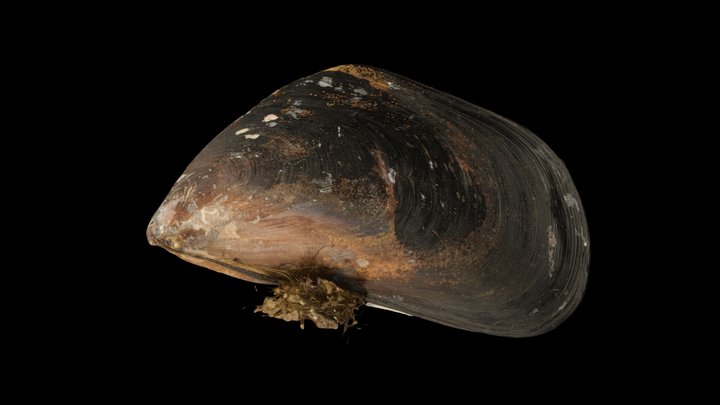
3D model
- Source
- Sketchfab
- Licence
- CC0 Public Domain
- Commercial use
- the licence allows it
Smithsonian Open Access and MorphoSource were not reached for this taxon, so this list is what the others held rather than everything there is.
The description on this site
- Licence
- CC BY-SA 4.0
This is what the site found, which is not the same as what exists.
Keep going
What may have been alongside itMytilus through timeFormations of the PleistoceneThe world it lived on
Occurrence data from the Paleobiology Database, CC BY 4.0. (Lamarck 1819)