Mylodon
Mylodon is an extinct genus of ground sloth belonging to the family Mylodontidae, known from southern South America. With a total length of 3 to 4 m and a body mass of 1-2 tonnes, it is one of the largest mylodontids.

Reinhardt, J. T · Public Domain · via Wikipedia/Commons. May be a photograph of a specimen, or an artist’s reconstruction — an interpretation of a skeleton, since colour and soft tissue are almost never preserved.
On record
Recorded, not inferred- Sits inside
- MylodontiniPBDB
- Diet
- herbivorePBDB, for Mylodontidae
- Life habit
- ground dwellingPBDB, for Mylodontidae
- Motility
- actively mobilePBDB, for Osteichthyes
- Environment
- terrestrialPBDB, for Eutheria
Time the record covers
At least 23 million years on record.
The record covers at least 23.04 Mya to 11.7 ka. No occurrence read is dated outside 27.3 Mya to 0 Mya.
48 occurrences of Mylodon on record, most of them in the Pleistocene. Bar height is expected occurrences, not a count: each fossil is spread across the span it is dated to, so a tall narrow bar means tight dating and a low wide one means loose.
When
48 occurrences- Oligocene2%
- Miocene2%
- Pliocene2%
- Pleistocene89%
- Holocene4%
These are dates about fossils, not the animal: the record can only begin after it arose and end before it died out, so either end may reach further. Shares are expected occurrences: a fossil dated to a span is counted partly in each period it straddles. More on what this infers.
Found in
11 formations
- Nuapua Formation2
- La Invernada Formation1
- Miramar Formation1
- Santa Vitória Formation1
- Blanco Formation1
- San Julian Formation1
Loading coastlines…
The named rock units Mylodon has been recovered from, largest first. Drawn where the rock is now, not where it formed. 36 occurrences have no formation on record, which is common for older literature.
Mylodon and its relatives
PleistoceneWhere Mylodon and its relatives were recorded in the Pleistocene.
Found in the same rock
217 taxa- Equus11 sites
- Gomphotheriidae10 sites
- Hippidion9 sites
- Megatherium americanum8 sites
- Lama guanicoe7 sites
- Glossotherium robustum6 sites
- Glyptodon reticulatus6 sites
- Lestodon armatus6 sites
- Pampatherium6 sites
- Glyptodon5 sites
- Notiomastodon platensis5 sites
- Panochthus tuberculatus5 sites
- Scelidotherium leptocephalum5 sites
- Toxodon5 sites
- Cervidae4 sites
- Macrauchenia patagonica4 sites
- Neosclerocalyptus4 sites
- Panochthus4 sites
- Panthera onca4 sites
- Arctotherium3 sites
- Bison3 sites
- Camelidae3 sites
- Camelops3 sites
- Catonyx tarijensis3 sites
The Paleobiology Database records 42 sites for Mylodon, and this reads all of them. The number is how many of those sites it was catalogued from too. The 24 sharing the most are listed.
This is not a list of everything alive at the time. It is only what has come out of the same ground as this animal and been written down.
Entered from
29 references- Mylodon darwini Owen (Xenarthra, Mylodontinae) from the late Pleistocene of Mesopotamia, Argentina, with remarks on individual variability, paleobiology, paleobiogeography, and paleoenvironment11
- Formas Terminales de Hippidion (Mammalia, Perissodactyla) de los Yacimientos del Pleistoceno Tardio-Holoceno de la Patagonia (Argentina y Chile)4
- The seventh quarterly report covering the quarter ending December 31, 1940 for the state-wide paleontologic-mineralogic survey in Texas3
- On Some Plistocene Mammalia from Petite Anse, La3
- Xenarthrans of the collection of Santiago Roth from the Pampean Region of Argentina (Pleistocene), in Zurich, Switzerland2
- Mamíferos Cenozoicos2
- Biostratigraphy and geochronology of the late Cenozoic of Córdoba Province (central Argentina)1
- The fossil mammals collected by Charles Darwin in South America during his travels on board the HMS Beagle1
- Protocyon troglodytes (Lund) (Mammalia, Carnivora) in the Late Pleistocene of Rio Grande do Sul and their paleoecological significance1
- The Southernmost bear: Pararctotherium (Carnivora, Ursidae, Tremarctinae) in the latest Pleistocene of Southern Patagonia, Chile1
- Le site paléo-indien de Piedra Museo (Patagonie). Sa contribution au débat sur le premier peuplement du continent amérlcaln1
- Informe paleontologico1
Each of the 48 occurrences read was entered from one of these publications, ordered by how many each accounts for. This is not a search for papers mentioning the name. 17 further references are not listed. Entries link to doi.org where the Paleobiology Database holds an identifier, and to its own record where it does not. Relayed as the Paleobiology Database holds them, not checked against what they resolve to.
Media and terms
Media content2

Picture of Mylodon
- Source
- Wikipedia/Commons
- Credit
- Reinhardt, J. T
- Licence
- Public Domain
- Commercial use
- the licence allows it
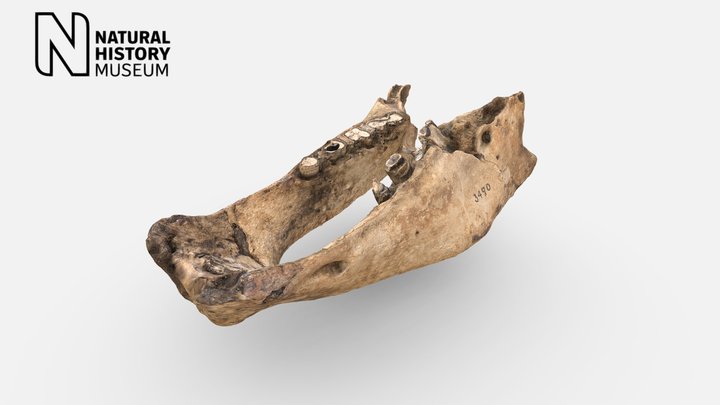
3D model
- Source
- Sketchfab
- Credit
- NHM_Imaging
- Licence
- CC Attribution-NonCommercial
- Commercial use
- the licence does not allow it
Smithsonian Open Access and MorphoSource were not reached for this taxon, so this list is what the others held rather than everything there is.
The description on this site
- Source
- Wikipedia, “Mylodon”
- Licence
- CC BY-SA 4.0
This is what the site found, which is not the same as what exists.
Keep going
What may have been alongside itMylodontini through timeFormations of the PleistoceneThe world it lived on
Occurrence data from the Paleobiology Database, CC BY 4.0. Owen 1859