Moeritherium
Moeritherium is an extinct genus of basal proboscideans from the Eocene of North and West Africa. The first specimen was discovered in strata from the Fayum fossil deposits of Egypt. It was named in 1901 by Charles William Andrews, who suggested that it was an early proboscidean, perhaps ancestral to mastodons, although subsequent workers considered it everything from a relative of manatees to a close relative of both clades' common ancestor. Currently, Moeritherium is seen as a proboscidean that, while fairly basal, diverged before the split between elephantiforms and deinotheres. Seven species have been named, though five are currently considered valid. The name comes from Lake Moeris, and the Ancient Greek θηρίον (thēríon), meaning "beast".

Momotarou2012 · CC BY-SA 3.0 · via Wikipedia/Commons. May be a photograph of a specimen, or an artist’s reconstruction — an interpretation of a skeleton, since colour and soft tissue are almost never preserved.
On record
Recorded, not inferred- Sits inside
- MoeritheriidaePBDB
- Diet
- grazer, browserPBDB, for Proboscidea
- Life habit
- ground dwellingPBDB, for Proboscidea
- Motility
- actively mobilePBDB, for Osteichthyes
- Environment
- terrestrialPBDB, for Eutheria
- Mass
- 235 kgWikidata
Time the record covers
At least 3.3 million years on record.
The record covers at least 41.03 Mya to 37.71 Mya. No occurrence read is dated outside 48.07 Mya to 27.3 Mya.
25 occurrences of Moeritherium on record, most of them in the Eocene. Bar height is expected occurrences, not a count: each fossil is spread across the span it is dated to, so a tall narrow bar means tight dating and a low wide one means loose.
When
25 occurrencesThese are dates about fossils, not the animal: the record can only begin after it arose and end before it died out, so either end may reach further. Shares are expected occurrences: a fossil dated to a span is counted partly in each period it straddles. More on what this infers.
Found in
7 formations
- Qasr el Sagha Formation11
- Qasr el-Sagha Formation4
- Jebel Qatrani Formation3
- Lumachelle calcaire marin Formation1
- Idam Unit Formation1
- Continental terminal Formation1
Loading coastlines…
The named rock units Moeritherium has been recovered from, largest first. Drawn where the rock is now, not where it formed. 3 occurrences have no formation on record, which is common for older literature.
Moeritherium and its relatives
EoceneWhere Moeritherium and its relatives were recorded in the Eocene.
Found in the same rock
89 taxa- Barytherium grave3 sites
- Crocodylia3 sites
- Osteichthyes3 sites
- Pristis3 sites
- Apterodon2 sites
- Basilosaurus2 sites
- Fajumia2 sites
- Lates2 sites
- Myliobatis2 sites
- Ostrea2 sites
- Phiomia minor2 sites
- Testudines2 sites
- Turritella2 sites
- Aetobatus1 site
- Andrewsemys libyca1 site
- Anomaluridae1 site
- Anthracotheriidae1 site
- Anthropoidea1 site
- Apterodon macrognathus1 site
- Apterodon saghensis1 site
- Arsinoitherium1 site
- Arsinoitherium zitteli1 site
- Astrhelia1 site
- Barytherium1 site
The Paleobiology Database records 21 sites for Moeritherium, and this reads all of them. The number is how many of those sites it was catalogued from too. The 24 sharing the most are listed.
This is not a list of everything alive at the time. It is only what has come out of the same ground as this animal and been written down.
Entered from
11 references- New records of terrestrial mammals from the upper Eocene Qasr el Sagha Formation, Fayum Depression, Egypt13
- A Descriptive Catalogue of the Tertiary Vertebrata of Fayum, Egypt3
- A new species of Moeritherium (Proboscidea, Mammalia) from the Eocene of Algeria: New perspectives on the ancestral morphotype of the genus1
- Marine Mammals (Cetacean and Sirenia) from the Eocene of Gebel Mokattam and Fayum, Egypt: Stratigraphy, Age, and Paleoenvironments1
- Palaeogene vertebrate fauna and regressive sediments of Dur at Talhah, southern Sirt Basin, Libya1
- Nouvelles récoltes de serpents fossiles dans l’Éocène Supérieur du désert Libyque1
- Premiere decouverte de Mammiferes dans le Tertiaire (Lutetien) du Senegal1
- Decouverte de genre Moeritherium Andrews dans le Tertiaire continental du Soudan1
- The topography and geology of the Fayum Province of Egypt1
- Neue geologisch-stratigraphische Beobachtungen in Aegypten1
- Preliminary note on some recently discovered extinct vertebrates from Egypt. (Part III)1
Each of the 25 occurrences read was entered from one of these publications, ordered by how many each accounts for. This is not a search for papers mentioning the name. Entries link to doi.org where the Paleobiology Database holds an identifier, and to its own record where it does not. Relayed as the Paleobiology Database holds them, not checked against what they resolve to.
Media and terms
Media content3

Picture of Moeritherium
- Source
- Wikipedia/Commons
- Credit
- Momotarou2012
- Licence
- CC BY-SA 3.0
- Commercial use
- the licence allows it
CT scan
- Source
- MorphoSource
- Licence
- not stated by the source
- Commercial use
- cannot be read from the licence given — check the record
- Specimen
- Moeritherium sp. · dpc:24617
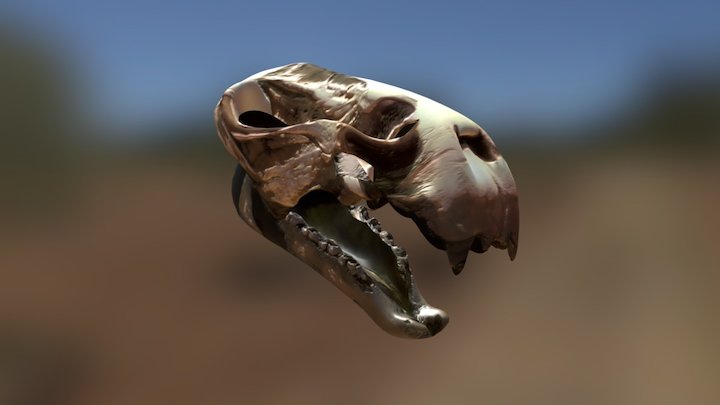
3D model
- Source
- Sketchfab
- Credit
- dario scaramuzza
- Licence
- CC Attribution
- Commercial use
- cannot be read from the licence given — check the record
Smithsonian Open Access was not reached for this taxon, so this list is what the others held rather than everything there is.
The description on this site
- Licence
- CC BY-SA 4.0
This is what the site found, which is not the same as what exists.
Keep going
What may have been alongside itMoeritheriidae through timeFormations of the EoceneThe world it lived on
Occurrence data from the Paleobiology Database, CC BY 4.0. Andrews 1901