Mirounga
Elephant seals or sea elephants are very large, oceangoing true seals in the genus Mirounga. Both species, the northern elephant seal and the southern elephant seal, were hunted to the brink of extinction for lamp oil by the end of the 19th century, but their numbers have since recovered. They are the largest seal species. Males can weigh up to 4,000 kilograms (8,800 lb). Elephant seals get their name from the large proboscis of the adult male, reminiscent of an elephant's trunk.

original image by Jan Roletto, uploaded 18:58, Feb 26, 2004 - de:Wikipedia by de:User:Baldhur , edited by Matthew Field · Public Domain · via Wikipedia/Commons. May be a photograph of a specimen, or an artist’s reconstruction — an interpretation of a skeleton, since colour and soft tissue are almost never preserved.
On record
Recorded, not inferred- Also called
- elephant sealPBDB
- Sits inside
- MonachinaePBDB
- Diet
- piscivore, carnivorePBDB, for Phocidae
- Life habit
- amphibiousPBDB, for Pinnipedia
- Motility
- actively mobilePBDB, for Osteichthyes
- Environment
- marinePBDB, for Pinnipedia
Time the record covers
At least 15 million years on record.
The record covers at least 15.98 Mya to 11.7 ka. No occurrence read is dated outside 20.45 Mya to 0 Mya.
50 occurrences of Mirounga on record. The Paleobiology Database records this as a living group. Bar height is expected occurrences, not a count: each fossil is spread across the span it is dated to, so a tall narrow bar means tight dating and a low wide one means loose.
When
50 occurrences- Miocene2%
- Pleistocene18%
- Holocene80%
These are dates about fossils, not the animal: the record can only begin after it arose and end before it died out, so either end may reach further. Shares are expected occurrences: a fossil dated to a span is counted partly in each period it straddles. More on what this infers.
Found in
2 formations
Loading coastlines…
The named rock units Mirounga has been recovered from, largest first. Drawn where the rock is now, not where it formed. 45 occurrences have no formation on record, which is common for older literature.
Found in the same rock
191 taxa- Arctocephalus pusillus6 sites
- Felis lybica5 sites
- Homo sapiens5 sites
- Hystrix africaeaustralis5 sites
- Lupulella mesomelas5 sites
- Procavia capensis5 sites
- Delphinidae4 sites
- Diceros bicornis4 sites
- Galerella pulverulenta4 sites
- Hippopotamus amphibius4 sites
- Mellivora capensis4 sites
- Papio ursinus4 sites
- Pelea capreolus4 sites
- Pelorovis antiquus4 sites
- Raphicerus4 sites
- Redunca arundinum4 sites
- Redunca fulvorufula4 sites
- Alcelaphus buselaphus3 sites
- Atilax paludinosus3 sites
- Bathyergus suillus3 sites
- Caracal caracal3 sites
- Connochaetes gnou3 sites
- Equus quagga3 sites
- Herpestes ichneumon3 sites
The Paleobiology Database records 50 sites for Mirounga, and this reads all of them. The number is how many of those sites it was catalogued from too. The 24 sharing the most are listed.
This is not a list of everything alive at the time. It is only what has come out of the same ground as this animal and been written down.
Entered from
18 references- Where were the northern elephant seals? Holocene archaeology and biogeography of Mirounga angustirostris27
- Control of growth in two populations of elephant seals6
- Pleistocene vertebrates of the Los Angeles basin and vicinity:(exclusive of Rancho La Brea)2
- Taphonomy of two Holocene penguin taphocoenoses in Potter Peninsula, South Shetland Islands, Antarctica1
- Fin whale (Balaenoptera physalus) bones from a 5850 year old shell midden on San Miguel Island, California, USA1
- Extreme dispersal or human-transport? The enigmatic case of an extralimital freshwater occurrence of a Southern elephant seal from Indiana1
- Elephant seal (Mirounga sp.) from the Pleistocene of the Antofagasta Region, northern Chile1
- The fossil record of elephant seals (Mirounga) in Southern California1
- Review of fossil phocid and otariid seals from the southern and western coasts of South Africa1
- Mid-Holocene macrofossil-bearing raised marine beaches at Potter Peninsula, King George Island, South Shetland Islands1
- Middle and later Stone Age large mammal and tortoise remains from Die Kelders Cave 1, Western Cape Province, South Africa1
- Geology and Palaeobiology of the Central and Southern Namib Desert, Southwestern Africa, Volume 1: Geology and History of Study1
Each of the 50 occurrences read was entered from one of these publications, ordered by how many each accounts for. This is not a search for papers mentioning the name. 6 further references are not listed. Entries link to doi.org where the Paleobiology Database holds an identifier, and to its own record where it does not. Relayed as the Paleobiology Database holds them, not checked against what they resolve to.
Media and terms
Media content2

Picture of Mirounga
- Source
- Wikipedia/Commons
- Credit
- original image by Jan Roletto, uploaded 18:58, Feb 26, 2004 - de:Wikipedia by de:User:Baldhur , edited by Matthew Field
- Licence
- Public Domain
- Commercial use
- the licence allows it
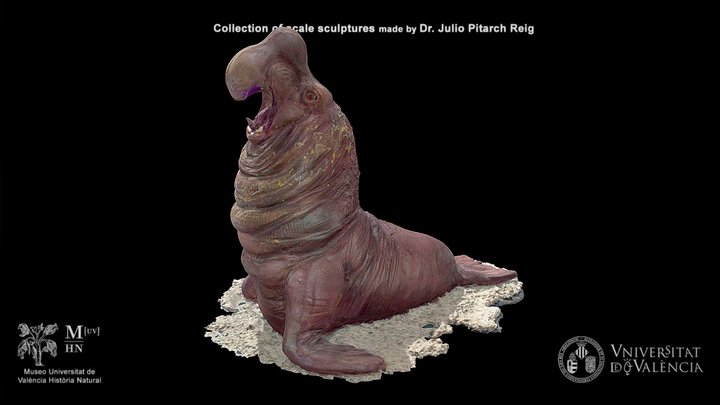
3D model
- Source
- Sketchfab
- Licence
- CC Attribution
- Commercial use
- cannot be read from the licence given — check the record
Smithsonian Open Access and MorphoSource were not reached for this taxon, so this list is what the others held rather than everything there is.
The description on this site
- Licence
- CC BY-SA 4.0
This is what the site found, which is not the same as what exists.
Keep going
What may have been alongside itMonachinae through timeThe world it lived on
Occurrence data from the Paleobiology Database, CC BY 4.0. Gray 1827