Meteoraspis
Meteoraspis is a genus of ptychopariid trilobites of the family Tricrepicephalidae. The various species lived from 501 to 497 million years ago during the Dresbachian faunal stage of the late Cambrian Period. Fossils of Meteoraspis are characteristic of Late Cambrian strata in North America, though they are found in Late Cambrian strata elsewhere in the world, such as M. nevensis from Victoria Land, Antarctica.

Apokryltaros · CC BY-SA 4.0 · via Wikipedia/Commons. May be a photograph of a specimen, or an artist’s reconstruction — an interpretation of a skeleton, since colour and soft tissue are almost never preserved.
On record
Recorded, not inferred- Sits inside
- TricrepicephalidaePBDB
- Diet
- carnivorePBDB, for Trilobita
- Life habit
- low-level epifaunalPBDB, for Trilobita
- Motility
- fast-movingPBDB, for Trilobita
- Vision
- well-developedPBDB, for Tricrepicephalidae
- Environment
- marinePBDB, for Trilobita
Time the record covers
At least 2.5 million years on record.
The record covers at least 499.5 Mya to 497 Mya. No occurrence read is dated outside 506.5 Mya to 486.85 Mya.
42 occurrences of Meteoraspis on record, most of them in the Cambrian. Bar height is expected occurrences, not a count: each fossil is spread across the span it is dated to, so a tall narrow bar means tight dating and a low wide one means loose.
When
42 occurrences- Cambrian100%
These are dates about fossils, not the animal: the record can only begin after it arose and end before it died out, so either end may reach further. Shares are expected occurrences: a fossil dated to a span is counted partly in each period it straddles. More on what this infers.
Found in
15 formations
- Riley Formation18
- Deadwood Formation5
- Orr Formation3
- Pilgrim Formation2
- Huaqiao Formation2
- Conococheague Formation1
Loading coastlines…
The named rock units Meteoraspis has been recovered from, largest first. Drawn where the rock is now, not where it formed. 2 occurrences have no formation on record, which is common for older literature.
Meteoraspis and its relatives
CambrianWhere Meteoraspis and its relatives were recorded in the Cambrian.
Found in the same rock
199 taxa- Blountia11 sites
- Coosella11 sites
- Porifera11 sites
- Tricrepicephalus coria11 sites
- Kingstonia10 sites
- Tricrepicephalus9 sites
- Kormagnostus seclusus8 sites
- Opisthotreta depressa8 sites
- Syspacheilus7 sites
- Arapahoia5 sites
- Crepicephalus5 sites
- Genevievella5 sites
- Menomonia5 sites
- Arcuolimbus convexus4 sites
- Coosia4 sites
- Coosina ariston4 sites
- Dicellomus4 sites
- Diraphora4 sites
- Dresbachia4 sites
- Hardyoides tenerus4 sites
- Hyolithes4 sites
- Kingstonia pontotocensis4 sites
- Kinsabia variegata4 sites
- Kormagnostus4 sites
The Paleobiology Database records 39 sites for Meteoraspis, and this reads all of them. The number is how many of those sites it was catalogued from too. The 24 sharing the most are listed.
This is not a list of everything alive at the time. It is only what has come out of the same ground as this animal and been written down.
Entered from
18 references- The Faunas of the Riley Formation in Central Texas18
- Upper Cambrian Orr Formation: Its Subdivisions and Correlatives in Western Utah3
- Corynexochida, Lichida and Asaphida2
- unpublished data2
- Trilobites, Biostratigraphy, and Lithostratigraphy of the Crepicephalus and Aphelaspis zones, Lower Deadwood formation (Marjuman and Steptoean Stages, Upper Cambrian), Black Hills, South Dakota2
- Trilobites from the Cedarina dakotaensis zone, lowermost part of the Deadwood Formation, (Marjuman Stage, Upper Cambrian), Black Hills South Dakota2
- Middle and upper Cambrian Faunas from western Newfoundland2
- Paleoecology of Cambrian-Ordovician marine communities of Arivechi, eastern Sonora, Mexico: paleoenvironmental considerations1
- Trilobites from the Cedaria prolifica Zone (Cambrian, upper Guzhangian) of the Precordillera of Mendoza, western Argentina1
- The diverse radiodont fauna from the Marjum Formation of Utah, USA (Cambrian: Drumian)1
- Trilobite biostratigraphy of the Cambrian 5 and Drumian stages, Series 3 (Laurentian Delamaran, Topazan, and Marjuman stages, Lincolnian Series) of the lower Emigrant Formation at Clayton Ridge, Esmeralda County, Nevada1
- An 'Acmarhachis typicalis' zone trilobite fauna from the Cambrian of Northern Victoria Land, Antarctica1
Each of the 42 occurrences read was entered from one of these publications, ordered by how many each accounts for. This is not a search for papers mentioning the name. 6 further references are not listed. Entries link to doi.org where the Paleobiology Database holds an identifier, and to its own record where it does not. Relayed as the Paleobiology Database holds them, not checked against what they resolve to.
Media and terms
Media content1
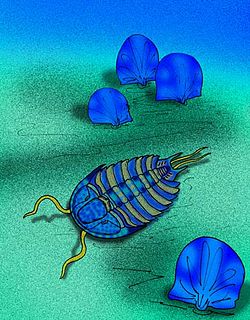
Picture of Meteoraspis
- Source
- Wikipedia/Commons
- Credit
- Apokryltaros
- Licence
- CC BY-SA 4.0
- Commercial use
- the licence allows it
No 3D scan of Meteoraspis was found in Sketchfab.
Smithsonian Open Access and MorphoSource were not reached for this taxon, so this list is what the others held rather than everything there is.
The description on this site
- Source
- Wikipedia, “Meteoraspis”
- Licence
- CC BY-SA 4.0
This is what the site found, which is not the same as what exists.
Keep going
What may have been alongside itTricrepicephalidae through timeFormations of the CambrianThe world it lived on
Occurrence data from the Paleobiology Database, CC BY 4.0. Resser 1935