Megacamelus
Megacamelus is an extinct genus of terrestrial herbivore in the family Camelidae, endemic to North America from the Miocene through Pliocene 10.3—4.9 mya, existing for approximately 5.4 million years.
No picture of Megacamelus was found. Wikipedia, Wikidata and iDigBio were searched and had none. Smithsonian Open Access did not answer, so this is what the others held rather than everything there is. GBIF was asked, and what came back is not recorded: nothing, or a picture this site could not tie to Megacamelus, or no answer at all. This entry cannot say which.
On record
Recorded, not inferred- Sits inside
- CameliniPBDB
- Diet
- browser, browserPBDB, for Camelidae
- Life habit
- ground dwellingPBDB, for Camelidae
- Motility
- actively mobilePBDB, for Osteichthyes
- Environment
- terrestrialPBDB, for Artiodactyla
Time the record covers
At most 4.7 million years on record.
Every occurrence read is dated to somewhere between 9.4 Mya and 4.7 Mya, and nothing in the dating separates them, so that window is what the record shows rather than a span.
4 occurrences of Megacamelus on record, most of them in the Miocene. Bar height is expected occurrences, not a count: each fossil is spread across the span it is dated to, so a tall narrow bar means tight dating and a low wide one means loose.
When
4 occurrencesThese are dates about fossils, not the animal: the record can only begin after it arose and end before it died out, so either end may reach further. Shares are expected occurrences: a fossil dated to a span is counted partly in each period it straddles. More on what this infers.
Found in
2 formations
Loading coastlines…
The named rock units Megacamelus has been recovered from, largest first. Drawn where the rock is now, not where it formed. 2 occurrences have no formation on record, which is common for older literature.
Megacamelus and its relatives
MioceneWhere Megacamelus and its relatives were recorded in the Miocene.
Found in the same rock
115 taxa- <Voorhies cricetid>2 sites
- Agriotherium2 sites
- Antilocapridae2 sites
- Apalone2 sites
- Aphelops mutilus2 sites
- Bensonomys2 sites
- Borophagus2 sites
- Brachyopsigale dubius2 sites
- Bufo2 sites
- Bufo holmani2 sites
- Buisnictis schoffi2 sites
- Castor californicus2 sites
- Chrysemys picta2 sites
- Citellus (Otospermophilus) matthewi2 sites
- Citellus (Otospermophilus) shotwelli2 sites
- Colubrinae2 sites
- Crotalus2 sites
- Dinohippus2 sites
- Dipoides2 sites
- Elaphe obsoleta2 sites
- Epigaulus hatcheri2 sites
- Geochelone2 sites
- Gomphotheriidae2 sites
- Hesperoscalops mcgrewi2 sites
The Paleobiology Database records 4 sites for Megacamelus, and this reads all of them. The number is how many of those sites it was catalogued from too. The 24 sharing the most are listed.
This is not a list of everything alive at the time. It is only what has come out of the same ground as this animal and been written down.
Entered from
3 references- Vertebrate biostratigraphy of the Ogallala Group in Nebraska2
- An additional occurrence of the genus Simocyon (Mammalia, Carnivora, Procyonidae) in North America1
- Extinct vertebrate faunas of the badlands of Bautista Creek and San Timoteo Canyon, southern California1
Each of the 4 occurrences read was entered from one of these publications, ordered by how many each accounts for. This is not a search for papers mentioning the name. Each entry links to the Paleobiology Database's own record for the work.
Media and terms
Media content1
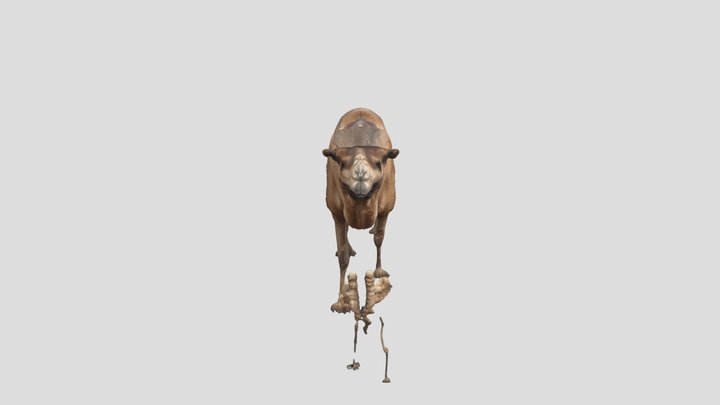
3D model
- Source
- Sketchfab
- Credit
- Rainbow Yoshi Gun
- Licence
- CC Attribution
- Commercial use
- cannot be read from the licence given — check the record
No picture of Megacamelus was found. Wikipedia, Wikidata and iDigBio were searched and had none.
Smithsonian Open Access did not answer, so this is what the others held rather than everything there is.
GBIF was asked, and what came back is not recorded: nothing, or a picture this site could not tie to Megacamelus, or no answer at all. This entry cannot say which.
Smithsonian Open Access and MorphoSource were not reached for this taxon, so this list is what the others held rather than everything there is.
The description on this site
- Source
- Wikipedia, “Megacamelus”
- Licence
- CC BY-SA 4.0
This is what the site found, which is not the same as what exists.
Keep going
What may have been alongside itCamelini through timeFormations of the MioceneThe world it lived on
Occurrence data from the Paleobiology Database, CC BY 4.0. Frick 1929