Lycidae
The Lycidae are a family in the beetle order Coleoptera, members of which are commonly called net-winged beetles. These beetles are cosmopolitan, being found in Nearctic, Palearctic, Neotropical, Afrotropical, Oriental, and Australian ecoregions.

fir0002 flagstaffotos [at] gmail.com Canon 20D + Sigma 150mm f/2.8 + Canon MT 24-EX · GFDL 1.2 · via Wikipedia/Commons. May be a photograph of a specimen, or an artist’s reconstruction — an interpretation of a skeleton, since colour and soft tissue are almost never preserved.
On record
Recorded, not inferred- Also called
- net-winged beetlePBDB
- Sits inside
- ElateroideaPBDB
- Motility
- actively mobilePBDB, for Arthropoda
- Environment
- terrestrialPBDB, for Insecta
Time the record covers
At least 73 million years on record.
The record covers at least 93.9 Mya to 20.45 Mya. No occurrence read is dated outside 100.5 Mya to 13.82 Mya.
22 occurrences of Lycidae on record, most of them in the Eocene. The Paleobiology Database records this as a living group, and the chart stops with its fossils rather than at the present. Bar height is expected occurrences, not a count: each fossil is spread across the span it is dated to, so a tall narrow bar means tight dating and a low wide one means loose.
When
22 occurrences- Late Cretaceous14%
- Eocene55%
- Miocene32%
These are dates about fossils, not the animal: the record can only begin after it arose and end before it died out, so either end may reach further. Shares are expected occurrences: a fossil dated to a span is counted partly in each period it straddles. More on what this infers.
Found in
3 formations
Loading coastlines…
The named rock units Lycidae has been recovered from, largest first. Drawn where the rock is now, not where it formed. 19 occurrences have no formation on record, which is common for older literature.
Lycidae and its relatives
EoceneWhere Lycidae and its relatives were recorded in the Eocene.
Found in the same rock
2,462 taxa- Forcipomyia5 sites
- Monogedania clunipes4 sites
- Brachypogon (Isohelea) prominulus3 sites
- Ceratopogon3 sites
- Cheilotrichia (Empeda) pawlowskii3 sites
- Dasyhelea3 sites
- Dicranomyia (Dicranomyia) lobata3 sites
- Forcipomyia (Forcipomyia)3 sites
- Formica flori3 sites
- Kroeberiella pinguis3 sites
- Palaeoapsilocephala pusilla3 sites
- Psocidus multiplex3 sites
- Reticulitermes antiquus3 sites
- Termopsis bremii3 sites
- Adorator hispidus2 sites
- Amphientomum paradoxum2 sites
- Anyphaena fuscata2 sites
- Aploceble (Aploceble) berendti2 sites
- Apocephalus succineus2 sites
- Archaeoellipes engeli2 sites
- Archaeterphis hennigi2 sites
- Archipseudophasma2 sites
- Archipseudophasmatidae2 sites
- Archipsocus puber2 sites
The Paleobiology Database records 17 sites for Lycidae, and this reads all of them. The number is how many of those sites it was catalogued from too. The 24 sharing the most are listed.
This is not a list of everything alive at the time. It is only what has come out of the same ground as this animal and been written down.
Entered from
18 references- Three new genera of fossil Lycidae from Baltic amber (Coleoptera, Lycidae)3
- Dominican amber net‑winged beetles suggest stable paleoenvironment as a driver for conserved morphology in a paedomorphic lineage2
- A new fossil genus of net-winged beetles, with a brief review of amber Lycidae (Insecta: Coleoptera)2
- Domipteron, a new genus of Calopterini from Miocene Dominican amber (Coleoptera: Elateroidea: Lycidae)1
- Eocene aposematic patterns persist in modern European Lycidae beetles despite the absence of co-mimics1
- Falsoceratoprion fumagalliae, new genus and species: the first Calopterini from Dominican amber (Coleoptera: Lycidae)1
- New genus of erotine net-winged beetles, Damzenium gen. nov. (Coleoptera: Lycidae), from Eocene Rovno amber1
- Imprint of a Helcophorus Fairmaire, 1881: the first net-winged beetle (Coleoptera: Lycidae) from Rovno amber1
- Murcybolus gen. nov., a new net-winged beetle genus from mid-Cretaceous Burmese amber (Coleoptera: Lycidae: Burmolycini)1
- First fossil representative of the net-winged beetles genus Plateros Bourgeois, 1879 (Insecta: Coleoptera: Lycidae) from Mexican amber, with redescription of Electropteron avus gen.n., sp.n. from Dominican amber and a note on the time of origin of the family1
- The discovery of Burmolycus compactus gen. et sp. nov. from the mid-Cretaceous of Myanmar provides the evidence for early diversification of net-winged beetles (Coleoptera, Lycidae)1
- Protolycus gedaniensis gen. et sp. nov., the first Baltic amber representative of Lycini (Coleoptera: Lycidae: Lycinae)1
Each of the 22 occurrences read was entered from one of these publications, ordered by how many each accounts for. This is not a search for papers mentioning the name. 6 further references are not listed. Entries link to doi.org where the Paleobiology Database holds an identifier, and to its own record where it does not. Relayed as the Paleobiology Database holds them, not checked against what they resolve to.
Media and terms
Media content1
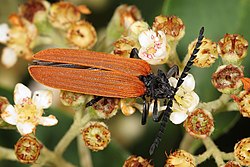
Picture of Lycidae
- Source
- Wikipedia/Commons
- Credit
- fir0002 flagstaffotos [at] gmail.com Canon 20D + Sigma 150mm f/2.8 + Canon MT 24-EX
- Licence
- GFDL 1.2
- Commercial use
- the licence allows it
No 3D scan was found. Smithsonian Open Access, MorphoSource and Sketchfab were all searched.
The description on this site
- Source
- Wikipedia, “Lycidae”
- Licence
- CC BY-SA 4.0
This is what the site found, which is not the same as what exists.
Keep going
What may have been alongside itElateroidea through timeFormations of the EoceneThe world it lived on
Occurrence data from the Paleobiology Database, CC BY 4.0. Laporte 1836