Luprisca incuba
Luprisca incuba is an extinct species of ostracod crustacean. It was described as a new species in 2014, following discovery and analysis of fossilized specimens in mudstone rocks from New York, United States. A team of researchers from the universities of Yale and Kansas, Oxford and the Japan Agency of Marine Science and Technology made the discovery.

Uncredited · via Wikipedia/Commons. May be a photograph of a specimen, or an artist’s reconstruction — an interpretation of a skeleton, since colour and soft tissue are almost never preserved.
On record
Recorded, not inferred- Sits inside
- LupriscaPBDB
- Diet
- suspension feeder, detritivorePBDB, for Myodocopida
- Life habit
- planktonicPBDB, for Myodocopida
- Motility
- actively mobilePBDB, for Ostracoda
- Vision
- limitedPBDB, for Myodocopida
- Environment
- marinePBDB, for Ostracoda
Time the record covers
At most 7.6 million years on record.
The one occurrence read is dated to somewhere between 452.8 Mya and 445.2 Mya, which is a dating window rather than a span.
1 occurrence of Luprisca incuba on record, most of them in the Ordovician. Bar height is expected occurrences, not a count: each fossil is spread across the span it is dated to, so a tall narrow bar means tight dating and a low wide one means loose.
When
1 occurrences- Ordovician100%
These are dates about fossils, not the animal: the record can only begin after it arose and end before it died out, so either end may reach further. Shares are expected occurrences: a fossil dated to a span is counted partly in each period it straddles. More on what this infers.
Found in
1 formation
Loading coastlines…
The named rock units Luprisca incuba has been recovered from, largest first. Drawn where the rock is now, not where it formed.
Luprisca incuba and its relatives
OrdovicianWhere Luprisca incuba and its relatives were recorded in the Ordovician.
Found in the same rock
26 taxa- Aparchites1 site
- Arthrostylus1 site
- Camarotoechia1 site
- Climacograptus1 site
- Crinoiodea indet.1 site
- Cryptolithus tessellatus1 site
- Dendroidea1 site
- Inocaulis1 site
- Lepidocoleus jamesi1 site
- Leptobolus insignis1 site
- Lingulasma progne1 site
- Lomankus edgecombei1 site
- Mastigograptus1 site
- Mesopalaeaster lanceolatus1 site
- Nectocotis rusmithi1 site
- Ogmocnemis beecheri1 site
- Orbicula filosa1 site
- Orbiculoidea1 site
- Polyplectella1 site
- Primaspis1 site
- Primitia1 site
- Protoscolex1 site
- Rhytimya1 site
- Serpulites1 site
The Paleobiology Database records 1 site for Luprisca incuba, and this reads all of them. The number is how many of those sites it was catalogued from too. The 24 sharing the most are listed.
This is not a list of everything alive at the time. It is only what has come out of the same ground as this animal and been written down.
Entered from
1 referenceEach of the 1 occurrence read was entered from one of these publications, ordered by how many each accounts for. This is not a search for papers mentioning the name. Each entry links to doi.org. Relayed as the Paleobiology Database holds them, not checked against what they resolve to.
Media and terms
Media content1
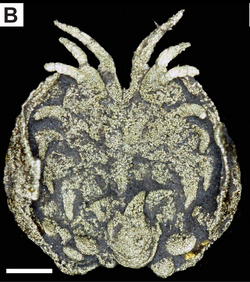
Picture of Luprisca incuba
- Source
- Wikipedia/Commons
- Credit
- nobody named on the record
- Licence
- not stated by the source
- Commercial use
- cannot be read from the licence given — check the record
No 3D scan of Luprisca incuba was found in Sketchfab.
Smithsonian Open Access and MorphoSource were not reached for this taxon, so this list is what the others held rather than everything there is.
The description on this site
- Source
- Wikipedia, “Luprisca”
- Licence
- CC BY-SA 4.0
This is what the site found, which is not the same as what exists.
Keep going
What may have been alongside itLuprisca through timeFormations of the OrdovicianThe world it lived on
Occurrence data from the Paleobiology Database, CC BY 4.0. Siveter et al. 2014