Lophophyllidiidae
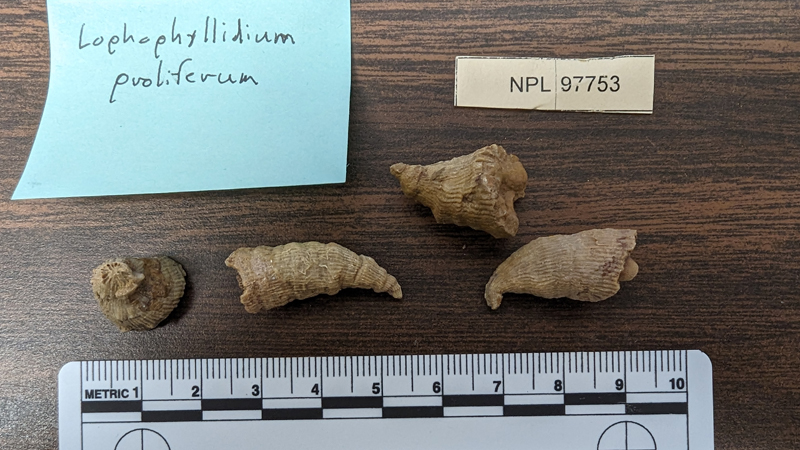
Not Lophophyllidiidae. This is Lophophyllidium proliferum (McChesney, 1860), a relative — both are Lophophyllidiidae.
Heuer, Edward · CC0 · via GBIF. May be a photograph of a specimen, or an artist’s reconstruction — an interpretation of a skeleton, since colour and soft tissue are almost never preserved.
On record
Recorded, not inferred- Sits inside
- StauriidaPBDB
- Diet
- suspension feederPBDB, for Rugosa
- Life habit
- epifaunalPBDB, for Rugosa
- Motility
- stationary, attachedPBDB, for Rugosa
- Vision
- blindPBDB, for Anthozoa
- Environment
- marinePBDB, for Rugosa
Time the record covers
At least 71 million years on record.
The record covers at least 335.9 Mya to 264.28 Mya. No occurrence read is dated outside 346.7 Mya to 259.857 Mya.
18 occurrences of Lophophyllidiidae on record, most of them in the Permian. Bar height is expected occurrences, not a count: each fossil is spread across the span it is dated to, so a tall narrow bar means tight dating and a low wide one means loose.
When
18 occurrences- Carboniferous39%
- Permian61%
These are dates about fossils, not the animal: the record can only begin after it arose and end before it died out, so either end may reach further. Shares are expected occurrences: a fossil dated to a span is counted partly in each period it straddles. More on what this infers.
Found in
8 formations
- Gaptank Formation5
- Sisophon Formation5
- Aheimer Formation1
- Neal Ranch Formation1
- Hess Formation1
- Zrigat Formation1
Loading coastlines…
The named rock units Lophophyllidiidae has been recovered from, largest first. Drawn where the rock is now, not where it formed. 2 occurrences have no formation on record, which is common for older literature.
Lophophyllidiidae and its relatives
PermianWhere Lophophyllidiidae and its relatives were recorded in the Permian.
Found in the same rock
167 taxa- Pseudowannerophyllum solidum7 sites
- Khmerophyllum cambodgense6 sites
- Meekella prionota4 sites
- Nudauris splendens4 sites
- Teguliferina boesei4 sites
- Allotropiochisma (Alligia) flabellum3 sites
- Composita3 sites
- Enteletes wolfcampensis3 sites
- Hystriculina sulcata3 sites
- Kutorginella uddeni3 sites
- Limbella wolfcampensis3 sites
- Linoproductus3 sites
- Lophophyllidium (Lophophyllidium) dunbari3 sites
- Neochonetes (Huangichonetes) costellata3 sites
- Neochonetes liratus3 sites
- Reticulatia3 sites
- Acosarina2 sites
- Allotropiophyllum2 sites
- Amplexizaphrentis2 sites
- Amplexocarinia2 sites
- Derbyia2 sites
- Dibunophyllum2 sites
- Eolyttonia fredericksi2 sites
- Eridmatus marathonensis2 sites
The Paleobiology Database records 14 sites for Lophophyllidiidae, and this reads all of them. The number is how many of those sites it was catalogued from too. The 24 sharing the most are listed.
This is not a list of everything alive at the time. It is only what has come out of the same ground as this animal and been written down.
Entered from
8 references- Pennsylvanian, Permian rugose corals, Glass Mountains, Texas5
- Les madreporaires paleozoiques du Viet-Nam, du Laos, et du Cambodge5
- Upper Paleozoic rugose corals from southwestern Texas and adjacent areas: Gaptank Formation and Wolfcampian corals3
- Ecological aspects of upper Carboniferous - lower Permian 'Cyathaxonia Fauna' taxonomical diversity (the Urals)1
- Middle Artinskian (Early Permian) ecological event: a case study of the Urals and northern Timan1
- An exhumed Palaeozoic underwater scenery: the Visean mud mounds of eastern Anti-Atlas (Morocco)1
- Late Carboniferous solitary rugose corals from the western side of the Gulf of Suez, Egypt1
- Coral and fusuline faunas from the Kabin Buri area, east central Thailand1
Each of the 18 occurrences read was entered from one of these publications, ordered by how many each accounts for. This is not a search for papers mentioning the name. Entries link to doi.org where the Paleobiology Database holds an identifier, and to its own record where it does not. Relayed as the Paleobiology Database holds them, not checked against what they resolve to.
Media and terms
Media content1
Picture of Lophophyllidium proliferum (McChesney, 1860)
- Source
- GBIF
- Credit
- Heuer, Edward
- Licence
- CC0
- Commercial use
- the licence allows it
No 3D scan of Lophophyllidiidae was found in Sketchfab.
Smithsonian Open Access and MorphoSource were not reached for this taxon, so this list is what the others held rather than everything there is.
This is what the site found, which is not the same as what exists.
Keep going
What may have been alongside itStauriida through timeFormations of the PermianThe world it lived on
Occurrence data from the Paleobiology Database, CC BY 4.0. Moore and Jeffords 1945