Lamna nasus
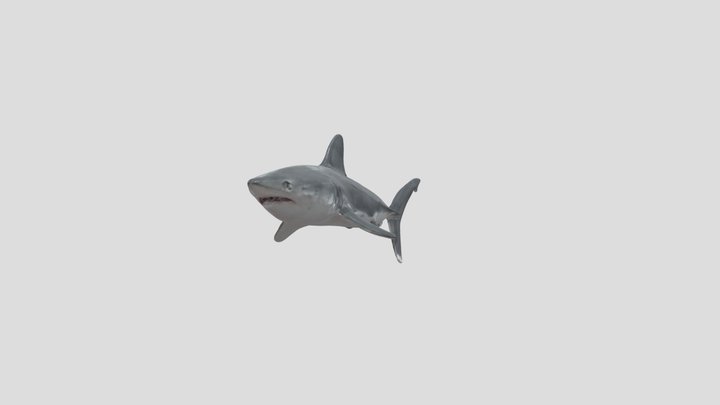
The porbeagle or porbeagle shark is a species of mackerel shark in the family Lamnidae, distributed widely in the cold and temperate marine waters of the North Atlantic and Southern Hemisphere. In the North Pacific, its ecological equivalent is the closely related salmon shark (L. ditropis). It typically reaches 2.5 m (8.2 ft) in length and a weight of 135 kg (298 lb); North Atlantic sharks grow larger than Southern Hemisphere sharks and differ in coloration and aspects of life history. Grey above and white below, the porbeagle has a very stout midsection that tapers towards the long, pointed snout and the narrow base of the tail. It has large pectoral and first dorsal fins, tiny pelvic, second dorsal, and anal fins, and a crescent-shaped caudal fin. The most distinctive features of this species are its three-cusped teeth, the white blotch at the aft base of its first dorsal fin, and the two pairs of lateral keels on its tail.

NOAA · Public Domain · via Wikipedia/Commons. May be a photograph of a specimen, or an artist’s reconstruction — an interpretation of a skeleton, since colour and soft tissue are almost never preserved.
On record
Recorded, not inferred- Also called
- porbeaglePBDB
- Sits inside
- LamnaPBDB
- Diet
- carnivorePBDB, for Lamniformes
- Life habit
- nektonicPBDB, for Lamniformes
- Motility
- actively mobilePBDB, for Lamniformes
Time the record covers
At least 1.7 million years on record.
The record covers at least 5.333 Mya to 3.6 Mya. No occurrence read is dated outside 23.04 Mya to 2.58 Mya.
5 occurrences of Lamna nasus on record, most of them in the Pliocene. The Paleobiology Database records this as a living group, and the chart stops with its fossils rather than at the present. Bar height is expected occurrences, not a count: each fossil is spread across the span it is dated to, so a tall narrow bar means tight dating and a low wide one means loose.
When
5 occurrencesThese are dates about fossils, not the animal: the record can only begin after it arose and end before it died out, so either end may reach further. Shares are expected occurrences: a fossil dated to a span is counted partly in each period it straddles. More on what this infers.
Found in
5 formations
- Bredasdorp & Varswater Formation1
- Breda Formation1
- Argille Azzurre Formation1
- Kattendijk Formation1
- Lillo Formation1
Loading coastlines…
The named rock units Lamna nasus has been recovered from, largest first. Drawn where the rock is now, not where it formed.
Lamna nasus and its relatives
PlioceneWhere Lamna nasus and its relatives were recorded in the Pliocene.
Found in the same rock
87 taxa- Cetorhinus maximus3 sites
- Hexanchus griseus3 sites
- Isurus oxyrinchus3 sites
- Pristiophorus2 sites
- Squalus acanthias2 sites
- Squatina2 sites
- Aetobatus arcuatus1 site
- Alopias superciliosus1 site
- Balaenopteridae1 site
- Bathygadus1 site
- Canis1 site
- Carcharhinus acanthodon1 site
- Carcharhinus perezi1 site
- Carcharhinus plumbeus1 site
- Carcharhinus priscus1 site
- Carcharias1 site
- Carcharias taurus1 site
- Carcharodon hastalis1 site
- Carcharomodus escheri1 site
- Centrophorus granulosus1 site
- Ceratoscopelus maderensis1 site
- Ceratotherium1 site
- Charcharias ferox1 site
- Charcharias sp.1 site
The Paleobiology Database records 5 sites for Lamna nasus, and this reads all of them. The number is how many of those sites it was catalogued from too. The 24 sharing the most are listed.
This is not a list of everything alive at the time. It is only what has come out of the same ground as this animal and been written down.
Entered from
5 references- The porbeagle shark, Lamna nasus (Elasmobranchii: Lamniformes), from the late Pliocene of the central Mediterranean Basin1
- A partial rostrum of the porbeagle shark Lamna nasus (Lamniformes, Lamnidae) from the Miocene of the North Sea Basin and the taxonomic importance of rostral morphology in extinct sharks1
- Fossiles de Belgique. Dents de Requins et de Raies du Tertiare de la Belgique1
- The Pliocene fossil occurences in 'E' Quarry, Langebaanweg, South Africa1
- Quelques restes de sélaciens récoltés dans les sables du Kattendijk à Kallo. I. Selachii - Euselachii1
Each of the 5 occurrences read was entered from one of these publications, ordered by how many each accounts for. This is not a search for papers mentioning the name. Entries link to doi.org where the Paleobiology Database holds an identifier, and to its own record where it does not. Relayed as the Paleobiology Database holds them, not checked against what they resolve to.
Media and terms
Media content3

Picture of Lamna nasus
- Source
- Wikipedia/Commons
- Credit
- NOAA
- Licence
- Public Domain
- Commercial use
- the licence allows it
CT scan
- Source
- MorphoSource
- Licence
- not stated by the source
- Commercial use
- cannot be read from the licence given — check the record
- Specimen
- Lamna nasus · L-MEP:LN650_248.0FL_female
Smithsonian Open Access was not reached for this taxon, so this list is what the others held rather than everything there is.
The description on this site
- Source
- Wikipedia, “Porbeagle”
- Licence
- CC BY-SA 4.0
This is what the site found, which is not the same as what exists.
Keep going
What may have been alongside itLamna through timeFormations of the PlioceneThe world it lived on
Occurrence data from the Paleobiology Database, CC BY 4.0. (Bonnaterre 1788)