Isognomon (Isognomon)
No picture of Isognomon (Isognomon) was found. Wikipedia, Wikidata, iDigBio and Smithsonian Open Access were searched and had none. GBIF was asked, and what came back is not recorded: nothing, or a picture this site could not tie to Isognomon (Isognomon), or no answer at all. This entry cannot say which.
On record
Recorded, not inferred- Sits inside
- IsognomonPBDB
- Diet
- suspension feederPBDB, for Isognomon
- Life habit
- epifaunalPBDB, for Isognomon
- Motility
- stationary, attachedPBDB, for Isognomon
- Vision
- blindPBDB, for Bivalvia
- Environment
- marine,brackishPBDB, for Ostreida
Time the record covers
At least 182 million years on record.
The record covers at least 205.7 Mya to 23.04 Mya. No occurrence read is dated outside 227.3 Mya to 15.98 Mya.
49 occurrences of Isognomon (Isognomon) on record, most of them in the Late Triassic. The Paleobiology Database records this as a living group, and the chart stops with its fossils rather than at the present. Bar height is expected occurrences, not a count: each fossil is spread across the span it is dated to, so a tall narrow bar means tight dating and a low wide one means loose.
When
49 occurrences- Late Triassic22%
- Early Jurassic12%
- Middle Jurassic3%
- Late Jurassic20%
- Early Cretaceous6%
- Late Cretaceous8%
- Eocene14%
- Oligocene2%
- Miocene12%
These are dates about fossils, not the animal: the record can only begin after it arose and end before it died out, so either end may reach further. Shares are expected occurrences: a fossil dated to a span is counted partly in each period it straddles. More on what this infers.
Found in
23 formations
- Vaqueros Formation6
- Kahuitara Tuff Formation · Pitt Island Group4
- Coldwater Formation4
- Korallenoolith Formation2
- Fődolomit Formation2
- Piedra Pintada Formation1
Loading coastlines…
The named rock units Isognomon (Isognomon) has been recovered from, largest first. Drawn where the rock is now, not where it formed. 13 occurrences have no formation on record, which is common for older literature.
Isognomon (Isognomon) and its relatives
Late TriassicWhere Isognomon (Isognomon) and its relatives were recorded in the Late Triassic.
Found in the same rock
731 taxa- Chlamys textoria7 sites
- Plagiostoma7 sites
- Bryozoa6 sites
- Calyptraea filosa5 sites
- Chlamys5 sites
- Nanogyra (Nanogyra) nana5 sites
- Spondylus5 sites
- Actinostreon gregarea4 sites
- Balanus4 sites
- Falcimytilus4 sites
- Limatula4 sites
- Lyropecten miguelensis4 sites
- Myoconcha4 sites
- Trichites4 sites
- Turritella ocoyana4 sites
- Amphidonte conica3 sites
- Anisocardia3 sites
- Arcomytilus3 sites
- Astarte (Astarte)3 sites
- Bittium topangensis3 sites
- Calyptraea costellata3 sites
- Calyptraea diegoana3 sites
- Chlamys (Mixtipecten)3 sites
- Coelopis (Coelopis)3 sites
The Paleobiology Database records 41 sites for Isognomon (Isognomon), and this reads all of them. The number is how many of those sites it was catalogued from too. The 24 sharing the most are listed.
This is not a list of everything alive at the time. It is only what has come out of the same ground as this animal and been written down.
Entered from
27 references- The Vaqueros Formation, Lower Miocene of California. I. Paleontology6
- A systematic survey of the Mesozoic Bivalvia from Japan5
- Macropaleontology of Eocene marine rocks, upper Sespe Creek area, Ventura County, southern California4
- Fossilfunde aus dem Hauptdolomit (Nor, Trias) der östlichen Galitaler Alpen (Kärnten, Österreich)4
- Triassische Megalodontaceae - Entwicklung, Stratigraphie und Palaontologie3
- Taxonomie der Muschelfauna aus dem Oberjura von Hildesheim (N-Deutschland)[Taxonomy of Upper Jurassic Bivalves from Hildesheim (Northern Germany)]2
- Tectonic and palaeobiogeographic significance of the Chatham Islands, South Pacific, Late Cretaceous fauna2
- Cretaceous-Cenozoic geology and biostratigraphy of the Chatham Islands, New Zealand2
- Early Jurassic Bivalvia of Argentina: Part 1, Stratigraphical introduction and superfamilies Nuculanacea, Arcacea, Mytilacea and Pinnacea2
- Revision der Bivalvenfauna der Kelheimer Diceraskalke (Untertithon, Bayern)2
- Microbial‑dominated carbonate depositional systems: a biosedimentary and stratigraphic reconstruction in the Late Triassic of Western Tethys (northern Calabria, Italy)1
- Unpublished data1
Each of the 49 occurrences read was entered from one of these publications, ordered by how many each accounts for. This is not a search for papers mentioning the name. 15 further references are not listed. Entries link to doi.org where the Paleobiology Database holds an identifier, and to its own record where it does not. Relayed as the Paleobiology Database holds them, not checked against what they resolve to.
Media and terms
Media content2
CT scan
- Source
- MorphoSource
- Licence
- In Copyright
- Commercial use
- cannot be read from the licence given — check the record
- Specimen
- Isognomon radiatus · FMNH:Invertebrate Zoology:183228
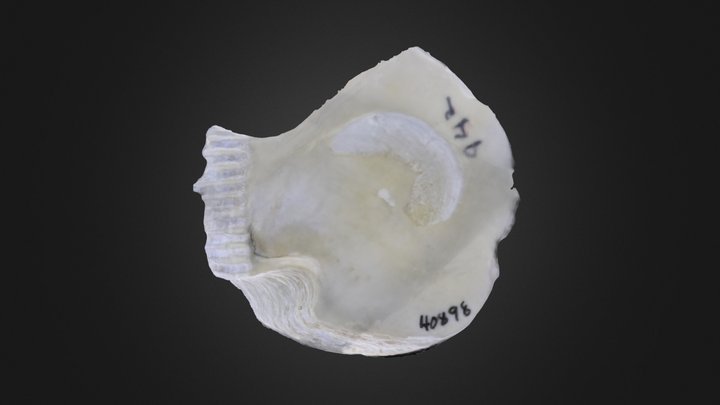
3D model
- Source
- Sketchfab
- Licence
- CC0 Public Domain
- Commercial use
- the licence allows it
No picture of Isognomon (Isognomon) was found. Wikipedia, Wikidata, iDigBio and Smithsonian Open Access were searched and had none.
GBIF was asked, and what came back is not recorded: nothing, or a picture this site could not tie to Isognomon (Isognomon), or no answer at all. This entry cannot say which.
This is what the site found, which is not the same as what exists.
Keep going
What may have been alongside itIsognomon through timeFormations of the Late TriassicThe world it lived on
Occurrence data from the Paleobiology Database, CC BY 4.0. Lightfoot 1786