Inioidea
River dolphins also called Freshwater dolphins, are a polyphyletic group of fully aquatic mammals that reside exclusively in freshwater or even in brackish water. They are an informal grouping of dolphins, which itself is a paraphyletic group within the infraorder Cetacea. These dolphins are placed in three superfamilies, Platanistoidea (Platanistidae), Inioidea and Lipotoidea (Lipotidae). They comprise the families Platanistidae, the possibly extinct Lipotidae, Iniidae and Pontoporiidae. There are five extant species of river dolphins. River dolphins, alongside other cetaceans, belong to the clade Artiodactyla, with even-toed ungulates, and their closest living relatives the hippopotamuses, from which they diverged about 40 million years ago. Specific types of dolphins can be pink.

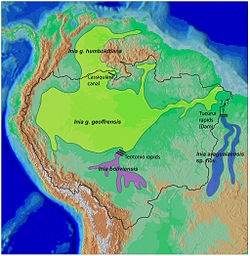
Tomas Hrbek, Vera Maria Ferreira da Silva, Nicole Dutra, Waleska Gravena, Anthony R. Martin, Izeni Pires Farias · CC BY 2.5 · via Wikipedia/Commons. May be a photograph of a specimen, or an artist’s reconstruction — an interpretation of a skeleton, since colour and soft tissue are almost never preserved.
On record
Recorded, not inferred- Sits inside
- DelphinidaPBDB
- Diet
- carnivorePBDB, for Odontoceti
- Life habit
- aquatic, depth=surfacePBDB, for Cetacea
- Motility
- actively mobilePBDB, for Cetacea
- Environment
- marine,freshwaterPBDB, for Odontoceti
Time the record covers
At least 15 million years on record.
The record covers at least 15.98 Mya to 11.7 ka. No occurrence read is dated outside 23.04 Mya to 0 Mya.
107 occurrences of Inioidea on record, most of them in the Miocene. The Paleobiology Database records this as a living group. Bar height is expected occurrences, not a count: each fossil is spread across the span it is dated to, so a tall narrow bar means tight dating and a low wide one means loose.
When
107 occurrences- Miocene70%
- Pliocene17%
- Pleistocene6%
- Holocene7%
These are dates about fossils, not the animal: the record can only begin after it arose and end before it died out, so either end may reach further. Shares are expected occurrences: a fossil dated to a span is counted partly in each period it straddles. More on what this infers.
Found in
30 formations
- Pisco Formation18
- Bahía Inglesa Formation9
- Yorktown Formation · Chesapeake Group7
- Peace River Formation · Hawthorn Group6
- Entre Rios Formation6
- Solimoes Formation6
Loading coastlines…
The named rock units Inioidea has been recovered from, largest first. Drawn where the rock is now, not where it formed. 6 further formations hold fewer occurrences each and are not listed. 19 occurrences have no formation on record, which is common for older literature.
Inioidea and its relatives
MioceneWhere Inioidea and its relatives were recorded in the Miocene.
Found in the same rock
1,461 taxa- Phocidae15 sites
- Carcharodon hastalis14 sites
- Mysticeti14 sites
- Otodus megalodon13 sites
- Ziphiidae12 sites
- Odontoceti11 sites
- Cetotheriidae10 sites
- Pontoporiidae10 sites
- Iniidae9 sites
- Carcharhinus8 sites
- Balaenopteridae7 sites
- Monachinae7 sites
- Myliobatis7 sites
- Physeteridae7 sites
- Pontoporia blainvillei7 sites
- Carcharodon carcharias6 sites
- Delphinidae6 sites
- Hemipristis serra6 sites
- Isurus oxyrinchus6 sites
- Phalacrocorax6 sites
- Squatina6 sites
- Sula6 sites
- Balaenidae5 sites
- Brachydelphis mazeasi5 sites
The Paleobiology Database records 77 sites for Inioidea, and this reads all of them. The number is how many of those sites it was catalogued from too. The 24 sharing the most are listed.
This is not a list of everything alive at the time. It is only what has come out of the same ground as this animal and been written down.
Entered from
76 references- Miocene and Pliocene marine mammal faunas from the Bone Valley Formation of central Florida5
- A new small, mesorostrine inioid (Cetacea, Odontoceti, Delphinida) from four upper Miocene localities in the Pisco Basin, Peru4
- Estado actual del conocimiento de los mamíferos fósiles de Chile4
- The Acre vertebrate fauna: Age, diversity, and geography4
- Fossil Cetaceans (Mammalia, Cetacea) from the Neogene of Colombia and Venezuela3
- A new long-snouted species of the Miocene pontoporiid dolphin Brachydelphis and a review of the Mio-Pliocene marine mammal levels in the Sacaco Basin, Peru3
- Toothed whale (Mammalia: Cetacea: Odontoceti) Limb bones of the Lee Creek mine, North Carolina3
- Miocene stratigraphy and vertebrate paleontology along the western side of Cerros Cadena de los Zanjones (East Pisco Basin, Peru)2
- Cetáceos fósiles de Chile: Contexto evolutivo y paleobiogeográfico2
- Systematics, biostratigraphy and evolutionary pattern of the Oligo-Miocene marine mammals from the Maltese Islands2
- High concentration of long-snouted beaked whales (Genus Messapicetus) from the Miocene of Peru2
- Tortonian pontoporiid odontocetes from the eastern North Seas2
Each of the 107 occurrences read was entered from one of these publications, ordered by how many each accounts for. This is not a search for papers mentioning the name. 64 further references are not listed. Entries link to doi.org where the Paleobiology Database holds an identifier, and to its own record where it does not. Relayed as the Paleobiology Database holds them, not checked against what they resolve to.
Media and terms
Media content1
Picture of Inioidea
- Source
- Wikipedia/Commons
- Credit
- Tomas Hrbek, Vera Maria Ferreira da Silva, Nicole Dutra, Waleska Gravena, Anthony R. Martin, Izeni Pires Farias
- Licence
- CC BY 2.5
- Commercial use
- the licence allows it
No 3D scan of Inioidea was found in Sketchfab.
Smithsonian Open Access and MorphoSource were not reached for this taxon, so this list is what the others held rather than everything there is.
The description on this site
- Licence
- CC BY-SA 4.0
This is what the site found, which is not the same as what exists.
Keep going
What may have been alongside itDelphinida through timeFormations of the MioceneThe world it lived on
Occurrence data from the Paleobiology Database, CC BY 4.0. de Muizon 1988