Impagidinium
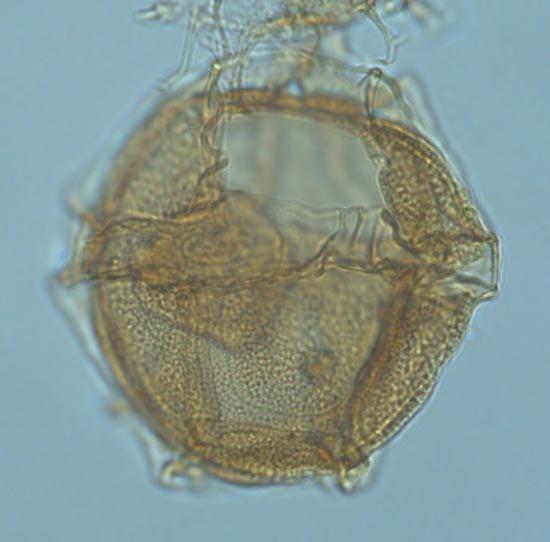
via iDigBio · CC BY · via iDigBio. May be a photograph of a specimen, or an artist’s reconstruction — an interpretation of a skeleton, since colour and soft tissue are almost never preserved.
On record
Recorded, not inferred- Sits inside
- GonyaulacaceaePBDB
- Diet
- "photoautotroph"PBDB, for Dinoflagellata
- Environment
- freshwaterPBDB, for Dinophyceae
Time the record covers
At least 84 million years on record.
The record covers at least 85.7 Mya to 774 ka. No occurrence read is dated outside 93.9 Mya to 0 Mya.
68 occurrences of Impagidinium on record, most of them in the Pleistocene. Bar height is expected occurrences, not a count: each fossil is spread across the span it is dated to, so a tall narrow bar means tight dating and a low wide one means loose.
When
68 occurrences- Late Cretaceous31%
- Paleocene3%
- Eocene4%
- Oligocene3%
- Miocene12%
- Pliocene10%
- Pleistocene37%
These are dates about fossils, not the animal: the record can only begin after it arose and end before it died out, so either end may reach further. Shares are expected occurrences: a fossil dated to a span is counted partly in each period it straddles. More on what this infers.
Found in
8 formations
- Hidden Lake Formation · Gustav Group12
- Calafate Formation4
- Whisky Bay Formation · Gustav Group3
- Kuma Formation2
- Jagüel Formation2
- Oosterhout Formation1
Loading coastlines…
The named rock units Impagidinium has been recovered from, largest first. Drawn where the rock is now, not where it formed. 42 occurrences have no formation on record, which is common for older literature.
Impagidinium and its relatives
PleistoceneWhere Impagidinium and its relatives were recorded in the Pleistocene.
Found in the same rock
363 taxa- Brigantedinium33 sites
- Dinoflagellata33 sites
- Foraminifera31 sites
- Operculodinium28 sites
- Operculodinium centrocarpum16 sites
- Spiniferites ramosus16 sites
- Clavifera triplex15 sites
- Cyatheacidites annulatus15 sites
- Densoisporites velatus15 sites
- Dryadopollis15 sites
- Herkosporites elliottii15 sites
- Ischyosporites volkheimeri15 sites
- Microcachryidites antarcticus15 sites
- Palaeohystrichophora infusorioides15 sites
- Phyllocladidites mawsonii15 sites
- Proteacidites15 sites
- Pterospermella15 sites
- Conosphaeridium14 sites
- Cymatiosphaera14 sites
- Trithyrodinium14 sites
- Islandinium13 sites
- Heterosphaeridium heteracanthum12 sites
- Nyssapollenties spp.12 sites
- Ornamentifera12 sites
The Paleobiology Database records 63 sites for Impagidinium, and this reads all of them. The number is how many of those sites it was catalogued from too. The 24 sharing the most are listed.
This is not a list of everything alive at the time. It is only what has come out of the same ground as this animal and been written down.
Entered from
18 references- Palinología de la Formación Hidden Lake (Coniaciano-Santoniano), Isla James Ross, Antártida15
- Site U13407
- Site U13416
- Site U15215
- Site U15224
- Site U13434
- Stratigraphy of the Maikop Group and Pteropoda Beds in Northern Azerbaijan4
- Sedimentology and palynology of the Calafate Formation (Maastrichtian), Austral Basin, Southern Patagonia, Argentina4
- Dinoflagellate cyst and nannoplankton assemblages from the Middle Eocene Kuma Formation of Crimean Peninsula — biostratigraphy and palynofacies3
- Site U13423
- Site U13443
- Palynology of the Jagüel Formation (Maastrichtian-Danian) in northwestern Río Negro, Neuquén Basin, Argentina: paleobiogeographic inferences2
Each of the 68 occurrences read was entered from one of these publications, ordered by how many each accounts for. This is not a search for papers mentioning the name. 6 further references are not listed. Entries link to doi.org where the Paleobiology Database holds an identifier, and to its own record where it does not. Relayed as the Paleobiology Database holds them, not checked against what they resolve to.
Media and terms
Media content1
Picture of Impagidinium
- Source
- iDigBio
- Credit
- via iDigBio
- Licence
- CC BY
- Commercial use
- the licence allows it
No 3D scan of Impagidinium was found in Sketchfab.
Smithsonian Open Access and MorphoSource were not reached for this taxon, so this list is what the others held rather than everything there is.
This is what the site found, which is not the same as what exists.
Keep going
What may have been alongside itGonyaulacaceae through timeFormations of the PleistoceneThe world it lived on
Occurrence data from the Paleobiology Database, CC BY 4.0. Stover and Evitt 1978