Hydrodamalis
Hydrodamalis is a genus of extinct herbivorous sirenian marine mammals. It included the Steller's sea cow, the Cuesta sea cow, and the Takikawa sea cow. The fossil genus Dusisiren is regarded as the sister taxon of Hydrodamalis: together, the two genera form the dugong subfamily Hydrodamalinae. They were the largest member of the order Sirenia, whose only extant members are the dugong and the manatees. They reached up to 9 metres (30 ft) in length, making the Steller's sea cow among the largest mammals other than whales to have existed in the Holocene epoch. Steller's sea cow was first described by Georg Wilhelm Steller, Cuesta by Daryl Domning, and Takikawa by Hitoshi Furusawa. The Steller's sea cow was the only member of the genus to survive into modern times, and, although had formerly been abundant throughout the North Pacific, by the mid 1700s, its range had been limited to a single, isolated population surrounding the uninhabited Commander Islands. It was hunted for its meat, skin, and fat by fur traders, and was also hunted by aboriginals of the North Pacific coast, leading to its and the genus' extinction 27 years after discovery. The Cuesta sea cow along with the Takikawa sea cow were probably extinct at the end of the Pliocene due to the onset of the Ice Ages and the subsequent recession of seagrasses—their main food source.

Daderot · CC0 · via Wikipedia/Commons. May be a photograph of a specimen, or an artist’s reconstruction — an interpretation of a skeleton, since colour and soft tissue are almost never preserved.
On record
Recorded, not inferred- Also called
- Steller's sea cowPBDB
- Sits inside
- HydrodamalinaePBDB
- Diet
- herbivorePBDB, for Dugongidae
- Life habit
- aquaticPBDB, for Sirenia
- Motility
- actively mobilePBDB, for Osteichthyes
- Environment
- marinePBDB, for Sirenia
Time the record covers
At least 7.2 million years on record.
The record covers at least 7.246 Mya to 11.7 ka. No occurrence read is dated outside 11.63 Mya to 0 Mya.
49 occurrences of Hydrodamalis on record, most of them in the Pliocene. Bar height is expected occurrences, not a count: each fossil is spread across the span it is dated to, so a tall narrow bar means tight dating and a low wide one means loose.
When
49 occurrences- Miocene8%
- Pliocene47%
- Pleistocene29%
- Holocene16%
These are dates about fossils, not the animal: the record can only begin after it arose and end before it died out, so either end may reach further. Shares are expected occurrences: a fossil dated to a span is counted partly in each period it straddles. More on what this infers.
Found in
15 formations
- San Mateo Formation6
- Capistrano Formation2
- Sarumaru Formation · Minochi Group2
- Shimonopporo Formation2
- Pismo Formation1
- San Diego Formation1
Loading coastlines…
The named rock units Hydrodamalis has been recovered from, largest first. Drawn where the rock is now, not where it formed. 26 occurrences have no formation on record, which is common for older literature.
Hydrodamalis and its relatives
PlioceneWhere Hydrodamalis and its relatives were recorded in the Pliocene.
Found in the same rock
211 taxa- Balaenopteridae7 sites
- Carcharodon carcharias3 sites
- Delphinidae3 sites
- Equini3 sites
- Isurus oxyrinchus3 sites
- Mysticeti3 sites
- Odobenus rosmarus3 sites
- Odontoceti3 sites
- Otariinae3 sites
- Phocoenidae3 sites
- Aves2 sites
- Balaenidae2 sites
- Camelidae2 sites
- Carcharodon hastalis2 sites
- Cepphus2 sites
- Cetacea2 sites
- Echinoidea2 sites
- Equus2 sites
- Eumetopias2 sites
- Gastropoda2 sites
- Gavia2 sites
- Gavia concinna2 sites
- Herpetocetus2 sites
- Lyropecten cerrosensis2 sites
The Paleobiology Database records 48 sites for Hydrodamalis, and this reads all of them. The number is how many of those sites it was catalogued from too. The 24 sharing the most are listed.
This is not a list of everything alive at the time. It is only what has come out of the same ground as this animal and been written down.
Entered from
21 references- Evolution of the North Pacific Sirenia (Hydrodamalinae) and their paleoenvironment13
- Sirenian evolution in the North Pacific Ocean11
- Dynamics of sea mammal and bird populations of the Bearing Sea region over the last several millennia3
- An annotated list of extant skeletal material of Steller's Sea Cow (Hydrodamalis gigas) (Sirenia: Dugongidae) from the Commander Islands2
- Sirenian fossils (Hydrodamalis) from early Pliocene of Hombetsu and early Pleistocene of Kuromatsunai, Hokkaido2
- A catalogue of late Quaternary Vertebrates from California: Part Two, Mammals2
- The vertebrate fossils of the marine Cenozoic San Mateo Formation at Oceanside, California2
- Rewriting the history of an extinction— was a population of Steller’s sea cows (Hydrodamalis gigas) at St Lawrence Island also driven to extinction?1
- Discovery of the Hydrodamalinae (Sirenia, Mammalia) from the Late Pliocene Shiroiwa Formation in Nagaoka City, Niigata Prefecture1
- Sirenian fossils1
- Discovery of a skeleton of the Hydrodamalis sea cow from the Lower Pleistocene Iimuro Formation, Koame City, Tokyo, central Japan1
- Steller's sea-cow (Hydrodamalis gigas) in the Bearing Island, Kamschatka1
Each of the 49 occurrences read was entered from one of these publications, ordered by how many each accounts for. This is not a search for papers mentioning the name. 9 further references are not listed. Entries link to doi.org where the Paleobiology Database holds an identifier, and to its own record where it does not. Relayed as the Paleobiology Database holds them, not checked against what they resolve to.
Media and terms
Media content3
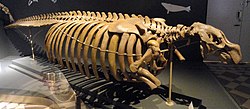
Picture of Hydrodamalis
- Source
- Wikipedia/Commons
- Credit
- Daderot
- Licence
- CC0
- Commercial use
- the licence allows it
Laser scan
- Source
- MorphoSource
- Licence
- In Copyright
- Commercial use
- cannot be read from the licence given — check the record
- Specimen
- Hydrodamalis Hydrodamalis gigas · mvz:mammal specimens:107764
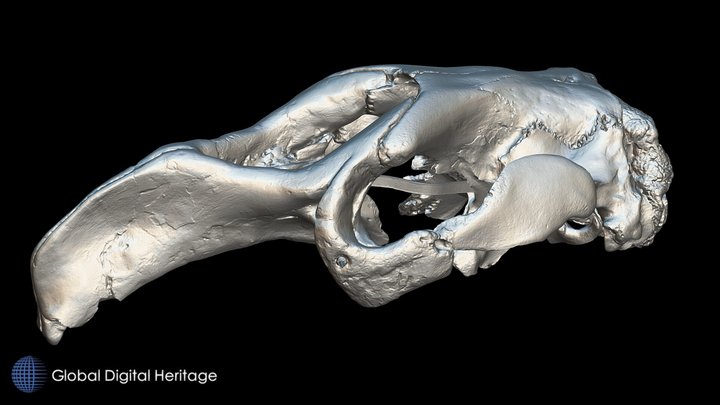
3D model
- Source
- Sketchfab
- Licence
- CC Attribution-NonCommercial
- Commercial use
- the licence does not allow it
The description on this site
- Licence
- CC BY-SA 4.0
This is what the site found, which is not the same as what exists.
Keep going
What may have been alongside itHydrodamalinae through timeFormations of the PlioceneThe world it lived on
Occurrence data from the Paleobiology Database, CC BY 4.0. Retzius 1794