Hyainailouros
Hyainailouros ("hyena-cat") is an extinct paraphyletic genus of hyaenodont belonging to the family Hyainailouridae that lived during the Early to Middle Miocene from 22 to 15 million years ago. This genus comprises at least three species spread across Afro-Eurasia. Currently, there’s a debate whether or not Megistotherium was synonymous to Hyainailouros or a separate genus entirely. The genus currently consists of at least 3 species, H. bugtiensis, H. sulzeri, and H. napakensis. H. sulzeri was the type species of and the largest species within the genus, weighing 500 kg (1,100 lb). On the other hand, H. napakensis was believed to have been the smallest weighing 202–271 kg (445–597 lb), the three species were some of the largest known hyaenodonts.

W. G. A. Biedermann · Public Domain · via Wikipedia/Commons. May be a photograph of a specimen, or an artist’s reconstruction — an interpretation of a skeleton, since colour and soft tissue are almost never preserved.
On record
Recorded, not inferred- Sits inside
- HyainailourinaePBDB
- Diet
- insectivorePBDB, for Theria
- Life habit
- scansorialPBDB, for Eutheria
- Motility
- actively mobilePBDB, for Osteichthyes
- Environment
- terrestrialPBDB, for Eutheria
Time the record covers
At least 9.2 million years on record.
The record covers at least 23.04 Mya to 13.82 Mya. No occurrence read is dated outside 27.3 Mya to 7.246 Mya.
15 occurrences of Hyainailouros on record, most of them in the Miocene. Bar height is expected occurrences, not a count: each fossil is spread across the span it is dated to, so a tall narrow bar means tight dating and a low wide one means loose.
When
15 occurrencesThese are dates about fossils, not the animal: the record can only begin after it arose and end before it died out, so either end may reach further. Shares are expected occurrences: a fossil dated to a span is counted partly in each period it straddles. More on what this infers.
Found in
6 formations
- Manchar Formation3
- Brackwater Molasse Formation · Molasse Group1
- Moghara Formation1
- Bakate Formation1
- Erageleit Formation1
- Vihowa Formation1
Loading coastlines…
The named rock units Hyainailouros has been recovered from, largest first. Drawn where the rock is now, not where it formed. 7 occurrences have no formation on record, which is common for older literature.
Hyainailouros and its relatives
MioceneWhere Hyainailouros and its relatives were recorded in the Miocene.
Found in the same rock
341 taxa- Gomphotherium angustidens5 sites
- Amphicyon giganteus4 sites
- Brachyodus4 sites
- Prodeinotherium pentapotamiae4 sites
- Rhinocerotidae4 sites
- Aceratherium3 sites
- Amphicyon3 sites
- Anchitherium aurelianense3 sites
- Anthracotheriidae3 sites
- Aureliachoerus aurelianensis3 sites
- Bovidae3 sites
- Bunolistriodon3 sites
- Conohyus sindiensis3 sites
- Dicerorhinus3 sites
- Gomphotherium3 sites
- Hyotherium soemmeringi3 sites
- Miopanthera lorteti3 sites
- Odontoceti3 sites
- Proboscidea3 sites
- Progiraffa3 sites
- Sivameryx3 sites
- Testudo3 sites
- Trionyx3 sites
- Varanus3 sites
The Paleobiology Database records 15 sites for Hyainailouros, and this reads all of them. The number is how many of those sites it was catalogued from too. The 24 sharing the most are listed.
This is not a list of everything alive at the time. It is only what has come out of the same ground as this animal and been written down.
Entered from
11 references- Preliminary report on the geology and vertebrate fauna of the Miocene Manchar Formation, Sind, Pakistan3
- New Hyaenodonts (Ferae, Mammalia) from the early Miocene of Napak (Uganda), Koru (Kenya) and Grillental (Namibia)2
- Stratigraphy and mammal faunas of the Brackwassermolasse in the surroundings of Ulm (Southwest Germany)2
- Le site paléontologique du Grand Morier (Pont-Boutard, Indre-et-Loire, France): contexte géologique et détail biostratigraphique des formations cénozoïques à partir des assemblages de vertébrés fossiles1
- Creodonta1
- A Mammalian Fauna from the Late Oligocene of Northwestern Kenya1
- Creodonta and Carnivora from Wadi Moghra, Egypt1
- Will Downs and the Zinda Pir Dome1
- Nouvelles decouvertes de vertebres miocenes dans le synclina de Dera Bugti (Balouchistan, Pakistan)1
- New higher primates from the early Miocene of Buluk, Kenya1
- Prosansanosmilus peregrinus, ein neuer machairodontider Felide aus dem Miocän Deutschlands und Frankreichs1
Each of the 15 occurrences read was entered from one of these publications, ordered by how many each accounts for. This is not a search for papers mentioning the name. Entries link to doi.org where the Paleobiology Database holds an identifier, and to its own record where it does not. Relayed as the Paleobiology Database holds them, not checked against what they resolve to.
Media and terms
Media content1
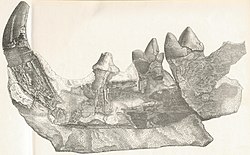
Picture of Hyainailouros
- Source
- Wikipedia/Commons
- Credit
- W. G. A. Biedermann
- Licence
- Public Domain
- Commercial use
- the licence allows it
No 3D scan of Hyainailouros was found in Sketchfab.
Smithsonian Open Access and MorphoSource were not reached for this taxon, so this list is what the others held rather than everything there is.
The description on this site
- Licence
- CC BY-SA 4.0
This is what the site found, which is not the same as what exists.
Keep going
What may have been alongside itHyainailourinae through timeFormations of the MioceneThe world it lived on
Occurrence data from the Paleobiology Database, CC BY 4.0. Stehlin 1907