Herrerasauridae
Herrerasauria is an extinct clade of carnivorous dinosaurs, possibly basal to either theropods or all saurischians, or even their own branching from Dracohors, separate from Dinosauria altogether. They are among the oldest known dinosaurs, first appearing in the fossil record around 233.23 million years ago, before becoming extinct by the end of the Carnian stage. Herrerasaurids were relatively small-sized dinosaurs, normally no more than 4 metres (13 ft) long, although the holotype specimen of "Frenguellisaurus ischigualastensis" is thought to have reached around 6 meters long. The best known representatives of this group are from South America, where they were first discovered in the 1930s in relation to Staurikosaurus and 1960s in relation to Herrerasaurus. A nearly complete skeleton of Herrerasaurus ischigualastensis was discovered in the Ischigualasto Formation in San Juan, Argentina, in 1988. Less complete possible herrerasaurids have been found in North America and Africa, and they may have inhabited other continents as well.

Eva K. · GFDL 1.2 · via Wikipedia/Commons. May be a photograph of a specimen, or an artist’s reconstruction — an interpretation of a skeleton, since colour and soft tissue are almost never preserved.
On record
Recorded, not inferred- Also called
- herrerasauridPBDB
- Sits inside
- SaurischiaPBDB
- Motility
- actively mobilePBDB, for Osteichthyes
- Environment
- terrestrialPBDB, for Diapsida
Time the record covers
At most 36 million years on record.
Every occurrence read is dated to somewhere between 237 Mya and 201.4 Mya, and nothing in the dating separates them, so that window is what the record shows rather than a span.
21 occurrences of Herrerasauridae on record, most of them in the Late Triassic. Bar height is expected occurrences, not a count: each fossil is spread across the span it is dated to, so a tall narrow bar means tight dating and a low wide one means loose.
When
21 occurrences- Late Triassic100%
These are dates about fossils, not the animal: the record can only begin after it arose and end before it died out, so either end may reach further. Shares are expected occurrences: a fossil dated to a span is counted partly in each period it straddles. More on what this infers.
Found in
6 formations
- Ischigualasto Formation12
- Santa Maria Formation · Rosário do Sul Group4
- Cooper Canyon Formation · Dockum Group2
- Chinle Formation1
- Wozniki Limestone Formation1
- Pebbly Arkose Formation · Karoo Group1
Loading coastlines…
The named rock units Herrerasauridae has been recovered from, largest first. Drawn where the rock is now, not where it formed.
Herrerasauridae and its relatives
Late TriassicWhere Herrerasauridae and its relatives were recorded in the Late Triassic.
Found in the same rock
123 taxa- Herrerasaurus ischigualastensis10 sites
- Archosauriformes3 sites
- Dinosauriformes3 sites
- Hyperodapedon3 sites
- Neotheropoda3 sites
- Theropoda3 sites
- Apachesaurus gregorii2 sites
- Archosauromorpha2 sites
- Calyptosuchus wellesi2 sites
- Ceratodus2 sites
- Cynodontia2 sites
- Drepanosauridae2 sites
- Dromomeron gregorii2 sites
- Exaeretodon2 sites
- Leptosuchus2 sites
- Phytosauria2 sites
- Postosuchus kirkpatricki2 sites
- Saurischia2 sites
- Shuvosaurus inexpectatus2 sites
- Staurikosaurus pricei2 sites
- Temnospondyli2 sites
- Trilophosaurus2 sites
- Trilophosaurus jacobsi2 sites
- Acaenasuchus geoffreyi1 site
The Paleobiology Database records 21 sites for Herrerasauridae, and this reads all of them. The number is how many of those sites it was catalogued from too. The 24 sharing the most are listed.
This is not a list of everything alive at the time. It is only what has come out of the same ground as this animal and been written down.
Entered from
16 references- La presencia de dinosaurios saurisquios en los "Estratos de Ischigualasto" (Mesotriasico Superior) de las provincias de San Juan y La Rioja (República Argentina) [The presence of saurischian dinosaurs in the "Ischigualasto beds" (upper Middle Triassic) of San Juan and La Rioja Provinces (Argentine Republic)]6
- Africa’s oldest dinosaurs reveal early suppression of dinosaur distribution1
- Taxonomic and phylogenetic reassessment of a large-bodied dinosaur from the earliest dinosaur-bearing beds (Carnian, Upper Triassic) from southern Brazil1
- Gnathovorax cabreirai: a new early dinosaur and the origin and initial radiation of predatory dinosaurs1
- New theropod fossils from the Upper Triassic Dockum Group of Texas, USA, and a brief overview of the Dockum theropod diversity1
- Basal dinosauriform and theropod dinosaurs from the mid–late Norian (Late Triassic) of Poland: implications for triassic dinosaur evolution and distribution1
- A taxonomic and biostratigraphic re-evaluation of the Post Quarry vertebrate assemblage from the Cooper Canyon Formation (Dockum Group, Upper Triassic) of southern Garza County, western Texas1
- A new herrerasaurid (Dinosauria, Saurischia) from the Upper Triassic Ischigualasto Formation of northwestern Argentina1
- The continental tetrapod-bearing Triassic of south Brazil1
- Carnivore coprolites from the Upper Triassic Ischigualasto Formation, Argentina: chemistry, mineralogy, and evidence for rapid initial mineralization1
- Late Triassic dinosaurs from the western United States1
- The skull and neck of the basal theropod Herrerasaurus ischigualastensis1
Each of the 21 occurrences read was entered from one of these publications, ordered by how many each accounts for. This is not a search for papers mentioning the name. 4 further references are not listed. Entries link to doi.org where the Paleobiology Database holds an identifier, and to its own record where it does not. Relayed as the Paleobiology Database holds them, not checked against what they resolve to.
Media and terms
Media content1
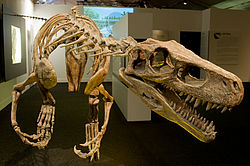
Picture of Herrerasauridae
- Source
- Wikipedia/Commons
- Credit
- Eva K.
- Licence
- GFDL 1.2
- Commercial use
- the licence allows it
No 3D scan of Herrerasauridae was found in MorphoSource and Sketchfab.
Smithsonian Open Access was not reached for this taxon, so this list is what the others held rather than everything there is.
The description on this site
- Licence
- CC BY-SA 4.0
This is what the site found, which is not the same as what exists.
Keep going
What may have been alongside itSaurischia through timeFormations of the Late TriassicThe world it lived on
Occurrence data from the Paleobiology Database, CC BY 4.0. Benedetto 1973