Helodermoides
Helodermoides is an extinct genus of anguid lizards from the Oligocene of North America. The genus is monotypic, including only the species Helodermoides tuberculatus. Helodermoides belongs to an extinct subfamily of anguids called Glyptosaurinae. In addition to many fragmentary bones, several complete skeletons of Helodermoides are known. Like other glyptosaurines, Helodermoides was covered in small scale-like bones called osteoderms. The osteoderms covering its skull are hexagonal, tightly interlocking, raised, and rounded.

Smokeybjb · CC BY-SA 3.0 · via Wikipedia/Commons. May be a photograph of a specimen, or an artist’s reconstruction — an interpretation of a skeleton, since colour and soft tissue are almost never preserved.
On record
Recorded, not inferred- Sits inside
- GlyptosaurinaePBDB
- Diet
- insectivore, carnivorePBDB, for Anguidae
- Life habit
- ground dwellingPBDB, for Glyptosaurinae
- Motility
- actively mobilePBDB, for Osteichthyes
- Environment
- terrestrialPBDB, for Glyptosaurinae
Time the record covers
At least 5.8 million years on record.
The record covers at least 39.7 Mya to 33.9 Mya. No occurrence read is dated outside 45.9 Mya to 31.8 Mya.
41 occurrences of Helodermoides on record, most of them in the Eocene. Bar height is expected occurrences, not a count: each fossil is spread across the span it is dated to, so a tall narrow bar means tight dating and a low wide one means loose.
When
41 occurrencesThese are dates about fossils, not the animal: the record can only begin after it arose and end before it died out, so either end may reach further. Shares are expected occurrences: a fossil dated to a span is counted partly in each period it straddles. More on what this infers.
Found in
6 formations
- Chadron Formation · White River Group19
- Brule Formation · White River Group8
- White River Formation8
- Renova Formation3
- Uinta Formation2
- Pipestone Creek Formation1
Loading coastlines…
The named rock units Helodermoides has been recovered from, largest first. Drawn where the rock is now, not where it formed.
Helodermoides and its relatives
EoceneWhere Helodermoides and its relatives were recorded in the Eocene.
Found in the same rock
218 taxa- Hesperocyon gregarius7 sites
- Brontotheriidae6 sites
- Ischyromys veterior6 sites
- <Novacek leptictid>5 sites
- Douglassciurus jeffersoni5 sites
- Leptomeryx speciosus5 sites
- Megalagus brachyodon5 sites
- Palaeolagus temnodon5 sites
- Trigonias5 sites
- Bathygenys alpha4 sites
- Centetodon chadronensis4 sites
- Didelphidae4 sites
- Epoicotherium unicum4 sites
- Heliscomys (Syphyriomys) ostranderi4 sites
- Hyracodon priscidens4 sites
- Leptomeryx mammifer4 sites
- Oligoryctes cameronensis4 sites
- Adjidaumo minimus3 sites
- Ankylodon3 sites
- Apternodus brevirostris3 sites
- Apternodus gregoryi3 sites
- Brachyrhynchocyon3 sites
- Chadrolagus emryi3 sites
- Chiroptera3 sites
The Paleobiology Database records 33 sites for Helodermoides, and this reads all of them. The number is how many of those sites it was catalogued from too. The 24 sharing the most are listed.
This is not a list of everything alive at the time. It is only what has come out of the same ground as this animal and been written down.
Entered from
7 references- Revision of the Paleogene genus Glyptosaurus (Reptilia, Anguidae)32
- Body size estimation from isolated fossil bones reveals deep time evolutionary trends in North American lizards3
- Fossil lizards of North America2
- Geometric morphometrics and anatomical network analyses reveal ecospace partitioning among geoemydid turtles from the Uinta Formation, Utah1
- A diverse new assemblage of late Eocene squamates (Reptilia) from the Chadron Formation of North Dakota, U.S.A.1
- Descriptions of new and little-known fossil lizards from North America1
- New vertebrates from the Montana Tertiary1
Each of the 41 occurrences read was entered from one of these publications, ordered by how many each accounts for. This is not a search for papers mentioning the name. Entries link to doi.org where the Paleobiology Database holds an identifier, and to its own record where it does not. Relayed as the Paleobiology Database holds them, not checked against what they resolve to.
Media and terms
Media content2
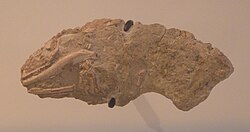
Picture of Helodermoides
- Source
- Wikipedia/Commons
- Credit
- Smokeybjb
- Licence
- CC BY-SA 3.0
- Commercial use
- the licence allows it
CT scan
- Source
- MorphoSource
- Licence
- In Copyright
- Commercial use
- cannot be read from the licence given — check the record
- Specimen
- Helodermoides tuberculatus · usnm:paleobiology:13861
Smithsonian Open Access was not reached for this taxon, so this list is what the others held rather than everything there is.
The description on this site
- Licence
- CC BY-SA 4.0
This is what the site found, which is not the same as what exists.
Keep going
What may have been alongside itGlyptosaurinae through timeFormations of the EoceneThe world it lived on
Occurrence data from the Paleobiology Database, CC BY 4.0. Douglass 1903