Haugia illustris
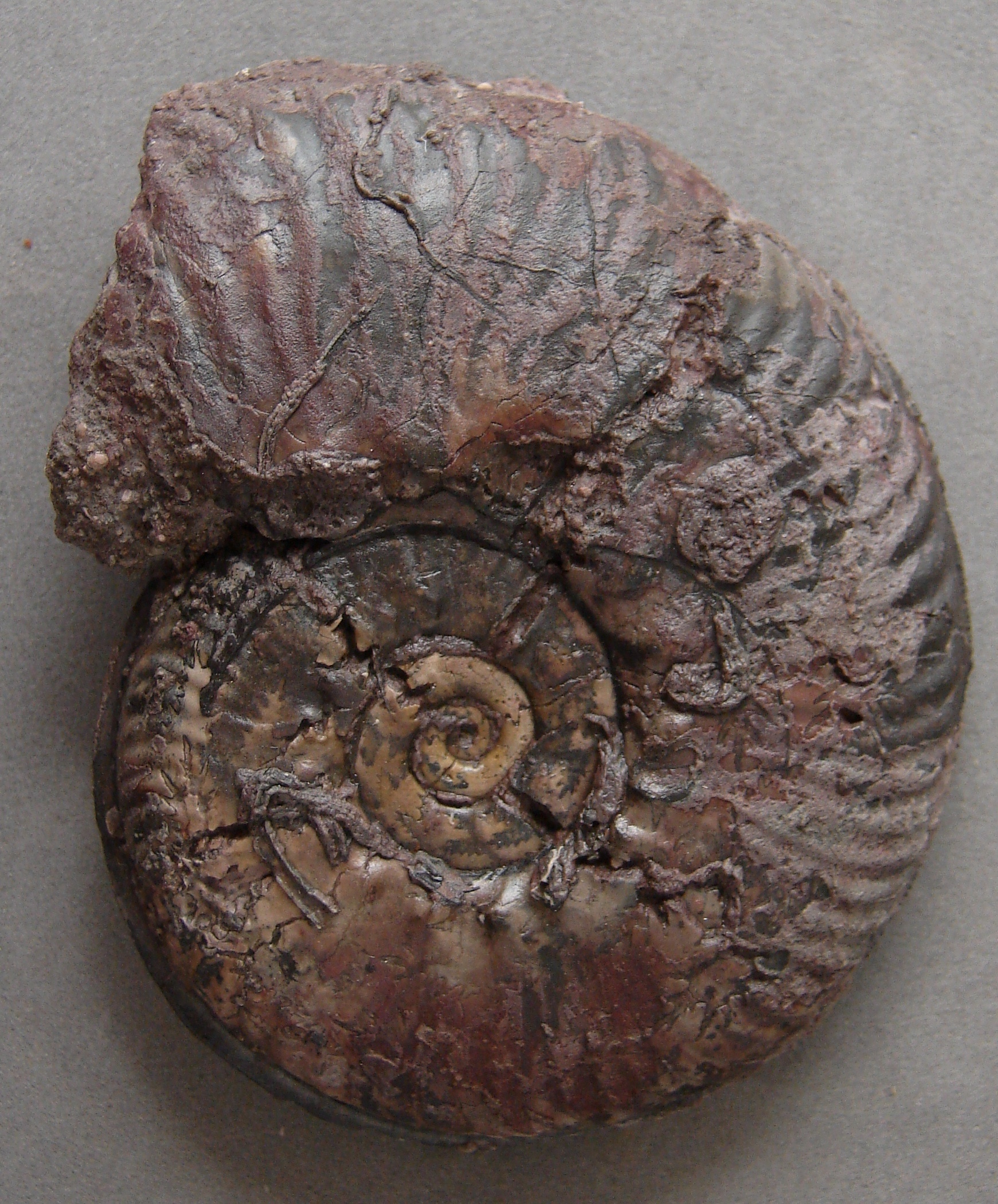
Roby Weis · CC0 · via GBIF. May be a photograph of a specimen, or an artist’s reconstruction — an interpretation of a skeleton, since colour and soft tissue are almost never preserved.
On record
Recorded, not inferred- Sits inside
- HaugiaPBDB
- Diet
- carnivorePBDB, for Ammonoidea
- Life habit
- nektonicPBDB, for Ammonoidea
- Motility
- fast-movingPBDB, for Ammonoidea
- Vision
- well-developedPBDB, for Cephalopoda
- Environment
- marinePBDB, for Cephalopoda
Time the record covers
At least 1.3 million years on record.
The record covers at least 184.2 Mya to 182.9 Mya. No occurrence read is dated outside 192.9 Mya to 174.7 Mya.
14 occurrences of Haugia illustris on record, most of them in the Early Jurassic. Bar height is expected occurrences, not a count: each fossil is spread across the span it is dated to, so a tall narrow bar means tight dating and a low wide one means loose.
When
14 occurrences- Early Jurassic100%
These are dates about fossils, not the animal: the record can only begin after it arose and end before it died out, so either end may reach further. Shares are expected occurrences: a fossil dated to a span is counted partly in each period it straddles. More on what this infers.
Found in
2 formations
Loading coastlines…
The named rock units Haugia illustris has been recovered from, largest first. Drawn where the rock is now, not where it formed. 10 occurrences have no formation on record, which is common for older literature.
Haugia illustris and its relatives
Early JurassicWhere Haugia illustris and its relatives were recorded in the Early Jurassic.
Found in the same rock
59 taxa- Denckmannia robusta4 sites
- Osperleioceras (Pseudopolyplectus) bicarinatum4 sites
- Denckmannia rudis3 sites
- Phymatoceras3 sites
- Acrocoelites2 sites
- Catacoeloceras confectum2 sites
- Catacoeloceras raquinianum2 sites
- Cenoceras2 sites
- Collina2 sites
- Lytoceras2 sites
- Lytoceras sublineatum2 sites
- Mucrodactylites mucronatus2 sites
- Osperleioceras2 sites
- Phymatoceratidae2 sites
- Podagrosites aratum2 sites
- Pseudolioceras lythense2 sites
- Actinopterygii1 site
- Alocolytoceras trautscholdi1 site
- Arieticeras1 site
- Astarte1 site
- Brodieia1 site
- Calliphylloceras1 site
- Catacoeloceras1 site
- Catacoeloceras dumortieri1 site
The Paleobiology Database records 14 sites for Haugia illustris, and this reads all of them. The number is how many of those sites it was catalogued from too. The 24 sharing the most are listed.
This is not a list of everything alive at the time. It is only what has come out of the same ground as this animal and been written down.
Entered from
6 references- Évolution et systématique des Phymatoceratinae et des Grammoceratinae (Hildocerataceae Ammonitina) de la région de Thouars, stratotype du Toarcien4
- Belemnites from the Upper Pliensbachian and the Toarcian (Lower Jurassic) of Tournadous (Causses, France)3
- Réparation biostratigraphique des ammonites du Toarcien moyen de la bordure sud des Causses (France) et révision des ammonites décrites et figurées par Monestier (1931)3
- Les Harpoceratinae, Hildoceratinae et Parinoceratinae du Toarcien de la Vendée et des Deux-Sèvres (France)2
- La Couche à Crassum (Toarcien moyen) au Luxembourg: stratigraphie et faunes de la coupe de Dudelange-Zoufftgen1
- Tethyan - Boreal connection during the Pliensbachian (Western Carpathians): an evidence from ammonite fauna1
Each of the 14 occurrences read was entered from one of these publications, ordered by how many each accounts for. This is not a search for papers mentioning the name. Entries link to doi.org where the Paleobiology Database holds an identifier, and to its own record where it does not. Relayed as the Paleobiology Database holds them, not checked against what they resolve to.
Media and terms
Media content1
Picture of Haugia illustris
- Source
- GBIF
- Credit
- Roby Weis
- Licence
- CC0
- Commercial use
- the licence allows it
No 3D scan of Haugia illustris was found in MorphoSource and Sketchfab.
Smithsonian Open Access was not reached for this taxon, so this list is what the others held rather than everything there is.
This is what the site found, which is not the same as what exists.
Keep going
What may have been alongside itHaugia through timeFormations of the Early JurassicThe world it lived on
Occurrence data from the Paleobiology Database, CC BY 4.0. (Denckmann 1887)