Cenoceras
Cenoceras is an extinct genus within the cephalopod mollusc family Nautilidae, which in turn makes up part of the superfamily Nautilaceae. This genus has been described by Hyatt in 1884. The type species is Cenoceras intermedium, which was originally described by Sowerby 1816 as Nautilus intermedius.

NobuTamura email:nobu.tamura@yahoo.com palaeocritti · CC BY-SA 3.0 · via Wikipedia/Commons. May be a photograph of a specimen, or an artist’s reconstruction — an interpretation of a skeleton, since colour and soft tissue are almost never preserved.
On record
Recorded, not inferred- Sits inside
- CenoceratidaePBDB
- Diet
- carnivorePBDB, for Nautilida
- Life habit
- nektobenthicPBDB, for Nautilida
- Motility
- actively mobilePBDB, for Nautilida
- Vision
- well-developedPBDB, for Cephalopoda
- Environment
- marinePBDB, for Cephalopoda
Time the record covers
At least 81 million years on record.
The record covers at least 233.6 Mya to 152.21 Mya. No occurrence read is dated outside 241.464 Mya to 149.2 Mya.
219 occurrences of Cenoceras on record, most of them in the Early Jurassic. Bar height is expected occurrences, not a count: each fossil is spread across the span it is dated to, so a tall narrow bar means tight dating and a low wide one means loose.
When
219 occurrences- Middle Triassicunder 1%
- Late Triassic4%
- Early Jurassic73%
- Middle Jurassic22%
- Late Jurassicunder 1%
These are dates about fossils, not the animal: the record can only begin after it arose and end before it died out, so either end may reach further. Shares are expected occurrences: a fossil dated to a span is counted partly in each period it straddles. More on what this infers.
Found in
32 formations
- Jurensismergel Formation23
- Blue Lias Formation · Lias Group10
- Saltrio Formation · Calcari Selciferi Lombardi Group10
- Whiteaves Formation · Maude Group9
- Dhruma Formation · Shaqra Group8
- Oust Formation4
Loading coastlines…
The named rock units Cenoceras has been recovered from, largest first. Drawn where the rock is now, not where it formed. 8 further formations hold fewer occurrences each and are not listed. 125 occurrences have no formation on record, which is common for older literature.
Cenoceras and its relatives
Early JurassicWhere Cenoceras and its relatives were recorded in the Early Jurassic.
Found in the same rock
686 taxa- Pleydellia costulata21 sites
- Pleydellia leura19 sites
- Cotteswoldia fluitans13 sites
- Pleurolytoceras hircinum13 sites
- Pleurolytoceras dilucidum11 sites
- Pleurolytoceras torulosum11 sites
- Cotteswoldia aalensis10 sites
- Dumortieria10 sites
- Pleydellia10 sites
- Cotteswoldia distans9 sites
- Cotteswoldia subcompta8 sites
- Hudlestonia serrodens8 sites
- Cotteswoldia mactra7 sites
- Chlamys textoria6 sites
- Phlyseogrammoceras dispansiforme6 sites
- Pholadomya6 sites
- Astarte5 sites
- Cardinia5 sites
- Chlamys5 sites
- Cotteswoldia lotharingica5 sites
- Pentacrinites5 sites
- Phymatoceras5 sites
- Pleurolytoceras wrighti5 sites
- Pleuromya5 sites
The Paleobiology Database records 158 sites for Cenoceras, and this reads all of them. The number is how many of those sites it was catalogued from too. The 24 sharing the most are listed.
This is not a list of everything alive at the time. It is only what has come out of the same ground as this animal and been written down.
Entered from
53 references- Rulleau, 200847
- Die Ammonitenfauna und Stratigraphie der Tongrube Mistelgau bei Bayreuth (Oberfranken)22
- Untersuchungen über die liassischen Nautiloidea19
- A sedimentary and faunal study of the Blue Lias of Dorset and Glamorgan10
- Toarcian (Early Jurassic) ammonoids from western North America9
- Le Jurassique D`Arabie Centrale9
- Nautílidos liasicos de los alrededores de Alfara (Tarragona, NE España)9
- I Nautili del Lias inferiore di Saltrio in Lombardia9
- Descriptions of new or imperfectly known species of Nautilus from the Inferior Oolite, preserved in the British Museum (Natural History)7
- A new giant nautilid species from the Middle Jurassic of Luxembourg and Southwest Germany5
- Triassic-Jurassic cenoceratids from New Zealand5
- Sui fossili degli strati a Terebratula aspasia della contrada Rocche Rosse presso Galati (prov. di Messina). Cefalopodi (fine) - Gasteropodi5
Each of the 219 occurrences read was entered from one of these publications, ordered by how many each accounts for. This is not a search for papers mentioning the name. 41 further references are not listed. Entries link to doi.org where the Paleobiology Database holds an identifier, and to its own record where it does not. Relayed as the Paleobiology Database holds them, not checked against what they resolve to.
Media and terms
Media content2

Picture of Cenoceras
- Source
- Wikipedia/Commons
- Credit
- NobuTamura email:nobu.tamura@yahoo.com palaeocritti
- Licence
- CC BY-SA 3.0
- Commercial use
- the licence allows it
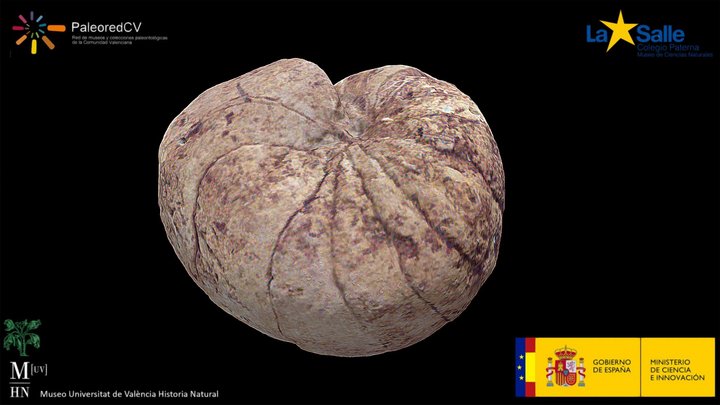
3D model
- Source
- Sketchfab
- Licence
- CC Attribution
- Commercial use
- cannot be read from the licence given — check the record
Smithsonian Open Access and MorphoSource were not reached for this taxon, so this list is what the others held rather than everything there is.
The description on this site
- Source
- Wikipedia, “Cenoceras”
- Licence
- CC BY-SA 4.0
This is what the site found, which is not the same as what exists.
Keep going
What may have been alongside itCenoceratidae through timeFormations of the Early JurassicThe world it lived on
Occurrence data from the Paleobiology Database, CC BY 4.0. (Hyatt 1884)