Haplophragmoididae
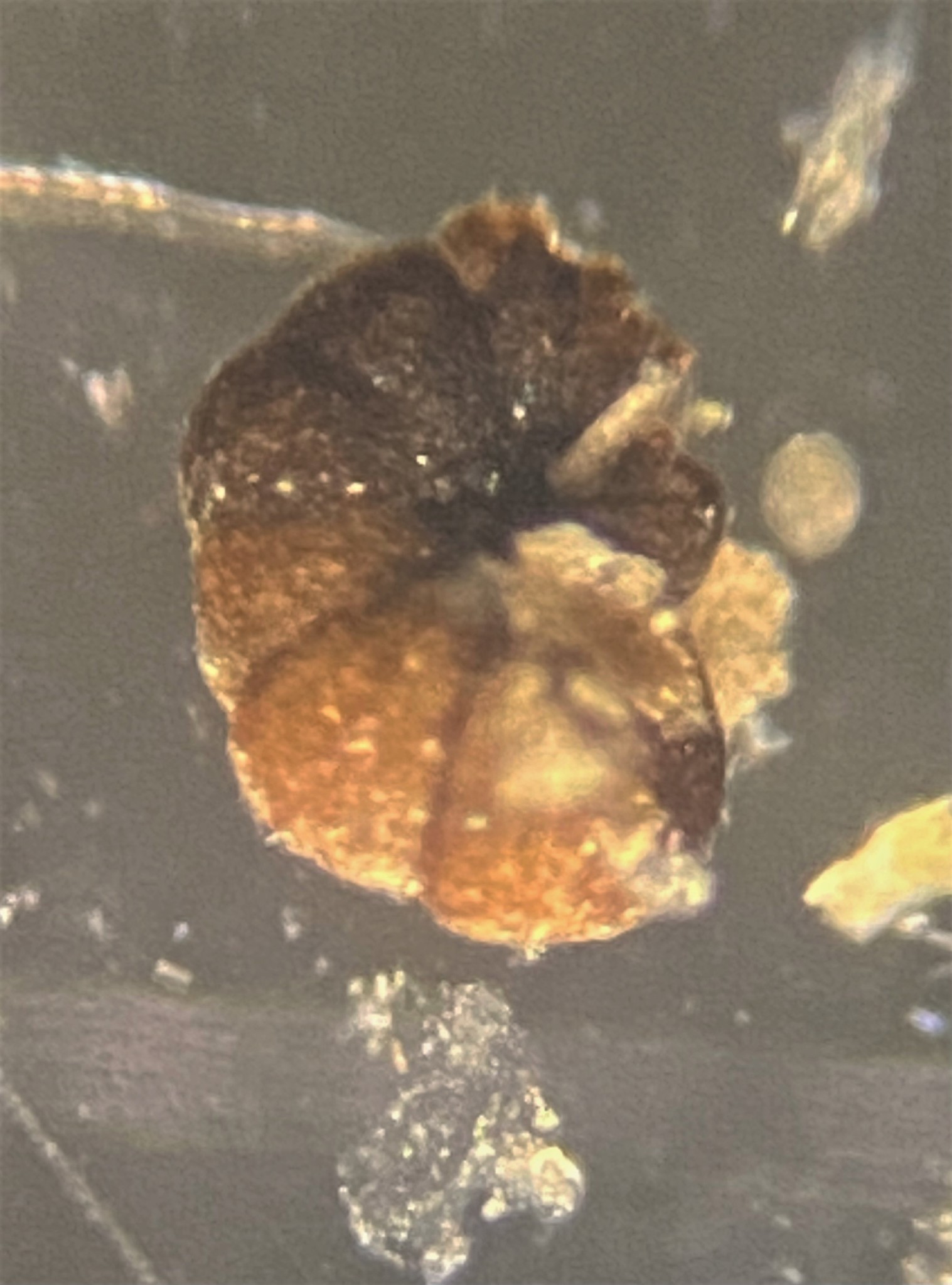
Not Haplophragmoididae. This is Labrospira crassimargo (Norman, 1892), a relative — both are Haplophragmoididae.
Karen L. Johnson · CC BY-NC 4.0 · via GBIF. May be a photograph of a specimen, or an artist’s reconstruction — an interpretation of a skeleton, since colour and soft tissue are almost never preserved.
On record
Recorded, not inferred- Sits inside
- LituoloideaPBDB
- Diet
- omnivorePBDB, for Foraminifera
- Life habit
- semi-infaunalPBDB, for Foraminifera
- Motility
- stationaryPBDB, for Foraminifera
Time the record covers
At least 323 million years on record.
The record covers at least 323.4 Mya to 11.7 ka. No occurrence read is dated outside 335.4 Mya to 0 Mya.
650 occurrences of Haplophragmoididae on record, most of them in the Early Cretaceous. The Paleobiology Database records this as a living group. Bar height is expected occurrences, not a count: each fossil is spread across the span it is dated to, so a tall narrow bar means tight dating and a low wide one means loose.
When
650 occurrences- Carboniferousunder 1%
- Permian2%
- Middle Triassicunder 1%
- Early Jurassic2%
- Middle Jurassic5%
- Late Jurassic2%
- Early Cretaceous45%
- Late Cretaceous12%
- Paleocene2%
- Eocene10%
- Oligocene9%
- Miocene8%
- Pliocene1%
- Pleistocene1%
- Holoceneunder 1%
These are dates about fossils, not the animal: the record can only begin after it arose and end before it died out, so either end may reach further. Shares are expected occurrences: a fossil dated to a span is counted partly in each period it straddles. More on what this infers.
Found in
66 formations
- Sundays River Formation133
- Westgate Formation · Colorado Group30
- Paksa Formation28
- Polat Formation · Geyik Dagi Unit Group27
- Djangura Formation18
- Chungliao Formation18
Loading coastlines…
The named rock units Haplophragmoididae has been recovered from, largest first. Drawn where the rock is now, not where it formed. 42 further formations hold fewer occurrences each and are not listed. 225 occurrences have no formation on record, which is common for older literature.
Haplophragmoididae and its relatives
Early CretaceousWhere Haplophragmoididae and its relatives were recorded in the Early Cretaceous.
Found in the same rock
1,249 taxa- Haplophragmoides196 sites
- Ammobaculites127 sites
- Lenticulina106 sites
- Trochammina77 sites
- Gaudryina59 sites
- Cristellaria (Marginulina)50 sites
- Dentalina43 sites
- Ammodiscus41 sites
- Astacolus38 sites
- Cribrostomoides38 sites
- Nodosaria37 sites
- Planularia36 sites
- Eoguttulina34 sites
- Textularia34 sites
- Globulina33 sites
- Lingulina32 sites
- Dorothia30 sites
- Reinholdella28 sites
- Epistomina27 sites
- Vaginulina27 sites
- Saccammina26 sites
- Reophax25 sites
- Recurvoides24 sites
- Gaudryina hayasakai22 sites
The Paleobiology Database records 362 sites for Haplophragmoididae, and this reads 240 of them. The number is how many of those sites it was catalogued from too. The 24 sharing the most are listed.
This is not a list of everything alive at the time. It is only what has come out of the same ground as this animal and been written down.
Entered from
83 references- The Foraminifera of the Late Valangian to Hautverian (Early Cretaceous) Sundays River Formation of the Algoa Basin, Eastern Cape Province, South Africa133
- Site U133839
- Benthic foraminiferal fauna and sedimen provenance of Eocene syn-rift sequences in Taiwan: implication for onset of Asian epi-continental marginal seas off China coast37
- The Jurassic-Cretaceous Boundary and the Berriasian Stage in the Boreal Realm36
- Sedimentology, micropaleontology, geochemistry and hydrocarbon potential of shale from the cretaceous Lower Colorado Group in Western Canada33
- Distribution of ammonites, foraminifera and dinoflagellate cysts in the Lower Cretaceous reference sections of the Khatanga Basin, and Boreal Valanginian biogeography31
- Taxonomic and Paelogeographic Approaches to the Dasyclad Algae in the Upper Jurassic (Kimmeridgian)-Upper Cretaceous (Cenomanian) Peritidal Carbonates of the Fele (YassÝbel) Area (Western Taurides, Turkey)27
- Site U133419
- Raschleneniye oligotsen-nizhnemiotsenovykh tolshch vostochnoy Kamchatki (zaliv Korfa). Subdivision of Oligocene-lower Miocene layers of eastern Kamchatka, Gulf of Korfa19
- Recherches géologiques sur le Crétacé inférieur de l'Estremadura (Portugal)19
- Site U151218
- Ammonites, Microfauna, and Palynomorphs from the Lower Part of the Upper Bajocian Parkinsoni Zone of the Basin of the Bolshoi Zelenchuk River, Northern Caucasus18
Each of the 650 occurrences read was entered from one of these publications, ordered by how many each accounts for. This is not a search for papers mentioning the name. 71 further references are not listed. Entries link to doi.org where the Paleobiology Database holds an identifier, and to its own record where it does not. Relayed as the Paleobiology Database holds them, not checked against what they resolve to.
Media and terms
Media content1
Picture of Labrospira crassimargo (Norman, 1892)
- Source
- GBIF
- Credit
- Karen L. Johnson
- Licence
- CC BY-NC 4.0
- Commercial use
- the licence does not allow it
No 3D scan of Haplophragmoididae was found in MorphoSource and Sketchfab.
Smithsonian Open Access was not reached for this taxon, so this list is what the others held rather than everything there is.
This is what the site found, which is not the same as what exists.
Keep going
What may have been alongside itLituoloidea through timeFormations of the Early CretaceousThe world it lived on
Occurrence data from the Paleobiology Database, CC BY 4.0. Maync 1952