Grandaurispina

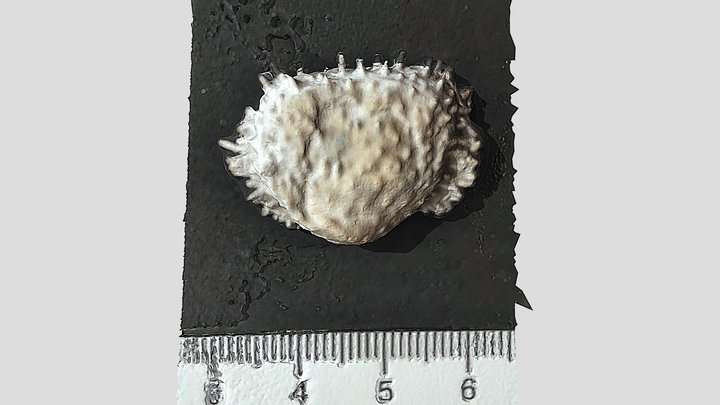
Yale Peabody Museum · CC0 · via GBIF. May be a photograph of a specimen, or an artist’s reconstruction — an interpretation of a skeleton, since colour and soft tissue are almost never preserved.
On record
Recorded, not inferred- Sits inside
- PaucispinauriinaePBDB
- Diet
- suspension feederPBDB, for Productidina
- Life habit
- low-level epifaunalPBDB, for Productidina
- Motility
- stationaryPBDB, for Productidina
- Vision
- blindPBDB, for Strophomenata
- Environment
- marinePBDB, for Lophophorata
Time the record covers
At least 14 million years on record.
The record covers at least 274.4 Mya to 259.857 Mya. No occurrence read is dated outside 283.3 Mya to 254.14 Mya.
130 occurrences of Grandaurispina on record, most of them in the Permian. Bar height is expected occurrences, not a count: each fossil is spread across the span it is dated to, so a tall narrow bar means tight dating and a low wide one means loose.
When
130 occurrences- Permian100%
These are dates about fossils, not the animal: the record can only begin after it arose and end before it died out, so either end may reach further. Shares are expected occurrences: a fossil dated to a span is counted partly in each period it straddles. More on what this infers.
Found in
13 formations
- Gerster Formation · Park City Group45
- Word Formation38
- Cherry Canyon Formation15
- Cathedral Mountain Formation9
- Khuff Formation5
- Kamiyasse Formation5
Loading coastlines…
The named rock units Grandaurispina has been recovered from, largest first. Drawn where the rock is now, not where it formed. 1 occurrence has no formation on record, which is common for older literature.
Grandaurispina and its relatives
PermianWhere Grandaurispina and its relatives were recorded in the Permian.
Found in the same rock
1,022 taxa- Ctenalosia fixata41 sites
- Xestotrema pulchrum40 sites
- Echinauris subhorrida38 sites
- Bryozoa37 sites
- Cyclacantharia kingorum33 sites
- Liosotella wordensis31 sites
- Meekella skenoides31 sites
- Composita parasulcata29 sites
- Crinoidea29 sites
- Xenosteges quadratus29 sites
- Composita mira28 sites
- Dielasma28 sites
- Dielasma phosphoriensis26 sites
- Cleiothyridina25 sites
- Echinosteges tuberculatus25 sites
- Cooperina inexpectata23 sites
- Derbyia texta23 sites
- Derbyia pannucia22 sites
- Derbyia sulca22 sites
- Dyoros (Dyoros) extensus22 sites
- Echinauris lateralis22 sites
- Heteralosia hystricula22 sites
- Girtypecten sublaqueatus21 sites
- Hustedia elongata21 sites
The Paleobiology Database records 112 sites for Grandaurispina, and this reads all of them. The number is how many of those sites it was catalogued from too. The 24 sharing the most are listed.
This is not a list of everything alive at the time. It is only what has come out of the same ground as this animal and been written down.
Entered from
9 references- Permian Brachiopods of West Texas, VI66
- The biostratigraphy and paleoecology of the Gerster Limestone (Upper Permian) in Nevada and Utah45
- Middle Permian (Wordian) mixed Boreal‒Tethyan brachiopod fauna from Kamiyasse‒Imo, South Kitakami Belt, Japan7
- Taxonomy and quantitative biochronology of Guadalupian brachiopods from the Khuff Formation, southeastern Oman4
- The Guadalupian fauna3
- Kalashnikov, 19932
- A Permian (late Guadalupian) brachiopod fauna from northeast Mexico and their paleobiogeographic affinities1
- Permian climatic and paleogeographic changes in northern Gondwana: the Khuff Formation of interior Oman1
- Middle Permian brachiopods from the Moribu area, Hida Gaien Belt, central Japan1
Each of the 130 occurrences read was entered from one of these publications, ordered by how many each accounts for. This is not a search for papers mentioning the name. Entries link to doi.org where the Paleobiology Database holds an identifier, and to its own record where it does not. Relayed as the Paleobiology Database holds them, not checked against what they resolve to.
Media and terms
Media content2
Picture of Grandaurispina
- Source
- GBIF
- Credit
- Yale Peabody Museum
- Licence
- CC0
- Commercial use
- the licence allows it
Smithsonian Open Access was not reached for this taxon, so this list is what the others held rather than everything there is.
This is what the site found, which is not the same as what exists.
Keep going
Everything alive alongside itPaucispinauriinae through timeFormations of the PermianThe world it lived on
Occurrence data from the Paleobiology Database, CC BY 4.0. Muir-Wood and Cooper 1960