Glaphyraspis
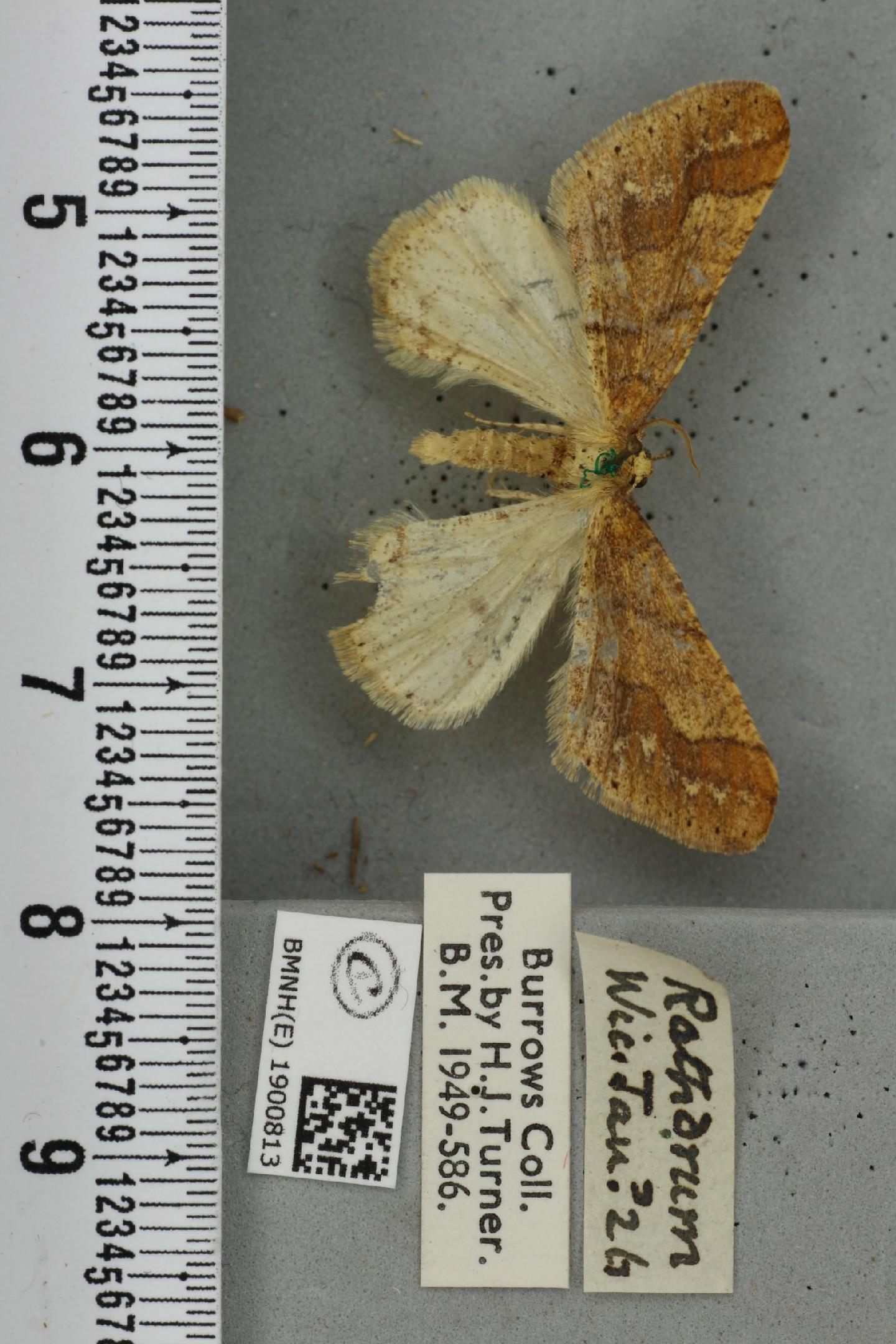
Not Glaphyraspis. This is Agriopis marginaria (Fabricius), a relative.
via GBIF · CC0 · via GBIF. May be a photograph of a specimen, or an artist’s reconstruction — an interpretation of a skeleton, since colour and soft tissue are almost never preserved.
On record
Recorded, not inferred- Sits inside
- LonchocephalidaePBDB
- Diet
- carnivorePBDB, for Trilobita
- Life habit
- low-level epifaunalPBDB, for Trilobita
- Motility
- fast-movingPBDB, for Trilobita
- Vision
- well-developedPBDB, for Lonchocephalidae
- Environment
- marinePBDB, for Trilobita
Time the record covers
At most 18 million years on record.
Every occurrence read is dated to somewhere between 504.5 Mya and 486.85 Mya, and nothing in the dating separates them, so that window is what the record shows rather than a span.
52 occurrences of Glaphyraspis on record, most of them in the Cambrian. Bar height is expected occurrences, not a count: each fossil is spread across the span it is dated to, so a tall narrow bar means tight dating and a low wide one means loose.
When
52 occurrences- Cambrian100%
These are dates about fossils, not the animal: the record can only begin after it arose and end before it died out, so either end may reach further. Shares are expected occurrences: a fossil dated to a span is counted partly in each period it straddles. More on what this infers.
Found in
13 formations
- Riley Formation13
- Deadwood Formation12
- Rabbitkettle Formation6
- Gatesburg Formation5
- Zhumabai Formation4
- Pilgrim Formation2
Loading coastlines…
The named rock units Glaphyraspis has been recovered from, largest first. Drawn where the rock is now, not where it formed. 1 occurrence has no formation on record, which is common for older literature.
Glaphyraspis and its relatives
CambrianWhere Glaphyraspis and its relatives were recorded in the Cambrian.
Found in the same rock
123 taxa- Cheilocephalus brevilobus15 sites
- Aphelaspis haguei14 sites
- Aphelaspis walcotti11 sites
- Blountia6 sites
- Cheilocephalus6 sites
- Blountia bristolensis5 sites
- Buttsia drabensis4 sites
- Cliffia lataegenae4 sites
- Crepicephalus4 sites
- Deckera completa4 sites
- Dictyonina perforata4 sites
- Kingstonia4 sites
- Nahannagnostus nganasanicus4 sites
- Aphelaspis3 sites
- Aphelaspis spinosa3 sites
- Coosina ariston3 sites
- Glyptagnostus reticulatus3 sites
- Homagnostus obesus3 sites
- Hypseloconus simplex3 sites
- Innitagnostus inexpectans3 sites
- Irvingella major3 sites
- Pinctus latus3 sites
- Porifera3 sites
- Pseudagnostina douvillei3 sites
The Paleobiology Database records 48 sites for Glaphyraspis, and this reads all of them. The number is how many of those sites it was catalogued from too. The 24 sharing the most are listed.
This is not a list of everything alive at the time. It is only what has come out of the same ground as this animal and been written down.
Entered from
13 references- The Faunas of the Riley Formation in Central Texas13
- Trilobites, Biostratigraphy, and Lithostratigraphy of the Crepicephalus and Aphelaspis zones, Lower Deadwood formation (Marjuman and Steptoean Stages, Upper Cambrian), Black Hills, South Dakota11
- Trilobites of the Marjuman and Steptoean stages (Upper Cambrian), Rabbitkettle Formation, southern Mackenzie Mountains, northwest Canada6
- High-Resolution Biostratigraphy in the Upper Cambrian ore hill Member of Gatesburg Formation, South-Central Pennsylvnia5
- Cambrian Malyy Karatau Range, Kazakhstan4
- A Cambrian Aphelaspis fauna from Steele Butte, near Boulder, Wyoming3
- Trilobites of the Late Cambrian Pterocephaliid Biomere in the Great Basin, United States2
- An Aphelaspis Zone faunule from Logan, Montana2
- Dresbachian and Franconian trilobites of the Conococheague and Frederick Limestones of the central Appalachians2
- Molluscs of the Holm Dal Formation (late Middle Cambrian), central North Greenland1
- Ontogenies of three late Cambrian trilobites from the Deadwood Formation, northern Black Hills, South Dakota1
- Crepicephalus Faunule from the Bonneterre Dolomite (Upper Cambrian) of Missouri1
Each of the 52 occurrences read was entered from one of these publications, ordered by how many each accounts for. This is not a search for papers mentioning the name. 1 further reference is not listed. Entries link to doi.org where the Paleobiology Database holds an identifier, and to its own record where it does not. Relayed as the Paleobiology Database holds them, not checked against what they resolve to.
Media and terms
Media content1
Picture of Agriopis marginaria (Fabricius)
- Source
- GBIF
- Credit
- via GBIF
- Licence
- CC0
- Commercial use
- the licence allows it
No 3D scan was found. Smithsonian Open Access, MorphoSource and Sketchfab were all searched.
This is what the site found, which is not the same as what exists.
Keep going
What may have been alongside itLonchocephalidae through timeFormations of the CambrianThe world it lived on
Occurrence data from the Paleobiology Database, CC BY 4.0. Resser 1937