Gaylussacia
Gaylussacia is a genus of about fifty species of flowering plants in the family Ericaceae, native to the Americas, where they occur in eastern North America and in South America in the Andes and the mountains of southeastern Brazil. Common English names include huckleberry and "dangleberry".

Johann Baptist Emanuel Pohl · Public Domain · via Wikipedia/Commons. May be a photograph of a specimen, or an artist’s reconstruction — an interpretation of a skeleton, since colour and soft tissue are almost never preserved.
On record
Recorded, not inferred- Sits inside
- EricaceaePBDB
- Diet
- "photoautotroph"PBDB, for Angiospermae
Time the record covers
At least 8.4 million years on record.
The record covers at least 13.82 Mya to 5.333 Mya. No occurrence read is dated outside 15.98 Mya to 2.58 Mya.
5 occurrences of Gaylussacia on record, most of them in the Miocene. The Paleobiology Database records this as a living group, and the chart stops with its fossils rather than at the present. Bar height is expected occurrences, not a count: each fossil is spread across the span it is dated to, so a tall narrow bar means tight dating and a low wide one means loose.
When
5 occurrencesThese are dates about fossils, not the animal: the record can only begin after it arose and end before it died out, so either end may reach further. Shares are expected occurrences: a fossil dated to a span is counted partly in each period it straddles. More on what this infers.
Gaylussacia and its relatives
MioceneWhere Gaylussacia and its relatives were recorded in the Miocene.
Found in the same rock
32 taxa- Acacia1 site
- Aeschynomene1 site
- Amicia antiqua1 site
- Caesalpinia1 site
- Caesalpinites1 site
- Cassia1 site
- Copaifera1 site
- Cuphea antiqua1 site
- Dodonaea1 site
- Drepanocarpus franckei1 site
- Duvaua pliocenica n. sp.1 site
- Enterolobium grandifolium1 site
- Goniopteris1 site
- Hoffmannia1 site
- Inga1 site
- Jacaranda potosina1 site
- Lonchocarpus1 site
- Machaerium eriocarpoides1 site
- Machaerium milleri1 site
- Mimosa1 site
- Mimosites1 site
- Myrica1 site
- Myrteola potosiana1 site
- Osteomeles pliocenica1 site
The Paleobiology Database records 1 site for Gaylussacia, and this reads all of them. The number is how many of those sites it was catalogued from too. The 24 sharing the most are listed.
This is not a list of everything alive at the time. It is only what has come out of the same ground as this animal and been written down.
Entered from
4 references- Miocene floras in the lower Rhenish basin and their ecological interpretation2
- Die mittelmiozaenen und obermiozaenen Floren aus der Meuroer und Raunoer Folge in der Lausitz. III. Fundstellen und Palaeobiologie1
- Allochthonous seed and fruit floras from the Pliocene of the Lower Rhine Basin1
- The fossil flora of Potosi, Bolivia1
Each of the 5 occurrences read was entered from one of these publications, ordered by how many each accounts for. This is not a search for papers mentioning the name. Each entry links to the Paleobiology Database's own record for the work.
Media and terms
Media content1
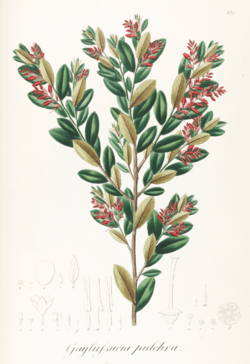
Picture of Gaylussacia
- Source
- Wikipedia/Commons
- Credit
- Johann Baptist Emanuel Pohl
- Licence
- Public Domain
- Commercial use
- the licence allows it
No 3D scan of Gaylussacia was found in Sketchfab.
Smithsonian Open Access and MorphoSource were not reached for this taxon, so this list is what the others held rather than everything there is.
The description on this site
- Source
- Wikipedia, “Gaylussacia”
- Licence
- CC BY-SA 4.0
This is what the site found, which is not the same as what exists.
Keep going
What may have been alongside itEricaceae through timeFormations of the MioceneThe world it lived on
Occurrence data from the Paleobiology Database, CC BY 4.0. Kunth 1818