Gastornis
Gastornis is an extinct genus of large, flightless birds that lived during the mid-Paleocene to mid-Eocene epochs of the Paleogene period. Most fossils have been found in Europe, and some species typically referred to the genus are known from North America and Asia. Several genera, including the well-studied genus Diatryma, have historically been considered junior synonyms of Gastornis. However, this interpretation has been challenged recently, and some researchers currently consider Diatryma to be a valid genus.

Vince Smith from London, United Kingdom · CC BY-SA 2.0 · via Wikipedia/Commons. May be a photograph of a specimen, or an artist’s reconstruction — an interpretation of a skeleton, since colour and soft tissue are almost never preserved.
On record
Recorded, not inferred- Sits inside
- GastornithidaePBDB
- Diet
- herbivorePBDB, for Galloanserae
- Life habit
- volantPBDB, for Galloanserae
- Motility
- actively mobilePBDB, for Theropoda
- Environment
- terrestrialPBDB, for Theropoda
Time the record covers
At least 3.2 million years on record.
The record covers at least 59.24 Mya to 56 Mya. No occurrence read is dated outside 61.66 Mya to 48.07 Mya.
13 occurrences of Gastornis on record, most of them in the Paleocene. Bar height is expected occurrences, not a count: each fossil is spread across the span it is dated to, so a tall narrow bar means tight dating and a low wide one means loose.
When
13 occurrencesThese are dates about fossils, not the animal: the record can only begin after it arose and end before it died out, so either end may reach further. Shares are expected occurrences: a fossil dated to a span is counted partly in each period it straddles. More on what this infers.
Found in
6 formations
- Sables de Bracheux Formation3
- Conglomérat de Cernay Formation1
- Vaugirard Formation1
- Margaret Formation · Eureka Sound Group1
- Heers Formation1
- Woolwich Formation1
Loading coastlines…
The named rock units Gastornis has been recovered from, largest first. Drawn where the rock is now, not where it formed. 5 occurrences have no formation on record, which is common for older literature.
Gastornis and its relatives
PaleoceneWhere Gastornis and its relatives were recorded in the Paleocene.
Found in the same rock
212 taxa- Asiatosuchus depressifrons4 sites
- Aves3 sites
- Berruvius lasseroni3 sites
- Boidae3 sites
- Bustylus cernaysi3 sites
- Bustylus germanicus3 sites
- Camptognathosaurus walbeckensis3 sites
- Trionyx3 sites
- Adapisorex2 sites
- Adapisoriculidae2 sites
- Afrodon2 sites
- Anura2 sites
- Berruchelus russelli2 sites
- Berrulestes pellouini2 sites
- Berrulestes phelizoni2 sites
- Berrulestes poirieri2 sites
- Berruornis orbisantiqui2 sites
- Chiromyoides campanicus2 sites
- Dipavali petri2 sites
- Diplocynodon2 sites
- Diplocynodon remensis2 sites
- Dissacus europaeus2 sites
- Eolacerta2 sites
- Fabaceae2 sites
The Paleobiology Database records 9 sites for Gastornis, and this reads all of them. The number is how many of those sites it was catalogued from too. The 24 sharing the most are listed.
This is not a list of everything alive at the time. It is only what has come out of the same ground as this animal and been written down.
Entered from
9 references- The status of the Late Paleocene birds Gastornis and Remiornis5
- Giant Birds from the Uppermost Paleocene of Rivecourt (Oise, Northern France)1
- Description of a new species of Gastornis (Aves, Gastornithiformes) from the early Eocene of La Borie, southwestern France1
- New Paleocene bird fossils from the North Sea Basin in Belgium and France1
- The Gastornis (Aves, Gastornithidae) from the Late Paleocene of Louvois (Marne, France)1
- The palaeobiology of high latitude birds from the early Eocene greenhouse of Ellesmere Island, Arctic Canada1
- Early Eocene birds from La Borie, southern France1
- The birds from the Paleocene fissure filling of Walbeck (Germany)1
- Birds of the British Lower Eocene1
Each of the 13 occurrences read was entered from one of these publications, ordered by how many each accounts for. This is not a search for papers mentioning the name. Entries link to doi.org where the Paleobiology Database holds an identifier, and to its own record where it does not. Relayed as the Paleobiology Database holds them, not checked against what they resolve to.
Media and terms
Media content2

Picture of Gastornis
- Source
- Wikipedia/Commons
- Credit
- Vince Smith from London, United Kingdom
- Licence
- CC BY-SA 2.0
- Commercial use
- the licence allows it
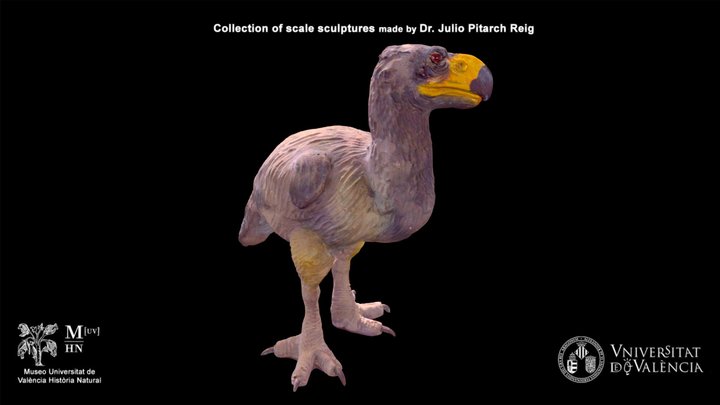
3D model
- Source
- Sketchfab
- Licence
- CC Attribution
- Commercial use
- cannot be read from the licence given — check the record
Smithsonian Open Access and MorphoSource were not reached for this taxon, so this list is what the others held rather than everything there is.
The description on this site
- Source
- Wikipedia, “Gastornis”
- Licence
- CC BY-SA 4.0
This is what the site found, which is not the same as what exists.
Keep going
What may have been alongside itGastornithidae through timeFormations of the PaleoceneThe world it lived on
Occurrence data from the Paleobiology Database, CC BY 4.0. Hébert 1855