Evanioidea
The Evanioidea are a small hymenopteran superfamily that includes three extant families, two of which are much more closely related to one another than they are to the remaining family, Evaniidae. The rich fossil record, however, helps fill in the gaps between these lineages. They all share the trait of having the metasoma attached very high above the hind coxae on the propodeum.

Muhammad Mahdi Karim · GFDL 1.2 · via Wikipedia/Commons. May be a photograph of a specimen, or an artist’s reconstruction — an interpretation of a skeleton, since colour and soft tissue are almost never preserved.
On record
Recorded, not inferred- Sits inside
- ApocritaPBDB
- Motility
- actively mobilePBDB, for Arthropoda
- Environment
- terrestrialPBDB, for Insecta
Time the record covers
At least 469 million years on record.
The record covers at least 469.1 Mya to 11.7 ka. No occurrence read is dated outside 471.3 Mya to 0 Mya.
259 occurrences of Evanioidea on record, most of them in the Early Cretaceous. The Paleobiology Database records this as a living group. Bar height is expected occurrences, not a count: each fossil is spread across the span it is dated to, so a tall narrow bar means tight dating and a low wide one means loose.
When
259 occurrences- Ordovicianunder 1%
- Middle Jurassic7%
- Late Jurassic26%
- Early Cretaceous29%
- Late Cretaceous24%
- Paleoceneunder 1%
- Eocene9%
- Miocene3%
- Holoceneunder 1%
These are dates about fossils, not the animal: the record can only begin after it arose and end before it died out, so either end may reach further. Shares are expected occurrences: a fossil dated to a span is counted partly in each period it straddles. More on what this infers.
Found in
33 formations
- Daohugou Formation49
- Karabastau Formation31
- Yixian Formation · Jehol Group14
- Gurvan-Eren Formation8
- Zaza Formation6
- Escucha Formation5
Loading coastlines…
The named rock units Evanioidea has been recovered from, largest first. Drawn where the rock is now, not where it formed. 9 further formations hold fewer occurrences each and are not listed. 84 occurrences have no formation on record, which is common for older literature.
Evanioidea and its relatives
Early CretaceousWhere Evanioidea and its relatives were recorded in the Early Cretaceous.
Found in the same rock
4,132 taxa- Protoscelis jurassica8 sites
- Archirhyphus asiaticus7 sites
- Liassothrips crassipes7 sites
- Protoscelis longicornis7 sites
- Distenorrhinus (Distenorrhinus) pallidirostris6 sites
- Kararhynchus occiduus6 sites
- Paramesopsocus adibi6 sites
- Polyanka minuta6 sites
- Procramptonomyia kovalevi6 sites
- Protoscelis nitidicornis6 sites
- Blattogryllus karatavicus5 sites
- Eoptychopterina karatavica5 sites
- Mycetophiloidea5 sites
- Parandrexis parvula5 sites
- Protoscelis parvula5 sites
- Tanypodinae5 sites
- Abolescus glabratus4 sites
- Ampliceps furcitibia4 sites
- Apocrita4 sites
- Araneoidea4 sites
- Charonoscapha ovata4 sites
- Chironomaptera vesca4 sites
- Coptoclava longipoda4 sites
- Dermapteron incerta4 sites
The Paleobiology Database records 93 sites for Evanioidea, and this reads all of them. Of that, one read hit the database's own return limit, so every count below is a floor rather than a total. The number is how many of those sites it was catalogued from too. The 24 sharing the most are listed.
This is not a list of everything alive at the time. It is only what has come out of the same ground as this animal and been written down.
Entered from
94 references- Late Jurassic hymenopterous insects (Preaulacidae) of Karatau28
- Middle Jurassic Praeaulacidae (Insecta: Hymenoptera: Evanioidea) of Inner Mongolia and Kazakhstan17
- Phylogeny of Evanioidea (Hymenoptera, Apocrita), with descriptions of new Mesozoic species from China and Myanmar11
- Hymenoptera Apocrita of Mesozoic9
- New representatives of the hymenopterous family Praeaulacidae from Early Cretaceous Buryatia and Mongolia8
- Wasps. Vespida (=Hymenoptera), in Nasekomye v rannemelovykh ekosistemakh zapadnoy Mongolii8
- Anomopterellidae restored, with two new genera and its phylogeny in Evanioidea (Hymenoptera)7
- Wasps (Insecta: Vespida = Hymenoptera) from the Purbeck and Wealden (Lower Cretaceous) of southern England and their biostratigraphical and palaeoenvironmental significance7
- The Parasitic Hymenoptera of the Baltic Amber7
- Revision of Anomopterella Rasnitsyn, 1975 (Insecta, Hymenoptera, Anomopterellidae) with two new Middle Jurassic species from northeastern China6
- Nevaniinae subfam. n, a new fossil taxon (Insecta: Hymenoptera: Evanioidea: Praeaulicidae) from the Middle Jurassic of Daohugou in Inner Mongolia, China6
- Mesozoic Evaniidae (Insecta: Hymenoptera) in Spanish amber: reanalysis of the phylogeny of the Evanioidea5
Each of the 259 occurrences read was entered from one of these publications, ordered by how many each accounts for. This is not a search for papers mentioning the name. 82 further references are not listed. Entries link to doi.org where the Paleobiology Database holds an identifier, and to its own record where it does not. Relayed as the Paleobiology Database holds them, not checked against what they resolve to.
Media and terms
Media content1
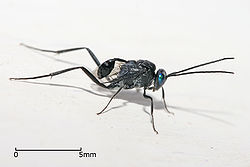
Picture of Evanioidea
- Source
- Wikipedia/Commons
- Credit
- Muhammad Mahdi Karim
- Licence
- GFDL 1.2
- Commercial use
- the licence allows it
No 3D scan of Evanioidea was found in Sketchfab.
Smithsonian Open Access and MorphoSource were not reached for this taxon, so this list is what the others held rather than everything there is.
The description on this site
- Source
- Wikipedia, “Evanioidea”
- Licence
- CC BY-SA 4.0
This is what the site found, which is not the same as what exists.
Keep going
What may have been alongside itApocrita through timeFormations of the Early CretaceousThe world it lived on
Occurrence data from the Paleobiology Database, CC BY 4.0. Latreille 1802