Ephemeroidea
Ephemeroidea is a superfamily of mayflies. Members of this superfamily are found in most parts of the world with the exception of the Arctic, the Antarctic and Australia.

Uncredited · CC BY-SA 3.0 · via Wikipedia/Commons. May be a photograph of a specimen, or an artist’s reconstruction — an interpretation of a skeleton, since colour and soft tissue are almost never preserved.
On record
Recorded, not inferred- Sits inside
- SchistonotaPBDB
- Motility
- actively mobilePBDB, for Arthropoda
- Environment
- terrestrialPBDB, for Insecta
Time the record covers
At least 151 million years on record.
The record covers at least 237 Mya to 85.7 Mya. No occurrence read is dated outside 247 Mya to 83.6 Mya.
19 occurrences of Ephemeroidea on record, most of them in the Early Cretaceous. The Paleobiology Database records this as a living group, and the chart stops with its fossils rather than at the present. Bar height is expected occurrences, not a count: each fossil is spread across the span it is dated to, so a tall narrow bar means tight dating and a low wide one means loose.
When
19 occurrencesThese are dates about fossils, not the animal: the record can only begin after it arose and end before it died out, so either end may reach further. Shares are expected occurrences: a fossil dated to a span is counted partly in each period it straddles. More on what this infers.
Found in
6 formations
- Crato Formation · Santana Group10
- Kheta Formation3
- Raritan Formation · Potomac Group1
- Uda Formation1
- Tsagaantsav Formation1
- Varengayakhinskaya Formation · Tampeiskaya Group1
Loading coastlines…
The named rock units Ephemeroidea has been recovered from, largest first. Drawn where the rock is now, not where it formed. 2 occurrences have no formation on record, which is common for older literature.
Ephemeroidea and its relatives
Early CretaceousWhere Ephemeroidea and its relatives were recorded in the Early Cretaceous.
Found in the same rock
739 taxa- Ephemeroptera4 sites
- Araripeliupanshania annesuseae3 sites
- Chresmoda neotropica3 sites
- Colocrus indivicum3 sites
- Cretereisma3 sites
- Gomphaeschnaoides obliquus3 sites
- Pristiplocia rupestris3 sites
- Protoligoneuria limai3 sites
- Wightonia araripina3 sites
- Ampulicidae2 sites
- Aphytocerus communis2 sites
- Araripegomphus andreneli2 sites
- Araripeneura damianii2 sites
- Araripephlebia mirabilis2 sites
- Archaepyris minutus2 sites
- Archichrysotus hennigi2 sites
- Atriculicoides2 sites
- Atriculicoides macrophthalmus2 sites
- Austroconops sibiricus2 sites
- Baeomorpha gracilis2 sites
- Baeomorpha quattoruno2 sites
- Blittersdorffia pleoneura2 sites
- Cordulagomphus (Procordulagomphus) michaeli2 sites
- Cordulagomphus (Procordulagomphus) xavieri2 sites
The Paleobiology Database records 15 sites for Ephemeroidea, and this reads all of them. The number is how many of those sites it was catalogued from too. The 24 sharing the most are listed.
This is not a list of everything alive at the time. It is only what has come out of the same ground as this animal and been written down.
Entered from
10 references- Insects from the Santana Formation, Lower Cretaceous of Brazil. Chapter 2: Ephemeroptera4
- Martill et al., 20073
- New data on mayflies (Ephemeroptera) from Mesozoic and Cenozoic resins3
- Efêmeras escavadoras (Insecta, Ephemeroptera, Ephemeropidea) na Formaçào Santana (Cretáceo inferior), bacia do Araripe Nordeste do Brasil: descriçào de três novos gêneros e trêes novas espécies (ninfas)3
- A new genus and species of Australiphemeridae (Insecta: Ephemeroptera) in mid-Cretaceous Kachin amber of northern Myanmar1
- A new Cretaceous mayfly from Burmese amber (Ephemeroptera: Australiphemeridae)1
- New Jersey amber mayflies: the first North American Mesozoic members of the order (Insecta; Ephemeroptera)1
- A review of Triassic mayflies, with a description of new species from western Siberia and Ukraine (Ephemerida = Ephemeroptera)1
- New Mesozoic mayflies (Ephemerida) from Mongolia1
- Distinctive new mayfly nymphs (Ephemeroptera: Palingeniidae, Behingiidae) from the Jurassic of Transbaikalia1
Each of the 19 occurrences read was entered from one of these publications, ordered by how many each accounts for. This is not a search for papers mentioning the name. Entries link to doi.org where the Paleobiology Database holds an identifier, and to its own record where it does not. Relayed as the Paleobiology Database holds them, not checked against what they resolve to.
Media and terms
Media content1
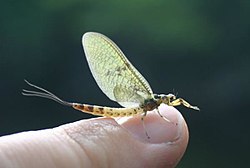
Picture of Ephemeroidea
- Source
- Wikipedia/Commons
- Credit
- nobody named on the record
- Licence
- CC BY-SA 3.0
- Commercial use
- the licence allows it
No 3D scan of Ephemeroidea was found in MorphoSource and Sketchfab.
Smithsonian Open Access was not reached for this taxon, so this list is what the others held rather than everything there is.
The description on this site
- Licence
- CC BY-SA 4.0
This is what the site found, which is not the same as what exists.
Keep going
What may have been alongside itSchistonota through timeFormations of the Early CretaceousThe world it lived on
Occurrence data from the Paleobiology Database, CC BY 4.0. Latreille 1810