Ebala
Ebala is a genus of sea snails, marine gastropod mollusks in the subfamily Ebalinae, family Murchisonellidae.

George Washington Tryon (1838–1888) · Public Domain · via Wikipedia/Commons. May be a photograph of a specimen, or an artist’s reconstruction — an interpretation of a skeleton, since colour and soft tissue are almost never preserved.
On record
Recorded, not inferred- Sits inside
- MurchisonellidaePBDB
- Diet
- carnivorePBDB, for Murchisonellidae
- Life habit
- epifaunalPBDB, for Murchisonellidae
- Motility
- actively mobilePBDB, for Murchisonellidae
- Vision
- limitedPBDB, for Gastropoda
Time the record covers
At least 233 million years on record.
The record covers at least 233.6 Mya to 129 ka. No occurrence read is dated outside 237 Mya to 11.7 ka.
24 occurrences of Ebala on record, most of them in the Miocene. The Paleobiology Database records this as a living group. Bar height is expected occurrences, not a count: each fossil is spread across the span it is dated to, so a tall narrow bar means tight dating and a low wide one means loose.
When
24 occurrences- Late Triassic8%
- Middle Jurassic4%
- Early Cretaceous4%
- Late Cretaceous4%
- Paleocene13%
- Eocene4%
- Oligocene8%
- Miocene46%
- Pliocene4%
- Pleistocene4%
These are dates about fossils, not the animal: the record can only begin after it arose and end before it died out, so either end may reach further. Shares are expected occurrences: a fossil dated to a span is counted partly in each period it straddles. More on what this infers.
Found in
6 formations
- Lellinge Greensand Formation2
- Cassian Formation2
- Falun de Saucats Formation2
- Borgloon Formation · Tongeren Group2
- Selsey Formation · Bracklesham Group1
- Calcaire de Mons Formation1
Loading coastlines…
The named rock units Ebala has been recovered from, largest first. Drawn where the rock is now, not where it formed. 14 occurrences have no formation on record, which is common for older literature.
Ebala and its relatives
MioceneWhere Ebala and its relatives were recorded in the Miocene.
Found in the same rock
1,224 taxa- Naticidae11 sites
- Roxania11 sites
- Babylonella10 sites
- Euspira10 sites
- Limopsis10 sites
- Odostomia10 sites
- Odostomia (Megastomia)10 sites
- Tectonatica10 sites
- Alvania9 sites
- Asthenotoma9 sites
- Nassarius9 sites
- Parvicardium9 sites
- Sassia9 sites
- Syrnola9 sites
- Turritella9 sites
- Varicorbula gibba9 sites
- Anachis (Costoanachis)8 sites
- Aporrhais (Aporrhais)8 sites
- Astarte (Astarte) radiata8 sites
- Balcis (Balcis)8 sites
- Boreodrillia8 sites
- Circulus8 sites
- Cochlis tigrina8 sites
- Conus (Conolithes)8 sites
The Paleobiology Database records 19 sites for Ebala, and this reads all of them. The number is how many of those sites it was catalogued from too. The 24 sharing the most are listed.
This is not a list of everything alive at the time. It is only what has come out of the same ground as this animal and been written down.
Entered from
13 references- Die Fauna des marinen Miozäns von Kevelaer (Niederrhein). Band 4 Gastropoda ab Mitridae8
- The molluscan fauna of the Borgloon Formation in Belgium (Rupelian, Early Oligocene)2
- The evolution of conch ontogeny in Mesozoic open sea gastropods2
- Révision des Gastropoda (Mollusca) du stratotype de L'Aquitanien (Miocéne inf.) site de Saucats "Lariey", Gironde, France2
- The Selandian (Paleocene) mollusc fauna from Copenhagen, Denmark: the Poul Harder 1920 collection2
- Paleobiology from Museum collections: comparing historical and novel data on Upper Miocene molluscs of the Livorno Hills1
- Diversity and palaeoecology of a highly diverse Late Triassic marine biota from the Cassian Formation of north Italy1
- Shallow-buried Pleistocene Madrepora-dominated coral mounds on a muddy continental slope, Tuscan Archipelago, NE Tyrrhenian Sea1
- Some heterostrophic gastropods from Triassic St. Cassian Formation with a discussion on the classification of the Allogastropoda1
- Distribution of Mollusca in Units S1 to S9 of the Selsey Formation (middle Lutetian), Selsey Peninsula, West Sussex1
- Facies analysis, paleoecology and sequence stratigraphy in a Pliocene siliciclastic succession, Sanb Miniato (Pisa, Italy)1
- Faziesverteilung und Fossilvergesellschaftungen im karbonatischen Flachwassser-Milieu der alpinen Oberkreide (Gosau-Formation) [Facies and fossils from the Upper Cretaceous carbonate shallow water deposits of the Eastern Alps (Gosau Formation)]1
Each of the 24 occurrences read was entered from one of these publications, ordered by how many each accounts for. This is not a search for papers mentioning the name. 1 further reference is not listed. Entries link to doi.org where the Paleobiology Database holds an identifier, and to its own record where it does not. Relayed as the Paleobiology Database holds them, not checked against what they resolve to.
Media and terms
Media content1
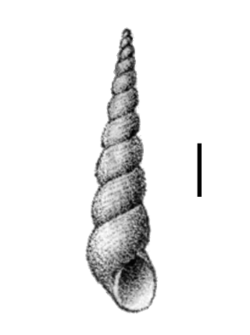
Picture of Ebala
- Source
- Wikipedia/Commons
- Credit
- George Washington Tryon (1838–1888)
- Licence
- Public Domain
- Commercial use
- the licence allows it
No 3D scan of Ebala was found in Smithsonian Open Access and Sketchfab.
MorphoSource was not reached for this taxon, so this list is what the others held rather than everything there is.
The description on this site
- Source
- Wikipedia, “Ebala”
- Licence
- CC BY-SA 4.0
This is what the site found, which is not the same as what exists.
Keep going
What may have been alongside itMurchisonellidae through timeFormations of the MioceneThe world it lived on
Occurrence data from the Paleobiology Database, CC BY 4.0. Gray 1847