Dryopteris
Dryopteris, commonly called the wood ferns, male ferns, or buckler ferns, is a fern genus in the family Dryopteridaceae, subfamily Dryopteridoideae, according to the Pteridophyte Phylogeny Group classification of 2016 (PPG I). There are about 300-400 species in the genus. The species are distributed in Asia, the Americas, Europe, Africa, and the Pacific islands, with the highest diversity in eastern Asia. It is placed in the family Dryopteridaceae, subfamily Dryopteridoideae, according to the Pteridophyte Phylogeny Group classification of 2016 (PPG I). Many of the species have stout, slowly creeping rootstocks that form a crown, with a vase-like ring of fronds. The sori are round, with a peltate indusium. The stipes have prominent scales.

Carl Axel Magnus Lindman · Public Domain · via Wikipedia/Commons. May be a photograph of a specimen, or an artist’s reconstruction — an interpretation of a skeleton, since colour and soft tissue are almost never preserved.
On record
Recorded, not inferred- Sits inside
- DryopteridoideaePBDB
- Diet
- "photoautotroph"PBDB, for Streptophyta
Time the record covers
At least 143 million years on record.
The record covers at least 143.1 Mya to 11.7 ka. No occurrence read is dated outside 161.5 Mya to 0 Mya.
41 occurrences of Dryopteris on record, most of them in the Eocene. The Paleobiology Database records this as a living group. Bar height is expected occurrences, not a count: each fossil is spread across the span it is dated to, so a tall narrow bar means tight dating and a low wide one means loose.
When
41 occurrences- Late Jurassic10%
- Late Cretaceous20%
- Paleocene20%
- Eocene23%
- Oligocene11%
- Pleistocene12%
- Holocene5%
These are dates about fossils, not the animal: the record can only begin after it arose and end before it died out, so either end may reach further. Shares are expected occurrences: a fossil dated to a span is counted partly in each period it straddles. More on what this infers.
Found in
16 formations
- Florissant Formation4
- Fort Union Formation4
- Sepulcher Formation3
- Protection Formation · Nanaimo Group3
- Frontier Formation2
- La Postrera Formation2
Loading coastlines…
The named rock units Dryopteris has been recovered from, largest first. Drawn where the rock is now, not where it formed. 12 occurrences have no formation on record, which is common for older literature.
Dryopteris and its relatives
EoceneWhere Dryopteris and its relatives were recorded in the Eocene.
Found in the same rock
512 taxa- Carya9 sites
- Rhamnites9 sites
- Pinus8 sites
- Quercus8 sites
- Salix8 sites
- Equisetum6 sites
- Sequoia6 sites
- Acer florissanti5 sites
- Athyana5 sites
- Betula5 sites
- Bursera5 sites
- Cedrelospermum5 sites
- Cercis parvifolia5 sites
- Cercocarpus5 sites
- Chamaecyparis5 sites
- Cotinus fraterna5 sites
- Crataegus5 sites
- Dicotyledoneae5 sites
- Fagopsis longifolia5 sites
- Koelreuteria5 sites
- Mahonia5 sites
- Picea5 sites
- Pinus florissanti5 sites
- Pinus hambachi5 sites
The Paleobiology Database records 33 sites for Dryopteris, and this reads all of them. The number is how many of those sites it was catalogued from too. The 24 sharing the most are listed.
This is not a list of everything alive at the time. It is only what has come out of the same ground as this animal and been written down.
Entered from
17 references- Paleocene flora of the Rocky Mountains and Great Plains8
- Fossil Plants of the Florissant Beds of Colorado5
- Paleoecological and Floristic Heterogeneity in the Plant-Fossil Record - An Analysis Based on the Eocene of Washington4
- Pre-Late Wisconsinan Pleistocene biota from southeastern Michigan, U.S.A.3
- Flora of the Upper Cretaceous Nanaimo Group of Vancouver Island, British Columbia3
- Fossil Flora of the Yellowstone National Park3
- Upper Cretaceous floras of King George Island, West Antarctica, and their palaeoenvironmental and phytogeographic implications2
- A Catalogue of Fossil Plants from India Part 2: Palaeozoic and Mesozoic Megafossils2
- Palinología de paleosuelos del Cuaternario de los alrededores de Lobería (Provincia de Buenos Aires, República Argentina)2
- Nuevos elementos florísticos del Magellaniano de Patagonia Austral2
- The fauna from the Tyrannosaurus rex excavation, Frenchman Formation (Late Maastrichtian), Saskatchewan1
- Denver Museum of Nature & Science archival records of Kirk Johnson fieldwork in Cretaceous rocks of the Rocky Mountain region.1
Each of the 41 occurrences read was entered from one of these publications, ordered by how many each accounts for. This is not a search for papers mentioning the name. 5 further references are not listed. Entries link to doi.org where the Paleobiology Database holds an identifier, and to its own record where it does not. Relayed as the Paleobiology Database holds them, not checked against what they resolve to.
Media and terms
Media content2
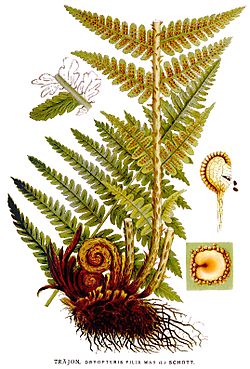
Picture of Dryopteris
- Source
- Wikipedia/Commons
- Credit
- Carl Axel Magnus Lindman
- Licence
- Public Domain
- Commercial use
- the licence allows it
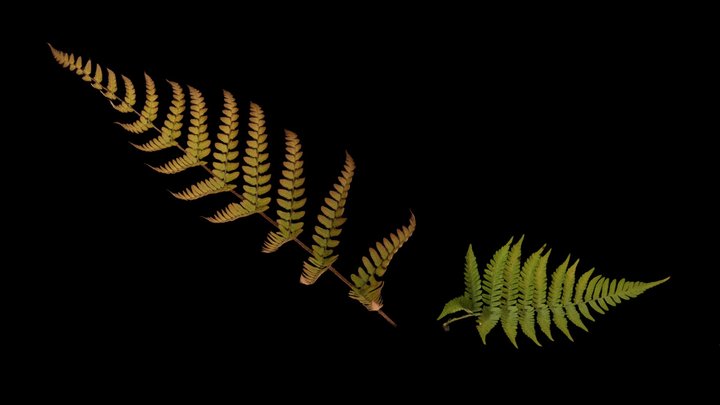
3D model
- Source
- Sketchfab
- Licence
- CC0 Public Domain
- Commercial use
- the licence allows it
The description on this site
- Source
- Wikipedia, “Dryopteris”
- Licence
- CC BY-SA 4.0
This is what the site found, which is not the same as what exists.
Keep going
What may have been alongside itDryopteridoideae through timeFormations of the EoceneThe world it lived on
Occurrence data from the Paleobiology Database, CC BY 4.0. Adanson 1763