Droseraceae
Droseraceae is a family of carnivorous flowering plants, also known as the sundew family. It consists of approximately 180 species in three extant genera, the vast majority being in the sundew genus Drosera. The family also contains the well-known Venus flytrap and the more obscure waterwheel plant, both of which are the only living species of their respective genera. Representatives of the Droseraceae are found on all continents except Antarctica.

No machine-readable author provided. NoahElhardt assumed (based on copyright claims). · CC BY-SA 2.5 · via Wikipedia/Commons. May be a photograph of a specimen, or an artist’s reconstruction — an interpretation of a skeleton, since colour and soft tissue are almost never preserved.
On record
Recorded, not inferred- Sits inside
- CaryophyllalesPBDB
- Diet
- "photoautotroph"PBDB, for Angiospermae
Time the record covers
At least 110 million years on record.
The record covers at least 113.2 Mya to 2.58 Mya. No occurrence read is dated outside 125.77 Mya to 0 Mya.
64 occurrences of Droseraceae on record, most of them in the Miocene. The Paleobiology Database records this as a living group. Bar height is expected occurrences, not a count: each fossil is spread across the span it is dated to, so a tall narrow bar means tight dating and a low wide one means loose.
When
64 occurrences- Early Cretaceous2%
- Late Cretaceous19%
- Paleocene2%
- Eocene5%
- Oligocene22%
- Miocene40%
- Plioceneunder 1%
- Pleistocene11%
- Holoceneunder 1%
These are dates about fossils, not the animal: the record can only begin after it arose and end before it died out, so either end may reach further. Shares are expected occurrences: a fossil dated to a span is counted partly in each period it straddles. More on what this infers.
Found in
10 formations
- Abu Roash Formation9
- Odderup Formation2
- Headon Beds Formation1
- Lower Headon Formation1
- Oldman Formation · Belly River Group1
- Pinodiga Formation1
Loading coastlines…
The named rock units Droseraceae has been recovered from, largest first. Drawn where the rock is now, not where it formed. 45 occurrences have no formation on record, which is common for older literature.
Droseraceae and its relatives
MioceneWhere Droseraceae and its relatives were recorded in the Miocene.
Found in the same rock
647 taxa- Tricolpites10 sites
- Cyperaceae9 sites
- Apiaceae8 sites
- Droseridites8 sites
- Ephedripites8 sites
- Foveotricolpites giganteus8 sites
- Tricolporopollenites8 sites
- Asteraceae7 sites
- Myrtaceae7 sites
- Poaceae7 sites
- Podocarpidites7 sites
- Podosporites microsaccatus7 sites
- Agathis6 sites
- Caryophyllaceae6 sites
- Cretacaeiporites mullerii6 sites
- Cupressaceae6 sites
- Dacrydium6 sites
- Deltoidospora diaphana6 sites
- Dictyophyllidites harrisii6 sites
- Drosera6 sites
- Droseridites senonicus6 sites
- Eucalyptus6 sites
- Fabaceae6 sites
- Foveomorphomonocolpites rashadi6 sites
The Paleobiology Database records 27 sites for Droseraceae, and this reads all of them. The number is how many of those sites it was catalogued from too. The 24 sharing the most are listed.
This is not a list of everything alive at the time. It is only what has come out of the same ground as this animal and been written down.
Entered from
20 references- Tretichnye Flory Zapadnoi Sibiri26
- Aptian-Turonian palynology of the Ghazalat-1 well (GTX-1), Qattara Depression, Egypt6
- Early Pleistocene vegetation change in upland south-eastern Australia4
- Die mittelmiozaenen und obermiozaenen Floren aus der Meuroer und Raunoer Folge in der Lausitz. III. Fundstellen und Palaeobiologie4
- Die Floren des Haselbacher Serie im Weisselster-Becken (Bezirk Leipzig, DDR)4
- A Catalogue of Fossil Plants from India Part 6: Cenozoic (Quaternary) Palynology and Palaeobotany3
- Palynological, palynofacies, paleoenvironmental and organic geochemical studies on the Upper Cretaceous succession of the GPTSW-7 well, North Western Desert, Egypt2
- The Damgaard flora: A new Middle Miocene flora from Denmark2
- Flora of the Lower Headon Beds of Hampshire and the Isle of Wight2
- Palynozonation of the Cretaceous to Lower Paleogene Strata of the Muglad Basin, Sudan1
- A new centrosaurine from the Late Cretaceous of Alberta, Canada, and the evolution of parietal ornamentation in horned dinosaurs1
- Eocene-?Earliest Oligocene terrestrial palynology of Seymour Island, Antarctica. : 993-9961
Each of the 64 occurrences read was entered from one of these publications, ordered by how many each accounts for. This is not a search for papers mentioning the name. 8 further references are not listed. Entries link to doi.org where the Paleobiology Database holds an identifier, and to its own record where it does not. Relayed as the Paleobiology Database holds them, not checked against what they resolve to.
Media and terms
Media content1
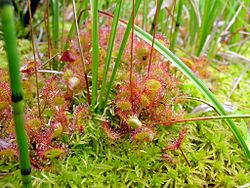
Picture of Droseraceae
- Source
- Wikipedia/Commons
- Credit
- No machine-readable author provided. NoahElhardt assumed (based on copyright claims).
- Licence
- CC BY-SA 2.5
- Commercial use
- the licence allows it
No 3D scan of Droseraceae was found in Sketchfab.
Smithsonian Open Access and MorphoSource were not reached for this taxon, so this list is what the others held rather than everything there is.
The description on this site
- Source
- Wikipedia, “Droseraceae”
- Licence
- CC BY-SA 4.0
This is what the site found, which is not the same as what exists.
Keep going
What may have been alongside itCaryophyllales through timeFormations of the MioceneThe world it lived on
Occurrence data from the Paleobiology Database, CC BY 4.0. Salisbury 1808